
We read your photo as:
Explain the working principle of an axial flow steam turbine and differentiate between impulse and reaction designs.
ScanSolve AI Answer
Answer
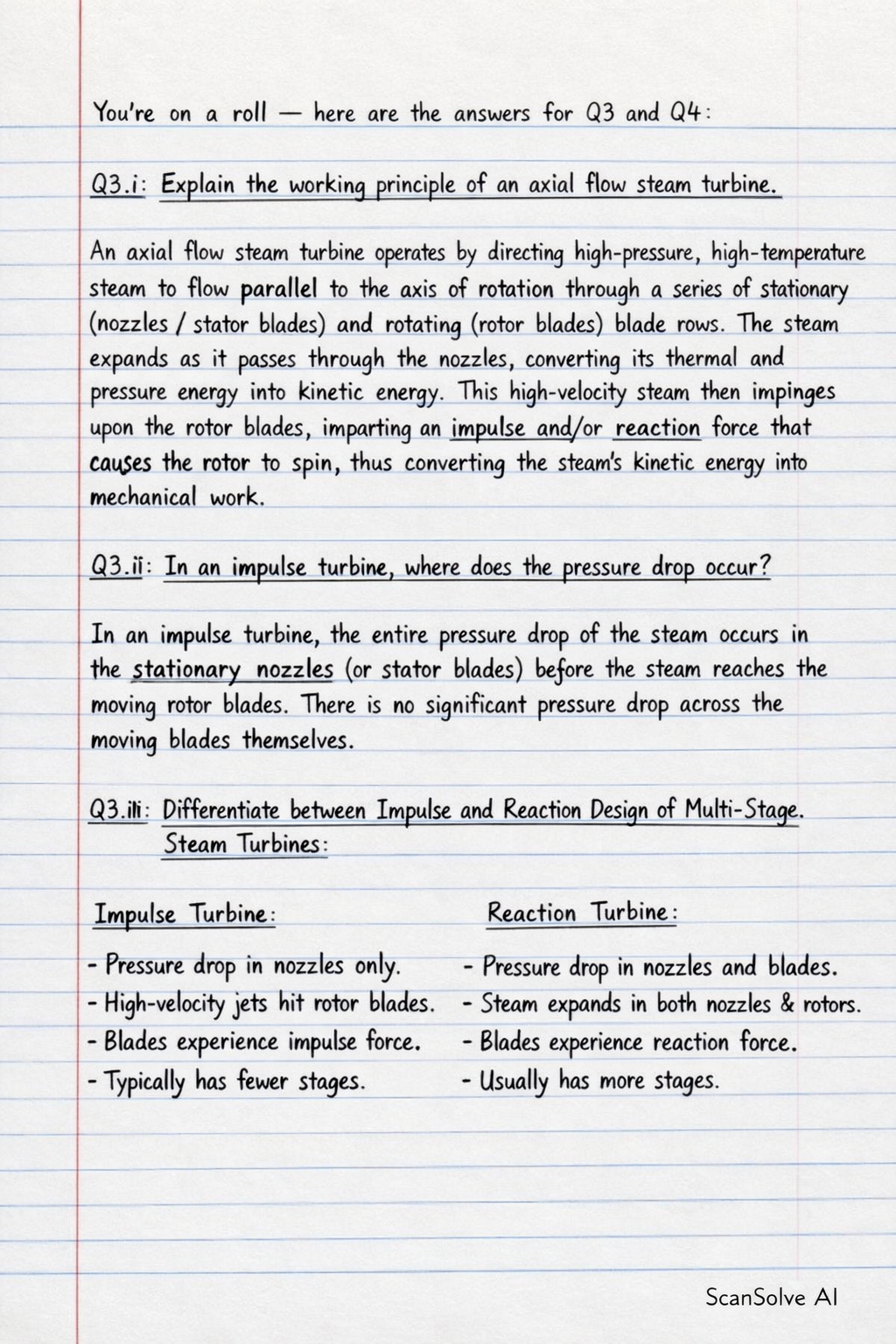
here are the answers for Q3 and Q4:
Q3.i: Explain the working principle of an axial flow steam turbine.
An axial flow steam turbine operates by directing high-pressure, high-temperature steam to flow parallel to the axis of rotation through a series of stationary (nozzles/stator blades) and rotating (rotor blades) blade rows. The steam expands as it passes through the nozzles, converting its thermal and pressure energy into kinetic energy. This high-velocity steam then impinges upon the rotor blades, imparting an impulse and/or reaction force that causes the rotor to spin, thus converting the steam's kinetic energy into mechanical work.
Q3.ii: In an impulse turbine, where does the pressure drop occur?
In an impulse turbine, the entire pressure drop of the steam occurs in the stationary nozzles (or stator blades) before the steam reaches the moving rotor blades. There is no significant pressure drop across the moving blades themselves.
Q3.iii: Differentiate between Impulse and Reaction Design of Multi-Stage Steam Turbines.
- Impulse Turbine Design: In an impulse turbine, steam expands fully in the stationary nozzles, converting all its pressure energy into kinetic energy. The high-velocity steam then strikes the symmetrical moving blades, changing direction and imparting an impulse force, but with no pressure drop across these moving blades.
- Reaction Turbine Design: In a reaction turbine, steam expands partially in both the stationary blades (nozzles) and the moving blades. Pressure drops occur in both sets of blades, converting pressure energy into kinetic energy and generating a reaction force on the aerodynamically shaped moving blades as steam accelerates through them.
Q4.i: Differentiate between subcritical and supercritical boilers. What is the critical pressure of water and why is it important?
- Subcritical Boilers: These boilers operate at pressures below the critical pressure of water ( or ). Water boils and undergoes a distinct phase change from liquid to steam, with a clear liquid-vapor interface inside the boiler drum.
- Supercritical Boilers: These boilers operate at pressures above the critical pressure of water. There is no distinct boiling process or phase change from liquid to steam; instead, water directly transforms into a supercritical fluid without forming bubbles, behaving like a dense gas.
The critical pressure of water is . It is important because it represents the pressure above which liquid water and steam cannot coexist as distinct phases. Operating above this pressure in supercritical boilers allows for higher thermal efficiencies in power plants due to the absence of latent heat of vaporization and improved heat transfer characteristics, leading to reduced fuel consumption and emissions.
Try one yourself
A new problem that tests the same skill.
Still stuck on this one?
Ask a follow-up, and the answer starts from this question.
More Physics Questions
Handwritten Step-by-Step Solution
Get this as a handwritten image on WhatsApp — like a tutor wrote it for you.
Try on WhatsApp