
We read your photo as:
How do you convert a galvanometer into an ammeter and calculate the shunt resistance needed for a 10A range?
ScanSolve AI Answer
Answer
Step-by-step solution
5 stepsTo convert a galvanometer into an ammeter, a low resistance resistor, called a shunt resistor, is connected in parallel with the galvanometer.
Identify the given values.
Galvanometer full-scale deflection current,
Galvanometer coil resistance,
Desired ammeter range (total current),Determine the current through the shunt resistor.
When the galvanometer and shunt resistor are in parallel, the total current splits between them.
The current through the shunt resistor, , is given by:Calculate the voltage across the galvanometer.
The voltage across the galvanometer at full-scale deflection is:
Calculate the shunt resistance.
Since the galvanometer and the shunt resistor are in parallel, the voltage across them is the same ().
Therefore,
Choose the correct option.
The calculated shunt resistance is approximately . Since it must be a shunt resistor (connected in parallel), the correct option is B.
The final answer is
Try one yourself
A new problem that tests the same skill.
Still stuck on this one?
Ask a follow-up, and the answer starts from this question.
More Physics Questions
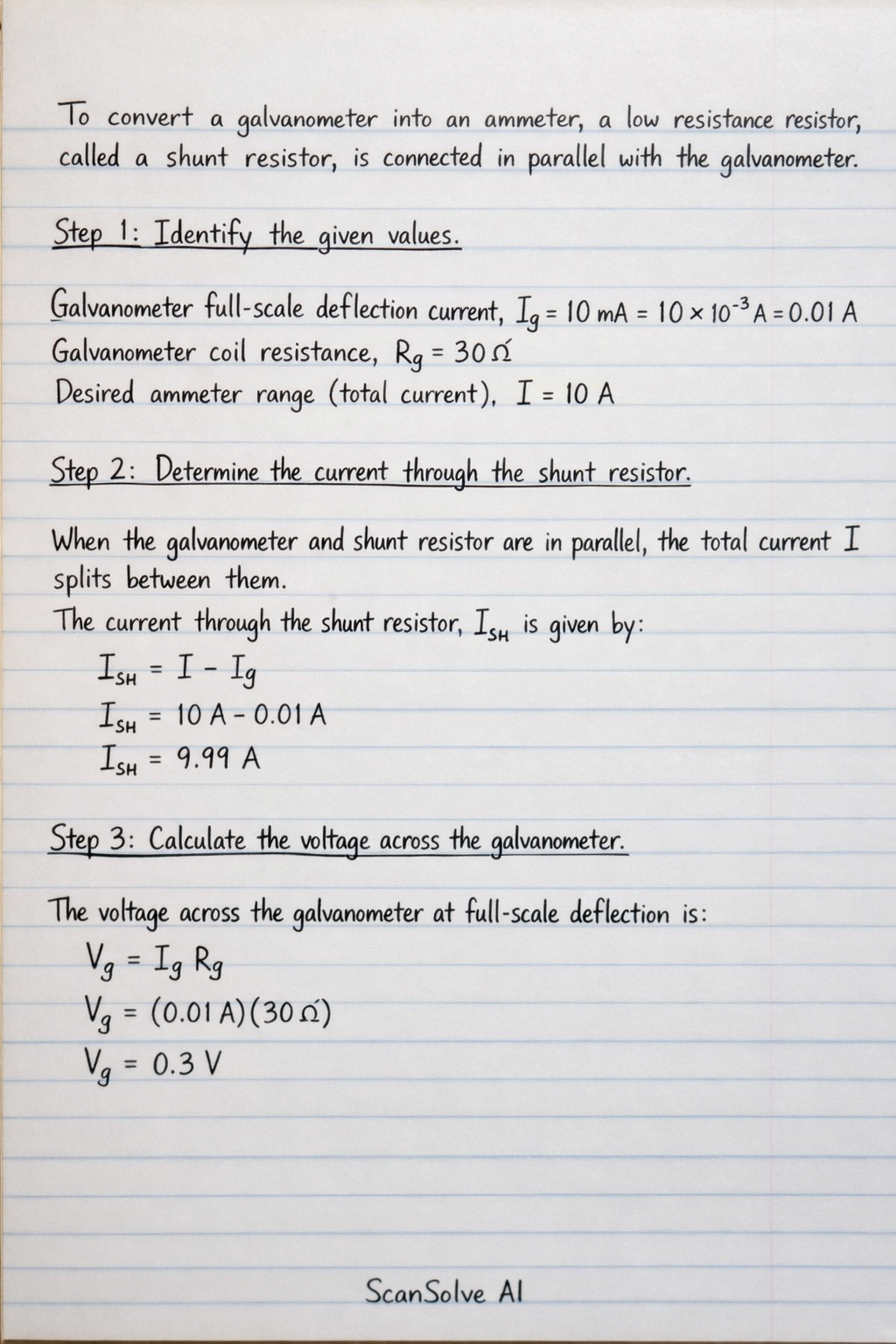
Handwritten Step-by-Step Solution
Get this as a handwritten image on WhatsApp — like a tutor wrote it for you.
Try on WhatsApp