You used combination method I want you to use pascal

Physics

ScanSolve AI Answer

Step-by-step solution

3 steps

You are correct that the combination method (nk)\binom{n}{k} is used to find the coefficients, which are the same numbers found in Pascal's Triangle. I will complete the expansion of (3+5x)6(3+5x)^6 using the coefficients from Pascal's Triangle.

  1. Identify the coefficients from Pascal's Triangle for n=6n=6.

    The 6th row of Pascal's Triangle (starting with row 0) provides the coefficients:

    1,6,15,20,15,6,11, 6, 15, 20, 15, 6, 1
  2. Apply these coefficients to the terms of the binomial expansion (a+b)n(a+b)^n, where a=3a=3 and b=5xb=5x.

    The general form is Ckan−kbkC_k a^{n-k} b^k, where CkC_k is the coefficient from Pascal's Triangle.

    • Term 1 (k=0k=0): Coefficient is 1.

      1⋅(3)6−0⋅(5x)0=1⋅36⋅1=1⋅729⋅1=7291 \cdot (3)^{6-0} \cdot (5x)^0 = 1 \cdot 3^6 \cdot 1 = 1 \cdot 729 \cdot 1 = 729
    • Term 2 (k=1k=1): Coefficient is 6.

      6⋅(3)6−1⋅(5x)1=6⋅35⋅5x=6⋅243⋅5x=6⋅1215x=7290x6 \cdot (3)^{6-1} \cdot (5x)^1 = 6 \cdot 3^5 \cdot 5x = 6 \cdot 243 \cdot 5x = 6 \cdot 1215x = 7290x
    • Term 3 (k=2k=2): Coefficient is 15.

      15⋅(3)6−2⋅(5x)2=15⋅34⋅(25x2)=15⋅81⋅25x2=15⋅2025x2=30375x215 \cdot (3)^{6-2} \cdot (5x)^2 = 15 \cdot 3^4 \cdot (25x^2) = 15 \cdot 81 \cdot 25x^2 = 15 \cdot 2025x^2 = 30375x^2
    • Term 4 (k=3k=3): Coefficient is 20.

      20⋅(3)6−3⋅(5x)3=20⋅33⋅(125x3)=20⋅27⋅125x3=20⋅3375x3=67500x320 \cdot (3)^{6-3} \cdot (5x)^3 = 20 \cdot 3^3 \cdot (125x^3) = 20 \cdot 27 \cdot 125x^3 = 20 \cdot 3375x^3 = 67500x^3
    • Term 5 (k=4k=4): Coefficient is 15.

      15⋅(3)6−4⋅(5x)4=15⋅32⋅(625x4)=15⋅9⋅625x4=15⋅5625x4=84375x415 \cdot (3)^{6-4} \cdot (5x)^4 = 15 \cdot 3^2 \cdot (625x^4) = 15 \cdot 9 \cdot 625x^4 = 15 \cdot 5625x^4 = 84375x^4
    • Term 6 (k=5k=5): Coefficient is 6.

      6⋅(3)6−5⋅(5x)5=6⋅31⋅(3125x5)=6⋅3⋅3125x5=18⋅3125x5=56250x56 \cdot (3)^{6-5} \cdot (5x)^5 = 6 \cdot 3^1 \cdot (3125x^5) = 6 \cdot 3 \cdot 3125x^5 = 18 \cdot 3125x^5 = 56250x^5
    • Term 7 (k=6k=6): Coefficient is 1.

      1⋅(3)6−6⋅(5x)6=1⋅30⋅(15625x6)=1⋅1⋅15625x6=15625x61 \cdot (3)^{6-6} \cdot (5x)^6 = 1 \cdot 3^0 \cdot (15625x^6) = 1 \cdot 1 \cdot 15625x^6 = 15625x^6
  3. Sum all the terms to get the full expansion.

    (3+5x)6=729+7290x+30375x2+67500x3+84375x4+56250x5+15625x6(3+5x)^6 = 729 + 7290x + 30375x^2 + 67500x^3 + 84375x^4 + 56250x^5 + 15625x^6

    The final answer is 729+7290x+30375x2+67500x3+84375x4+56250x5+15625x6\boxed{729 + 7290x + 30375x^2 + 67500x^3 + 84375x^4 + 56250x^5 + 15625x^6}.

Was this helpful?

Still stuck on this one?

Ask a follow-up, and the answer starts from this question.

Got a different question?Ask your own question
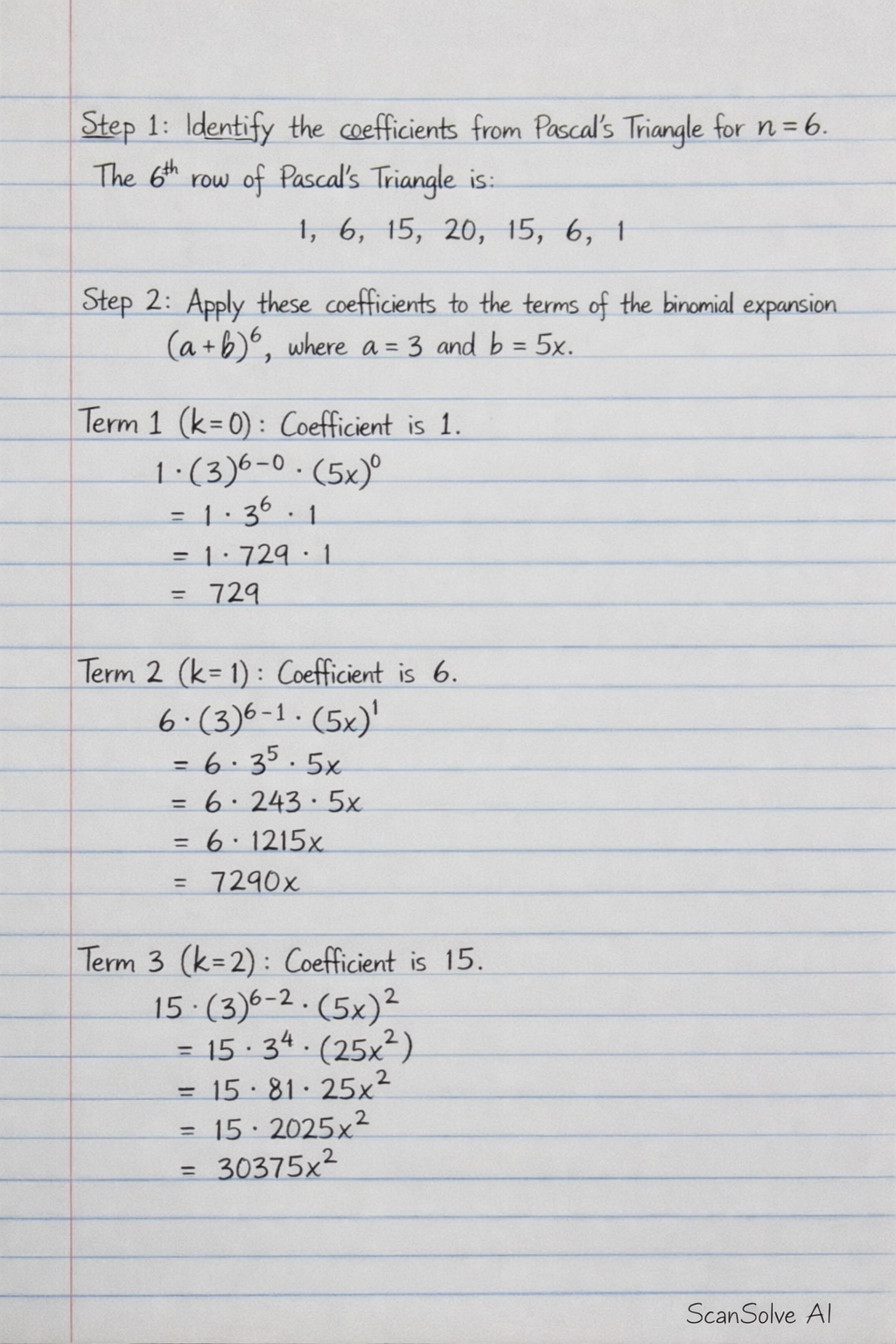
Handwritten step-by-step solution preview

Handwritten Step-by-Step Solution

Get this as a handwritten image on WhatsApp — like a tutor wrote it for you.

Try on WhatsApp