
We read your photo as:
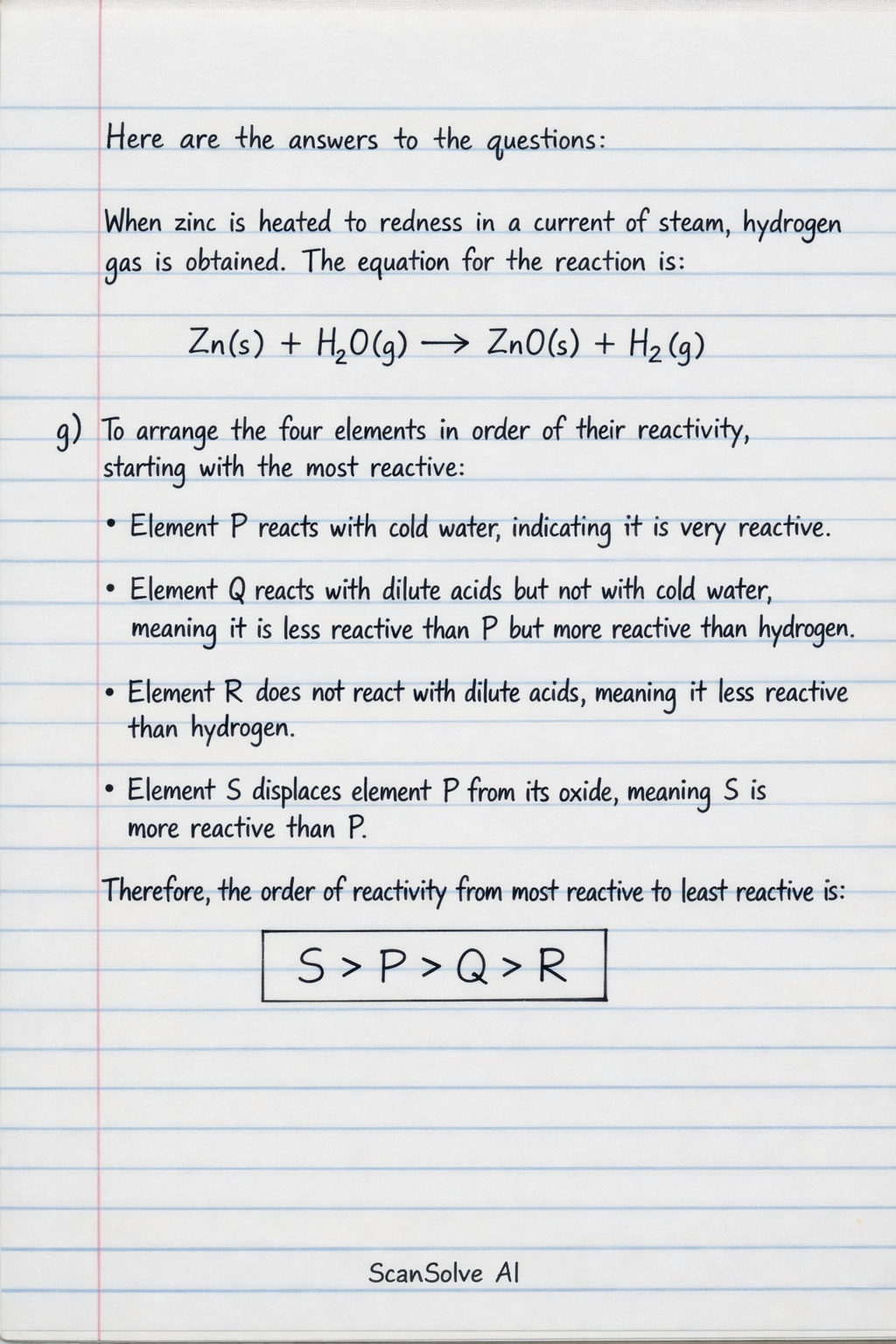
When zinc is heated to redness in a current of steam, hydrogen gas is obtained. The equation for the reaction is:
ScanSolve AI Answer
Here are the answers to the questions:
When zinc is heated to redness in a current of steam, hydrogen gas is obtained. The equation for the reaction is:
g) To arrange the four elements in order of their reactivity, starting with the most reactive:
- Element P reacts with cold water, indicating it is very reactive.
- Element Q reacts with dilute acids but not with cold water, meaning it is less reactive than P but more reactive than hydrogen.
- Element R does not react with dilute acids, meaning it is less reactive than hydrogen.
- Element S displaces element P from its oxide, meaning S is more reactive than P. Therefore, the order of reactivity from most reactive to least reactive is:
h) Hydrogen is used in the manufacture of margarine through a process called hydrogenation. In this process, hydrogen gas is added across the double bonds of unsaturated vegetable oils in the presence of a nickel catalyst. This converts the liquid unsaturated oils into solid or semi-solid saturated fats, which is margarine.
a) The set-up below is used to investigate the properties of hydrogen.
i) On the diagram, indicate what should be done for the reaction to occur:
A Bunsen burner should be placed under the combustion tube containing the Copper(II) Oxide to heat it.
ii) Hydrogen gas is allowed to pass through the tube for some time before it is lit because a mixture of hydrogen gas and air is explosive. Passing hydrogen first expels all the air from the apparatus, preventing an explosion when the hydrogen is ignited.
iii) The equation for the reaction that occurs in the combustion tube is:
iv) When the reaction is complete, hydrogen gas is passed through the apparatus until they cool down to prevent the hot copper metal from being re-oxidized by air as the apparatus cools. It also prevents an explosion if air were to enter the hot apparatus and mix with residual hydrogen.
v) The property of hydrogen being investigated is its reducing property.
vi) The observation that confirms the property stated in (v) above is that the black solid (Copper(II) Oxide) turns into a pinkish-brown solid (copper metal), and colorless liquid droplets (water) are formed on the cooler parts of the tube.
vii) Zinc oxide is not used to investigate this property of hydrogen gas because zinc is more reactive than hydrogen. Hydrogen is not a strong enough reducing agent to reduce zinc oxide to zinc metal under normal laboratory heating conditions. Zinc oxide is more stable than copper(II) oxide.
The set up below was used to collect gas K, produced by the reaction between water and calcium metal.
a) Name gas K:
Gas K is hydrogen ().
b) At the end of the experiment, the solution in the beaker was found to be a weak base. Explain why the solution is a weak base:
The solution formed is calcium hydroxide (). While calcium hydroxide is considered a strong base in terms of its dissociation (what dissolves, dissociates completely), its solubility in water is very low. This means that only a small amount of calcium hydroxide dissolves, resulting in a low concentration of hydroxide ions () in the solution, making it only weakly alkaline.
Still stuck on this one?
Ask a follow-up, and the answer starts from this question.
More Physics Questions
Handwritten Step-by-Step Solution
Get this as a handwritten image on WhatsApp — like a tutor wrote it for you.
Try on WhatsApp