
We read your photo as:
What is the significance of obtaining baseline vital signs? 18. When should a nurse check a patient's vital signs? 19. State the units used in measuring body temperature. 20. List four ways heat is lost from the body. 21. List five factors that affect body temperature.
ScanSolve AI Answer
Here are the answers to the questions:
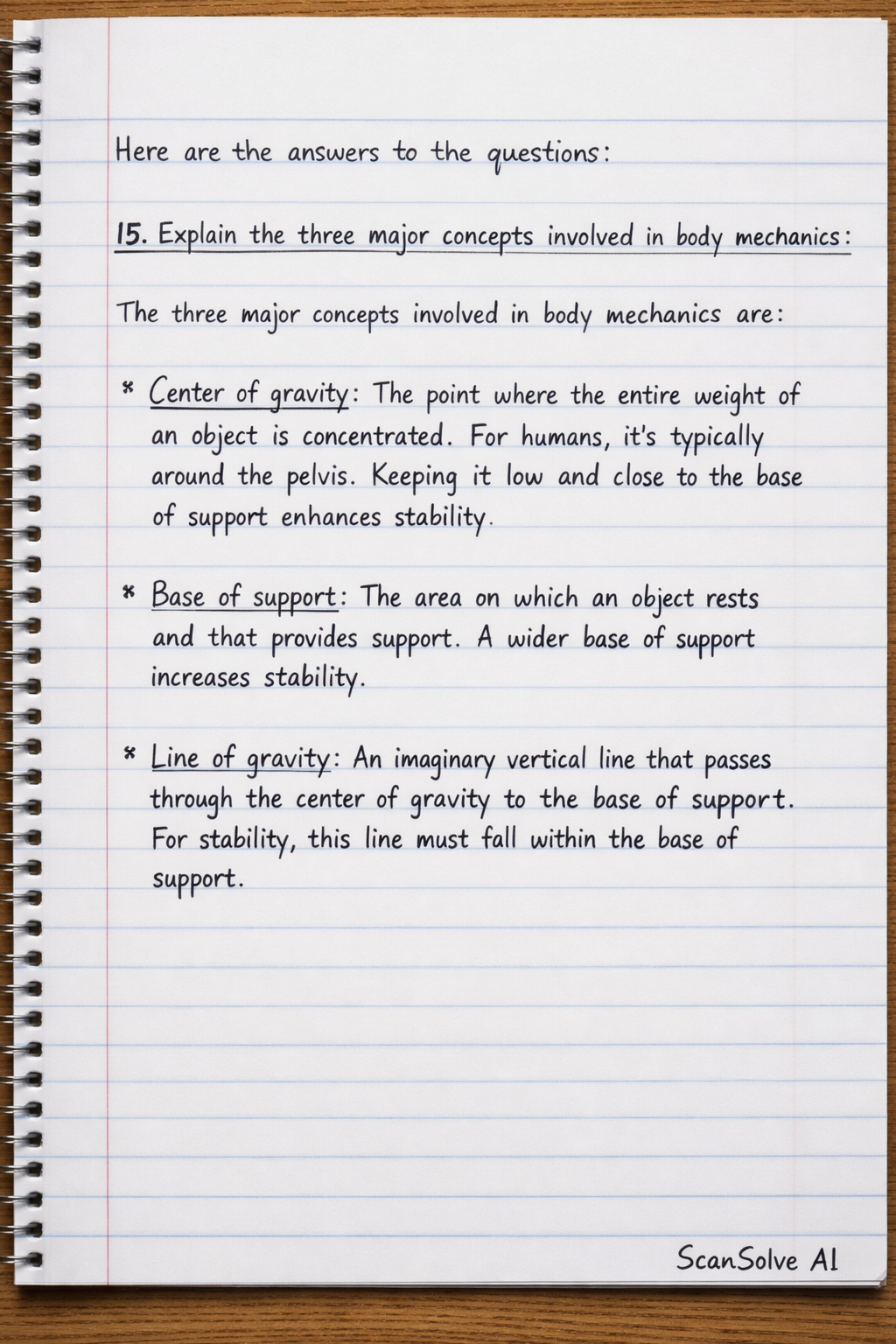
15. Explain the three major concepts involved in body mechanics.
The three major concepts involved in body mechanics are:
- Center of gravity: The point where the entire weight of an object is concentrated. For humans, it's typically around the pelvis. Keeping it low and close to the base of support enhances stability.
- Base of support: The area on which an object rests and that provides support. A wider base of support increases stability.
- Line of gravity: An imaginary vertical line that passes through the center of gravity to the base of support. For stability, this line must fall within the base of support.
16. Discuss five general guidelines to be followed when lifting a patient.
- Assess the situation: Determine the patient's ability to assist, their weight, and the need for additional help or equipment.
- Widen your base of support: Stand with your feet shoulder-width apart to increase stability.
- Bend your knees, not your back: Keep your back straight and use your leg muscles to lift, rather than straining your back.
- Keep the patient close to your body: Hold the patient as close as possible to your center of gravity to reduce strain.
- Communicate clearly: Explain the procedure to the patient and any assisting colleagues, coordinating movements.
17. What is the significance of obtaining baseline vital signs?
Obtaining baseline vital signs (temperature, pulse, respiration, blood pressure, and sometimes pain and oxygen saturation) is significant because they provide a reference point for the patient's normal physiological state. This baseline allows healthcare professionals to identify deviations, monitor changes over time, evaluate the effectiveness of treatments, and detect early signs of deterioration or improvement.
18. When should a nurse check a patient's vital signs?
A nurse should check a patient's vital signs:
- Upon admission to a healthcare facility.
- Before and after surgical procedures or invasive diagnostic tests.
- Before, during, and after administering medications that affect cardiovascular or respiratory function.
- When the patient's condition changes or they report symptoms like pain, dizziness, or shortness of breath.
- According to routine institutional policy or physician's orders (e.g., every 4 hours, daily).
19. State the units used in measuring body temperature.
The units used in measuring body temperature are degrees Celsius () or degrees Fahrenheit ().
20. List four ways heat is lost from the body.
- Radiation: Transfer of heat from the surface of one object to the surface of another without direct contact.
- Conduction: Transfer of heat from one object to another through direct contact.
- Convection: Transfer of heat away from the body by air currents.
- Evaporation: Loss of heat when a liquid (like sweat) is converted to a vapor.
21. List five factors that affect body temperature.
- Age (infants and elderly are more susceptible to temperature fluctuations)
- Exercise (increases metabolic rate and heat production)
- Hormonal fluctuations (e.g., menstrual cycle, menopause)
- Circadian rhythm (body temperature varies throughout the day)
- Stress/Emotion (can increase temperature)
- Environmental temperature
- Illness/Infection (fever)
Still stuck on this one?
Ask a follow-up, and the answer starts from this question.
More Biology Questions
Handwritten Step-by-Step Solution
Get this as a handwritten image on WhatsApp — like a tutor wrote it for you.
Try on WhatsApp