

This psychology problem is solved step by step below, with detailed explanations to help you understand the method and arrive at the correct answer.
ScanSolve AI Answer
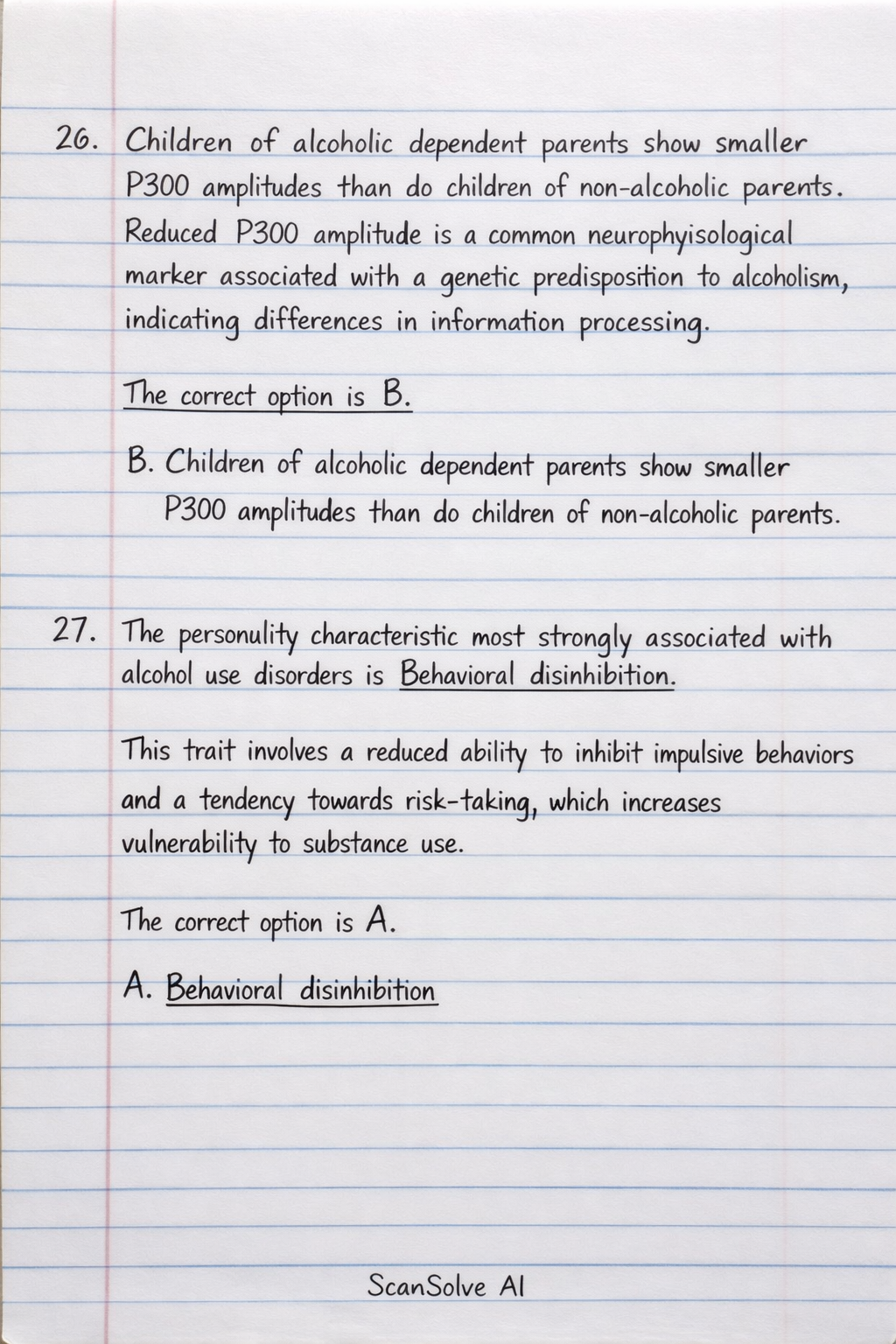
26. If you were a physician examining the brain wave activity of people with alcohol use disorder, non-problem drinkers, and their children, you would likely find that Children of alcoholic dependent parents show smaller P300 amplitudes than do children of non-alcoholic parents. Reduced P300 amplitude is a common neurophysiological marker associated with a genetic predisposition to alcoholism, indicating differences in information processing. The correct option is B. B. Children of alcoholic dependent parents show smaller P300 amplitudes than do children of non-alcoholic parents 27. The personality characteristic most strongly associated with alcohol use disorders is Behavioral disinhibition. This trait involves a reduced ability to inhibit impulsive behaviors and a tendency towards risk-taking, which increases vulnerability to substance use. The correct option is A. A. Behavioral disinhibition 28. The statement that supports the alcohol expectancy theory is Adjeley drinks a lot because she believes it will put her in a better mood, even though she actually becomes more aggressive. Alcohol expectancy theory states that an individual's beliefs and expectations about alcohol's effects significantly influence their drinking behavior and experience. The correct option is A. A. Adjeley drinks a lot because she believes it will put her in a better mood, even though she actually becomes more aggressive 29. Given the behavioral tolerance of drug use, a person with an addiction might be most severely impaired when drinking At a house that he has never been to before. Behavioral tolerance is context-dependent; individuals learn to compensate for drug effects in familiar environments. In a novel environment, these learned compensatory behaviors are less effective, leading to greater impairment. The correct option is A. A. At a house that he has never been to before