
We read your photo as:
Explain the areas of personal development and describe three stages of psychosexual development.
ScanSolve AI Answer
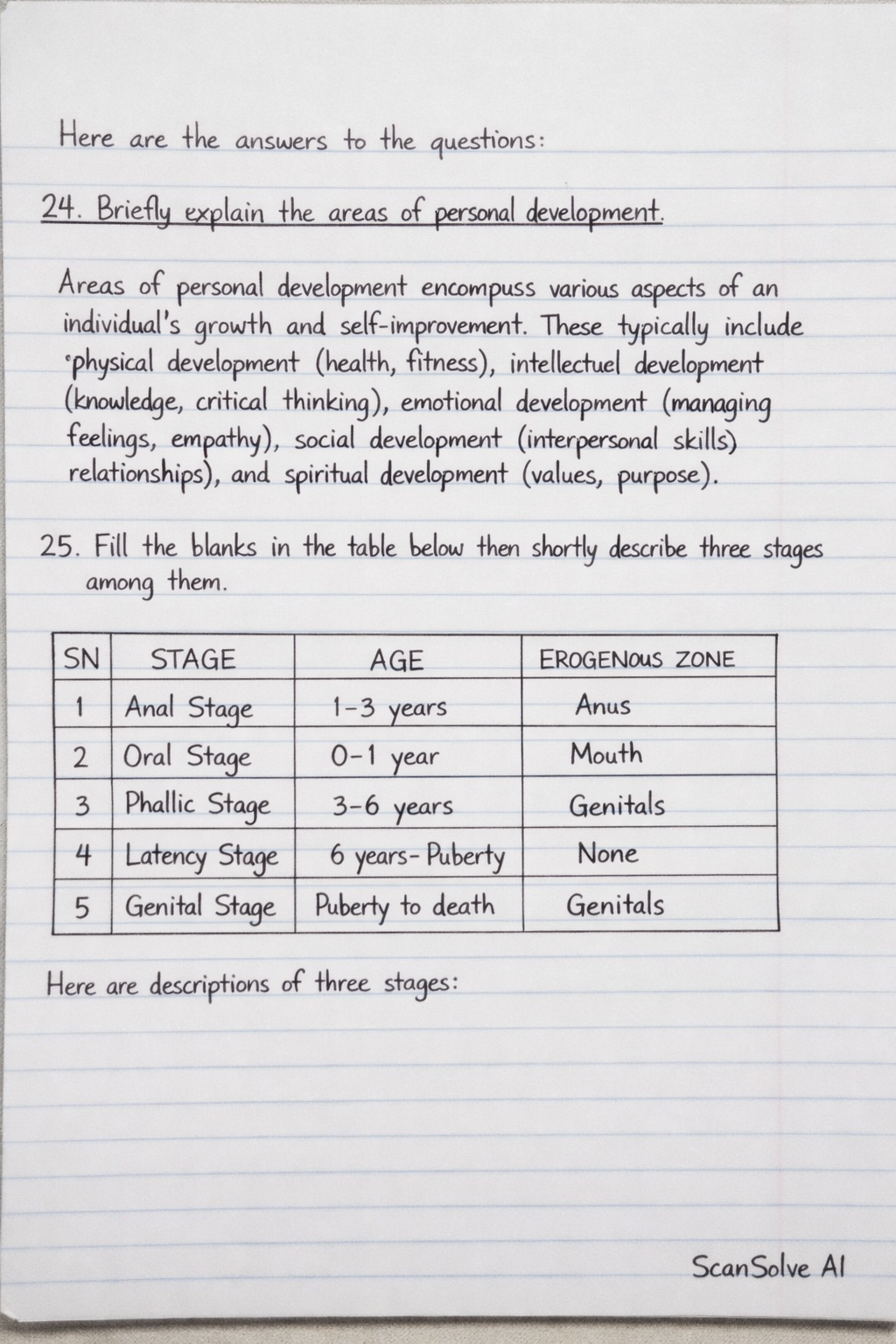
Here are the answers to the questions:
24. Briefly explain the areas of personal development
Areas of personal development encompass various aspects of an individual's growth and self-improvement. These typically include physical development (health, fitness), intellectual development (knowledge, critical thinking), emotional development (managing feelings, empathy), social development (interpersonal skills, relationships), and spiritual development (values, purpose).
25. Fill the blanks in the table below then shortly describe three stages among them
| SN | STAGE | AGE | EROGENOUS ZONE |
|---|---|---|---|
| 1 | Anal Stage | 1-3 years | Anus |
| 2 | Oral Stage | 0-1 year | Mouth |
| 3 | Phallic Stage | 3-6 years | Genitals |
| 4 | Latency Stage | 6 years - Puberty | None |
| 5 | Genital Stage | Puberty to death | Genitals |
Here are descriptions of three stages:
- Oral Stage (0-1 year): During this stage, the infant's primary source of interaction and pleasure is through the mouth. Activities like sucking, biting, and feeding are crucial for development. Fixation at this stage can lead to oral habits in adulthood, such as smoking or overeating.
- Anal Stage (1-3 years): This stage focuses on the anus as the primary erogenous zone, associated with bowel and bladder control. Toilet training is a significant event, and how parents handle it can influence a child's personality, leading to either an "anal-retentive" (orderly, rigid) or "anal-expulsive" (messy, rebellious) personality.
- Phallic Stage (3-6 years): The focus of pleasure shifts to the genitals. Children become aware of the differences between sexes and develop sexual curiosity. This stage is associated with the Oedipus complex in boys and the Electra complex in girls, involving desires for the opposite-sex parent and rivalry with the same-sex parent.
26. Mention five (5) points how cognitive development influence the mental process of an individual
Cognitive development significantly influences an individual's mental processes in several ways:
- Perception: It shapes how individuals interpret and make sense of sensory information from their environment.
- Memory: It impacts the capacity and strategies for encoding, storing, and retrieving information.
- Problem-solving: It develops the ability to analyze situations, devise strategies, and find solutions to challenges.
- Language acquisition: It underpins the development of communication skills, including vocabulary, grammar, and comprehension.
- Reasoning and Logic: It fosters the capacity for abstract thought, critical thinking, and making logical deductions.
27. Describe four features of developmental stages of human being during pre-operational stages.
During Piaget's pre-operational stage (approximately 2 to 7 years old), children exhibit several distinct cognitive features:
- Egocentrism: Children have difficulty understanding perspectives other than their own, assuming others see, think, and feel the same way they do.
- Centration: They tend to focus on only one salient aspect of a situation or object, neglecting other important features.
- Animism: Children often attribute human feelings, intentions, and characteristics to inanimate objects or natural phenomena.
- Symbolic Function: They develop the ability to use symbols, such as words and images, to represent objects, people, and events that are not physically present.
Still stuck on this one?
Ask a follow-up, and the answer starts from this question.
More Psychology Questions
Handwritten Step-by-Step Solution
Get this as a handwritten image on WhatsApp — like a tutor wrote it for you.
Try on WhatsApp