
We read your photo as:
Complete the following quiz questions on Psychology:
ScanSolve AI Answer
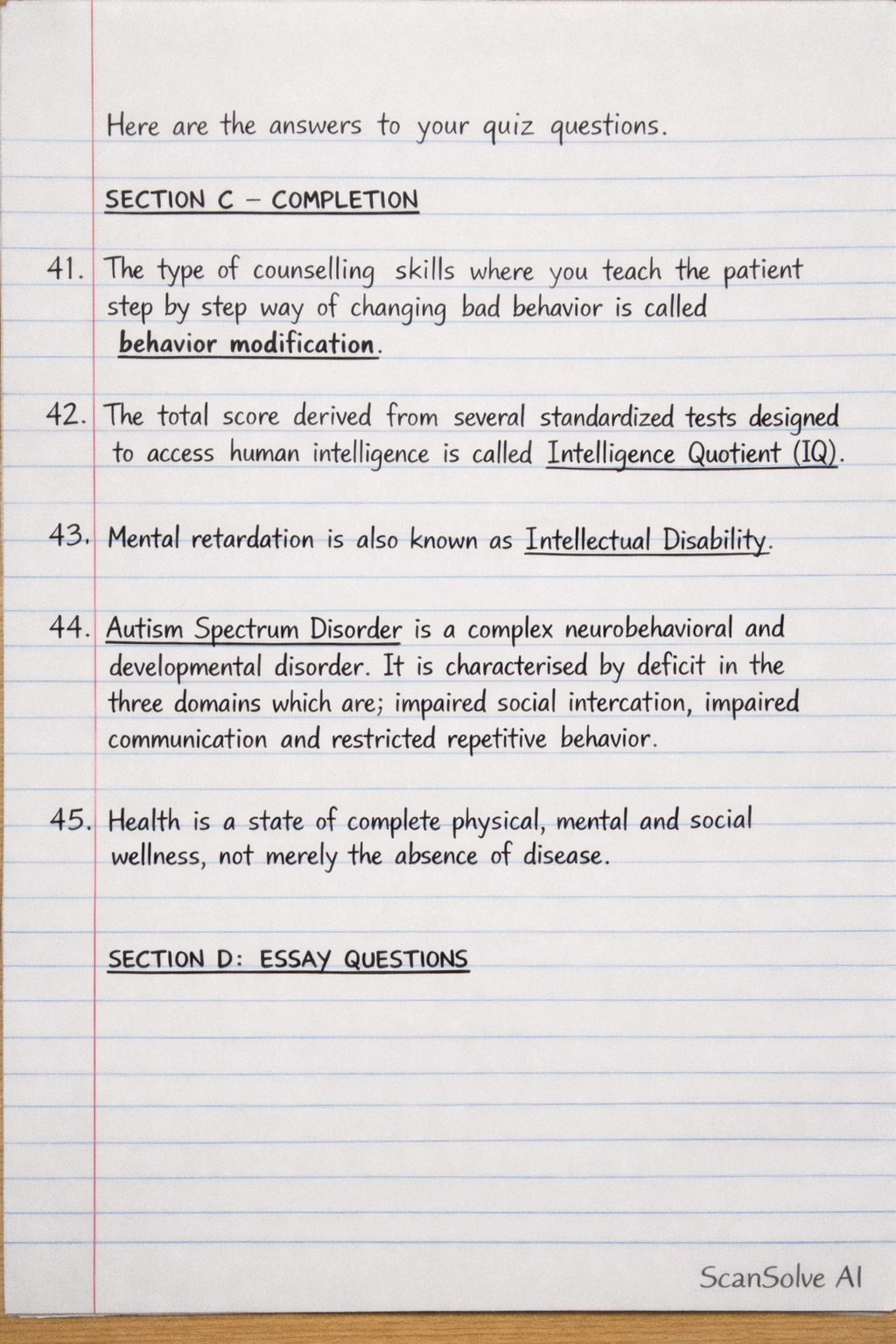
Here are the answers to your quiz questions.
SECTION C – COMPLETION
- The type of counselling skills where you teach the patient step by step way of changing bad behavior is called behavior modification.
- The total score derived from several standardized tests designed to access human intelligence is called Intelligence Quotient (IQ).
- Mental retardation is also known as Intellectual Disability.
- Autism Spectrum Disorder is a complex neurobehavioral and developmental disorder. It is characterized by deficit in the three domains which are; impaired social interaction, impaired communication and restricted repetitive behavior.
- Health is a state of complete physical, mental and social wellness, not merely the absence of disease.
SECTION D: ESSAY QUESTIONS
A) Define Attention Deficit Hyperactive Disorder
Attention Deficit Hyperactivity Disorder (ADHD) is a neurodevelopmental disorder characterized by persistent patterns of inattention, hyperactivity, and impulsivity that interfere with functioning or development. These symptoms typically begin in childhood and can continue into adulthood.
B) State the three (3) types of ADHD
The three types of ADHD are:
- Predominantly Inattentive Presentation: Individuals primarily struggle with attention, organization, and focus, but do not exhibit significant hyperactivity or impulsivity.
- Predominantly Hyperactive-Impulsive Presentation: Individuals primarily exhibit symptoms of hyperactivity and impulsivity, such as fidgeting, excessive talking, and difficulty waiting their turn, with less prominent inattention.
- Combined Presentation: Individuals display a significant number of symptoms from both the inattention and hyperactivity-impulsivity categories. This is the most common type of ADHD.
C) Explain the five (5) causes of ADHD
The exact causes of ADHD are not fully understood, but research suggests a combination of factors:
- Genetics: ADHD often runs in families, indicating a strong genetic component. Several genes have been identified that may increase the risk.
- Brain Structure and Function: Differences in brain structure and activity, particularly in areas that control attention, impulse control, and executive function (e.g., prefrontal cortex), are often observed in individuals with ADHD. Neurotransmitters like dopamine and norepinephrine may also be imbalanced.
- Environmental Factors: Exposure to certain environmental toxins, such as lead, during childhood may increase the risk. Prenatal exposure to alcohol or nicotine, and premature birth or low birth weight, are also associated with a higher risk.
- Brain Injury: In rare cases, brain injury or trauma can lead to ADHD-like symptoms.
- Maternal Health during Pregnancy: Factors such as maternal stress, infections, or complications during pregnancy and childbirth have been linked to an increased risk of ADHD in the child.
D) Using the nursing process identify five (5) problems and nurse them using the nursing care plan
Here are five common nursing problems for children with ADHD and general nursing interventions:
Nursing Care Plan for a Child with ADHD
1. Nursing Problem: Impaired Social Interaction related to impulsive and hyperactive behaviors. * Goal: The child will demonstrate improved social skills and engage in positive peer interactions. * Interventions: * Teach and role-play appropriate social behaviors (e.g., taking turns, listening, sharing). * Provide positive reinforcement for successful social interactions. * Facilitate structured group activities to practice social skills in a controlled environment. * Educate parents/caregivers on strategies to support social development at home.
2. Nursing Problem: Risk for Injury related to impulsivity and hyperactivity. * Goal: The child will remain free from injury. * Interventions: * Create a safe environment by removing hazards and supervising activities closely. * Teach the child about safety rules and the consequences of impulsive actions. * Encourage participation in structured physical activities to channel excess energy safely. * Implement consistent behavioral limits and consequences for unsafe behaviors.
3. Nursing Problem: Deficient Knowledge (parents/caregivers) regarding ADHD management. * Goal: Parents/caregivers will verbalize understanding of ADHD, its management, and available resources. * Interventions: * Provide education on ADHD symptoms, diagnosis, and treatment options (medication, behavioral therapy). * Discuss effective parenting strategies, such as consistent routines, clear expectations, and positive reinforcement. * Refer to support groups, educational materials, and community resources for ADHD. * Explain the importance of medication adherence and potential side effects if applicable.
4. Nursing Problem: Ineffective Coping related to frustration with academic difficulties and behavioral challenges. * Goal: The child will identify and utilize at least two effective coping strategies. * Interventions: * Help the child identify feelings of frustration and teach relaxation techniques (e.g., deep breathing, counting). * Encourage expression of feelings through play, drawing, or verbalization. * Teach problem-solving skills for dealing with challenging situations. * Provide opportunities for success in small, manageable tasks to build self-esteem.
5. Nursing Problem: Impaired Verbal Communication related to difficulty with attention and impulsivity (e.g., interrupting, difficulty following conversations). * Goal: The child will demonstrate improved ability to listen and respond appropriately in conversations. * Interventions: * Teach active listening skills and provide cues to help the child focus during conversations. * Encourage the child to wait for their turn to speak and practice not interrupting. * Use clear, concise language and provide instructions one step at a time. * Utilize visual aids or written instructions to supplement verbal communication.
Still stuck on this one?
Ask a follow-up, and the answer starts from this question.
More Psychology Questions
Handwritten Step-by-Step Solution
Get this as a handwritten image on WhatsApp — like a tutor wrote it for you.
Try on WhatsApp