
We read your photo as:
Design a data collection sheet to record reaction time experiments for different age groups, including calculations for individual and group averages.
ScanSolve AI Answer
Answer
This recording sheet is designed to collect and analyze reaction time data for different age groups.
Step-by-step solution
3 stepsUnderstand the data collection.
For each subject, you will record their name, signature, and age group. Then, you will measure their reaction time five separate times (trials 1 through 5) and record these values in the "Measured Reaction Time (sec)" columns.
Calculate the average reaction time for each subject.
After recording the five reaction times for a subject, you will calculate their average reaction time. This is done by summing the five measured times and dividing by the number of trials (which is 5).
For example, if a subject's reaction times are :This value will be entered into the "Average reaction time (sec)" column for that specific subject.
Calculate the average reaction time for each age group.
Once all subjects within an age group have completed their trials and their individual average reaction times have been calculated, you will find the average reaction time for that entire age group. This is done by summing the individual average reaction times of all subjects within that age group and dividing by the number of subjects in that group.
For example, if there are three subjects in the 10-19 age group with individual average reaction times :This value will be entered into the "Average reaction time for each age group" column, corresponding to that age group.
Still stuck on this one?
Ask a follow-up, and the answer starts from this question.
More Psychology Questions
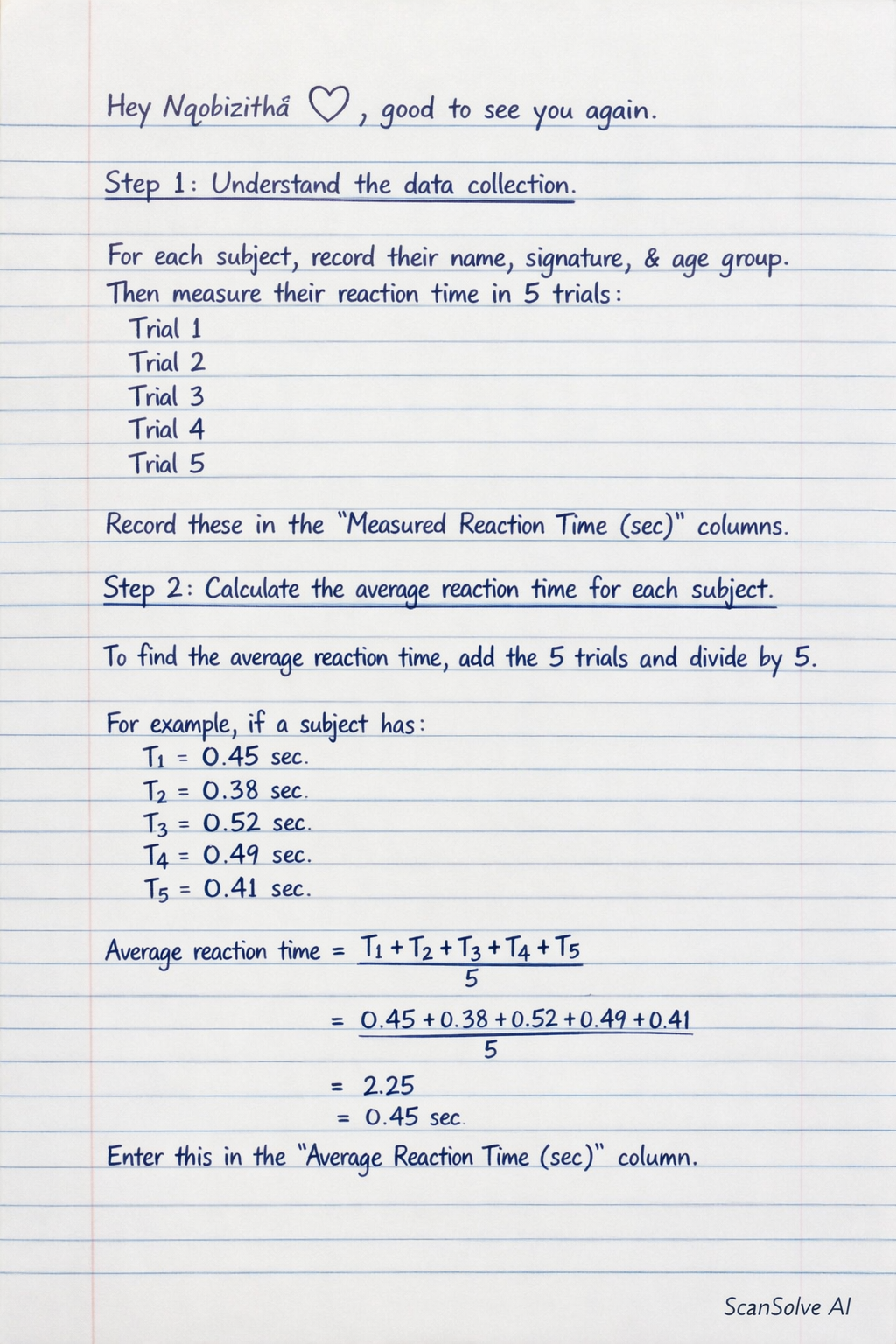
Handwritten Step-by-Step Solution
Get this as a handwritten image on WhatsApp — like a tutor wrote it for you.
Try on WhatsApp