
We read your photo as:
Explain the following learning styles: Visual, Auditory, Kinesthetic. Differentiate centripetal and centrifugal force. List four effects of a force.
Psychology
ScanSolve AI Answer
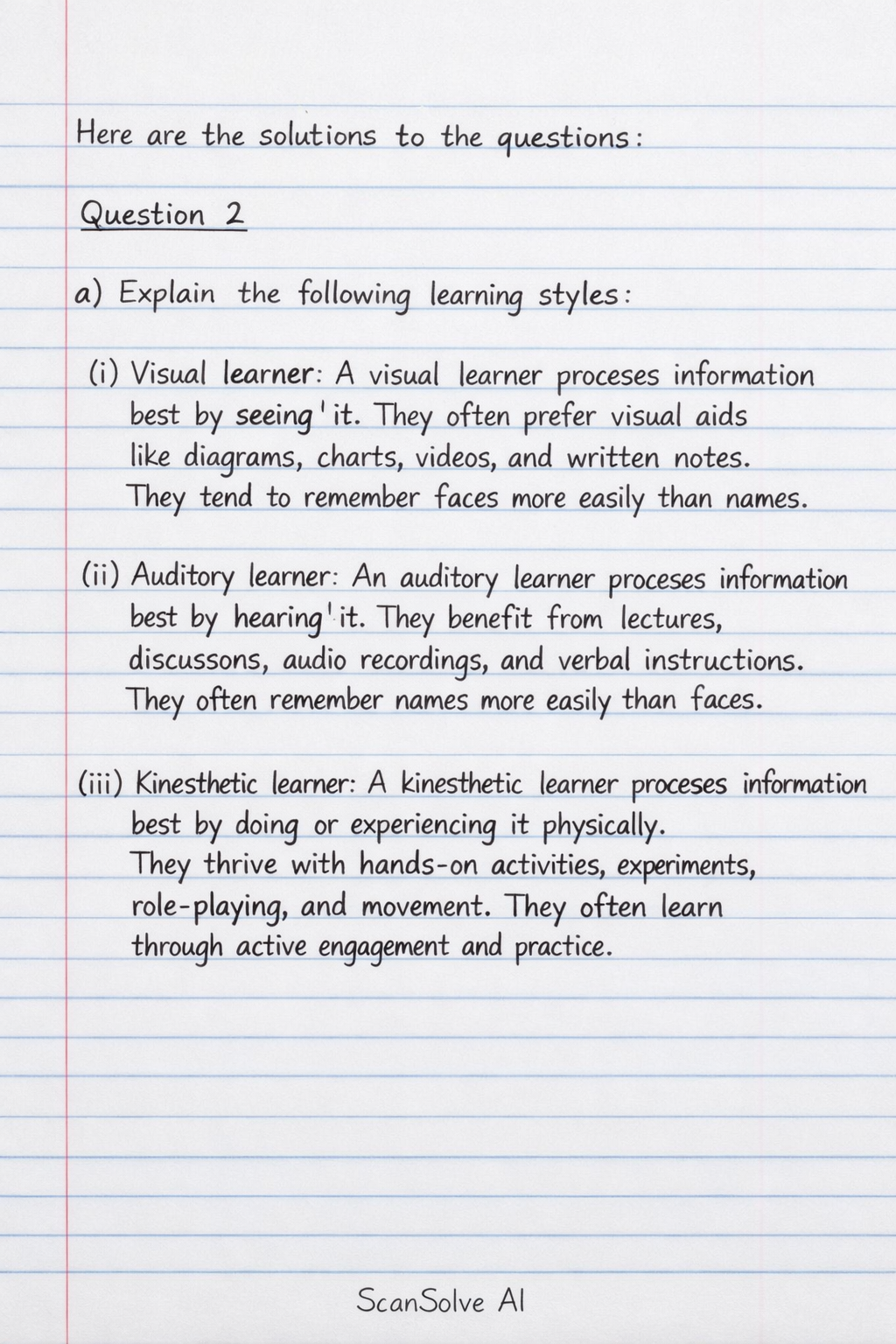
Here are the solutions to the questions:
Question 2
a) Explain the following learning styles:
- (i) Visual learner: A visual learner processes information best by seeing it. They often prefer visual aids like diagrams, charts, videos, and written notes. They tend to remember faces more easily than names.
- (ii) Auditory learner: An auditory learner processes information best by hearing it. They benefit from lectures, discussions, audio recordings, and verbal instructions. They often remember names more easily than faces.
- (iii) Kinesthetic learner: A kinesthetic learner processes information best by doing or experiencing it physically. They thrive with hands-on activities, experiments, role-playing, and movement. They often learn through active engagement and practice.
b) (i) Differentiate between centripetal force and centrifugal force.
- Centripetal force is a real force that acts inward towards the center of a circular path, causing an object to move in a circle. It is the net force required to maintain circular motion.
- Centrifugal force is an apparent or fictitious force that acts outward from the center of a circular path, experienced by an object in a rotating frame of reference. It is a reaction to centripetal force, not a fundamental force itself.
b) (ii) Write down four (4) effects of a force on an object.
- A force can change the state of motion of an object (e.g., start moving, stop moving, speed up, slow down).
- A force can change the direction of motion of an object.
- A force can change the shape or size of an object (deformation).
- A force can *cause an object to
Was this helpful?
Still stuck on this one?
Ask a follow-up, and the answer starts from this question.
Got a different question?Ask your own question
More Psychology Questions
QState TWO effects that a force can have on an object. Study illustrations A-E below. Identify the…QDifferent types of forcesQA force exerted on a body can cause a change in either the shape or the motion of the body. State…QSECTION A: (40 MARKS) Attempt ALL questions in this section 1. A force exerted on a body can cause a…QExplain two types of forces in physics
Handwritten Step-by-Step Solution
Get this as a handwritten image on WhatsApp — like a tutor wrote it for you.
Try on WhatsApp