
We read your photo as:
Identify and explain four learner characteristics that can act as barriers to learning, and suggest ways to address two of them.
Psychology
ScanSolve AI Answer
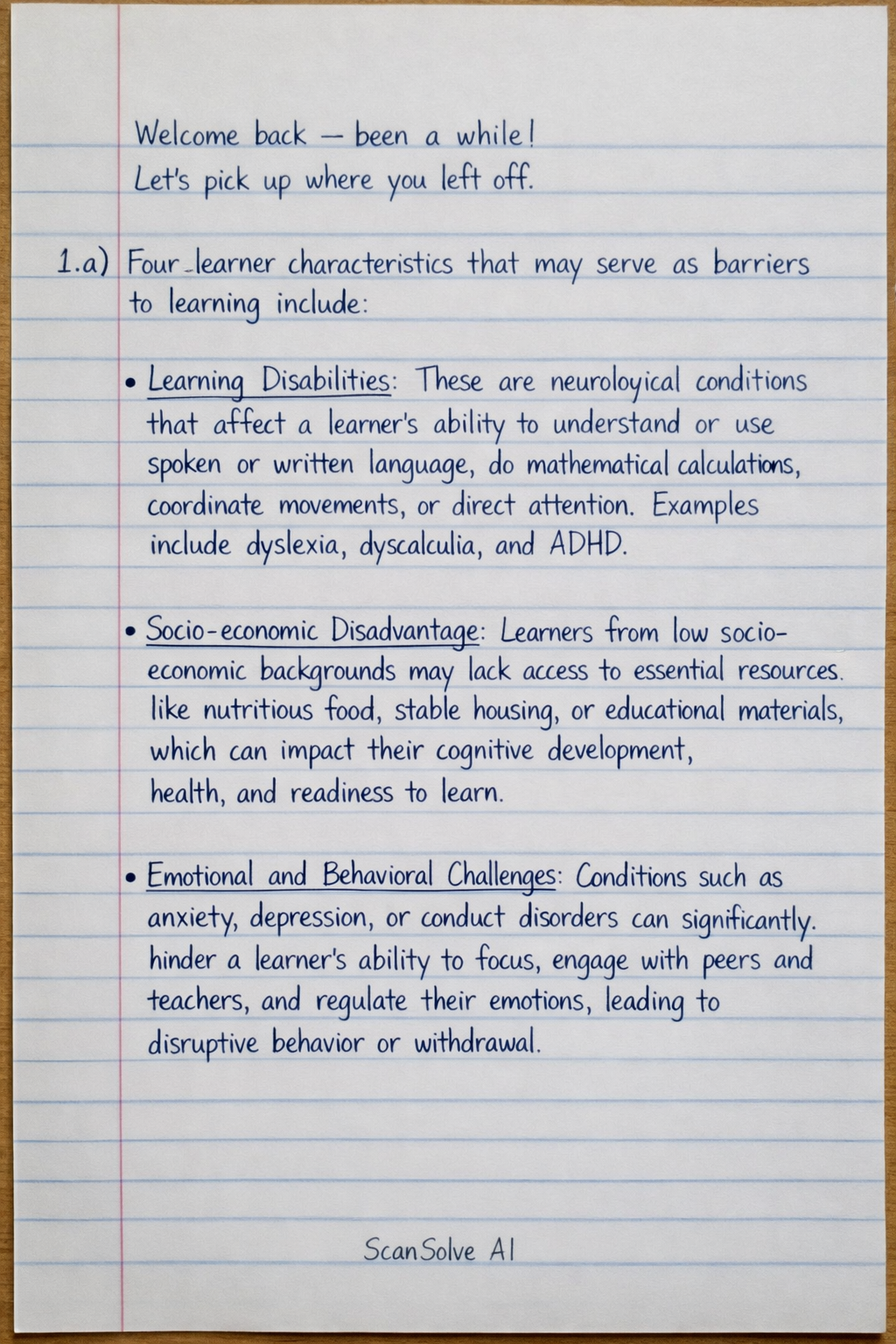
1.a) Four learner characteristics that may serve as barriers to learning include:
- Learning Disabilities: These are neurological conditions that affect a learner's ability to understand or use spoken or written language, do mathematical calculations, coordinate movements, or direct attention. Examples include dyslexia, dyscalculia, and ADHD.
- Socio-economic Disadvantage: Learners from low socio-economic backgrounds may lack access to essential resources like nutritious food, stable housing, or educational materials, which can impact their cognitive development, health, and readiness to learn.
- Emotional and Behavioral Challenges: Conditions such as anxiety, depression, or conduct disorders can significantly hinder a learner's ability to focus, engage with peers and teachers, and regulate their emotions, leading to disruptive behavior or withdrawal.
- Language Barriers: For learners whose first language is different from the language of instruction, understanding lessons, participating in discussions, and completing assignments can be extremely challenging, leading to academic underperformance.
1.b) Ways to address two of the barriers discussed above:
- Addressing Learning Disabilities: Implement differentiated instruction by tailoring teaching methods, materials, and assessments to meet individual learner needs. Provide individualized education plans (IEPs) with specific accommodations like extended time for tasks, assistive technology, or specialized instruction from learning support specialists.
- Addressing Language Barriers: Offer bilingual support or ESL (English as a Second Language) programs to help learners develop proficiency in the language of instruction. Use visual aids, gestures, and simplified language in lessons, and encourage peer support through group work with fluent speakers.
- Differentiating between Participatory observation and Non-participatory observation:
- Participatory Observation: In this method, the observer actively engages with the group or community being studied, becoming a part of their daily activities and interactions. The researcher's identity and purpose may or may not be known to the observed, and they gain an insider's perspective on the phenomena. This allows for deep understanding and rich qualitative data but can introduce observer bias or ethical dilemmas regarding involvement.
- Non-participatory Observation: Here, the observer remains detached from the group or situation being studied, observing from a distance without direct interaction or involvement. The researcher's presence is often unobtrusive or concealed, aiming to minimize influence on the observed behavior. This method typically yields more objective data and is useful for studying natural behaviors without interference, but it may lack the depth of understanding gained through direct participation.
Was this helpful?
Still stuck on this one?
Ask a follow-up, and the answer starts from this question.
Got a different question?Ask your own question
More Psychology Questions
QWhat are the four basic language skills and the impediments to effective listening?QDescribe four measures for student behavior, four risks, and two steps for the student to avoid…QIdentify and describe two learning styles that would best suit you and improve your school…QExplain the different teaching and learning methods that teachers can use to ensure that learners…Q5.One among the followings is not motivation to trainees a. Reward learners for engagement b. Create…
Handwritten Step-by-Step Solution
Get this as a handwritten image on WhatsApp — like a tutor wrote it for you.
Try on WhatsApp