
We read your photo as:
SECTION B Answer any two questions (20 MARKS EACH) 1. Examine the four core conditions for effective counselling
ScanSolve AI Answer
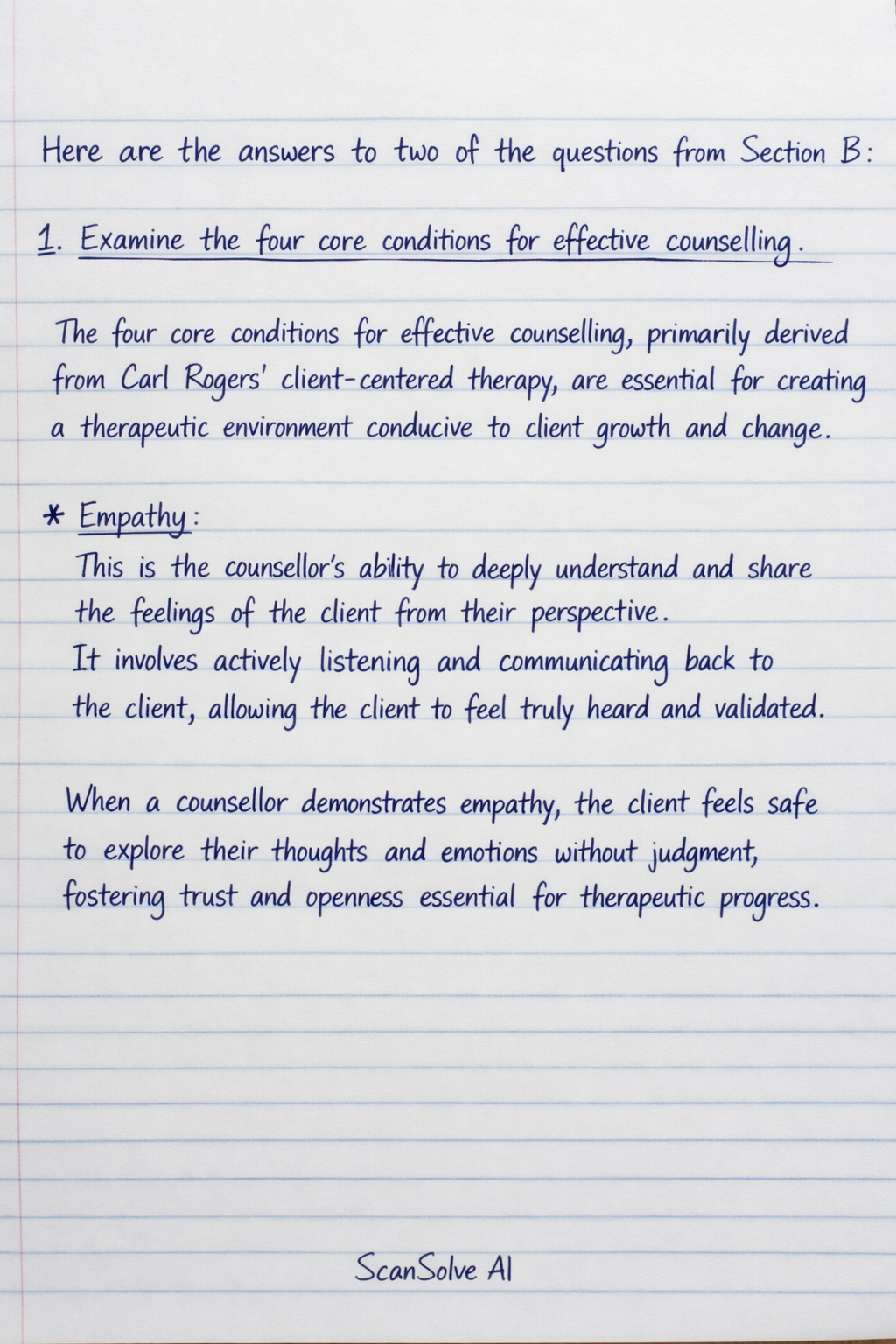
Here are the answers to two of the questions from Section B:
1. Examine the four core conditions for effective counselling.
The four core conditions for effective counselling, primarily derived from Carl Rogers' client-centered therapy, are essential for creating a therapeutic environment conducive to client growth and change.
-
Empathy: This is the counsellor's ability to deeply understand and share the feelings of the client from their perspective. It involves actively listening and communicating this understanding back to the client, allowing the client to feel truly heard and validated. When a counsellor demonstrates empathy, the client feels safe to explore their thoughts and emotions without judgment, fostering trust and openness essential for therapeutic progress.
-
Unconditional Positive Regard (UPR): This refers to the counsellor's complete acceptance and respect for the client as a person, regardless of their thoughts, feelings, or behaviors. It means valuing the client's humanity without imposing conditions or judgments. UPR creates a non-threatening environment where the client can be their authentic self, reducing defensiveness and encouraging self-acceptance, which is crucial for personal growth and problem-solving.
-
Congruence (Genuineness/Authenticity): This condition means the counsellor is real, transparent, and authentic in the therapeutic relationship. Their internal feelings and external expressions are consistent, and they are not hiding behind a professional facade. Congruence builds trust by demonstrating honesty and reliability, allowing the client to perceive the counsellor as a genuine human being rather than just a role, thereby facilitating a more profound and effective therapeutic connection.
-
Psychological Contact: This foundational condition means that a relationship exists between the client and counsellor, and the client perceives, at least to some degree, the counsellor's empathy and unconditional positive regard. Without this basic connection and the client's awareness of the counsellor's facilitative attitudes, the other conditions cannot effectively lead to therapeutic change. It ensures that the client is receptive to the counsellor's efforts and that the therapeutic process can truly begin.
2. Discuss in detail the need for referral services in primary schools. Support your answer with at least five reasons, showing how neglecting these services could affect pupils' academic performance and overall well-being.
Referral services in primary schools are crucial for addressing the diverse and complex needs of pupils that extend beyond the scope of general classroom teaching. These services connect students with specialized support, ensuring their holistic development and well-being. Neglecting these services can have significant negative impacts on pupils' academic performance and overall well-being for several reasons:
-
Specialized Expertise: Teachers, while dedicated, are not trained to handle all complex issues such as severe learning disabilities, mental health disorders, or family crises. Neglecting referrals means students with specialized needs do not receive expert diagnosis and intervention, leading to persistent academic struggles and emotional distress that teachers are ill-equipped to manage effectively.
-
Early Intervention and Prevention: Referral services enable the early identification and intervention of problems before they escalate into more severe issues. Neglecting to refer can result in minor difficulties becoming chronic, significantly impacting a child's long-term academic trajectory, social development, and overall mental health, requiring more intensive and costly interventions later.
-
Comprehensive Support for Holistic Development: Many student challenges, such as health issues, socio-economic difficulties, or behavioral problems, require support beyond academic instruction. Neglecting referrals leaves these critical areas unaddressed, hindering a child's overall well-being and creating barriers to their ability to learn and thrive in school.
-
Optimizing School Resources and Teacher Effectiveness: Schools have limited resources, and teachers have specific roles focused on education. Referral services allow schools to leverage external expertise, preventing teachers from being overburdened with issues outside their training. Neglecting referrals can lead to teacher burnout and a dilution of educational focus, ultimately compromising the quality of education for all students.
-
Ensuring Student Rights and Ethical Obligations: Schools have an ethical and often legal responsibility to provide a safe and supportive learning environment for all students. Neglecting to refer students with significant needs can be seen as a failure in this duty of care, potentially leading to negative outcomes for the child, legal repercussions for the school, and damage to the school's reputation, all of which undermine the educational mission.
Still stuck on this one?
Ask a follow-up, and the answer starts from this question.
More Psychology Questions
Handwritten Step-by-Step Solution
Get this as a handwritten image on WhatsApp — like a tutor wrote it for you.
Try on WhatsApp