
We read your photo as:
What are the answers to the following multiple-choice questions about learning disabilities, hearing loss, and gifted children?
ScanSolve AI Answer
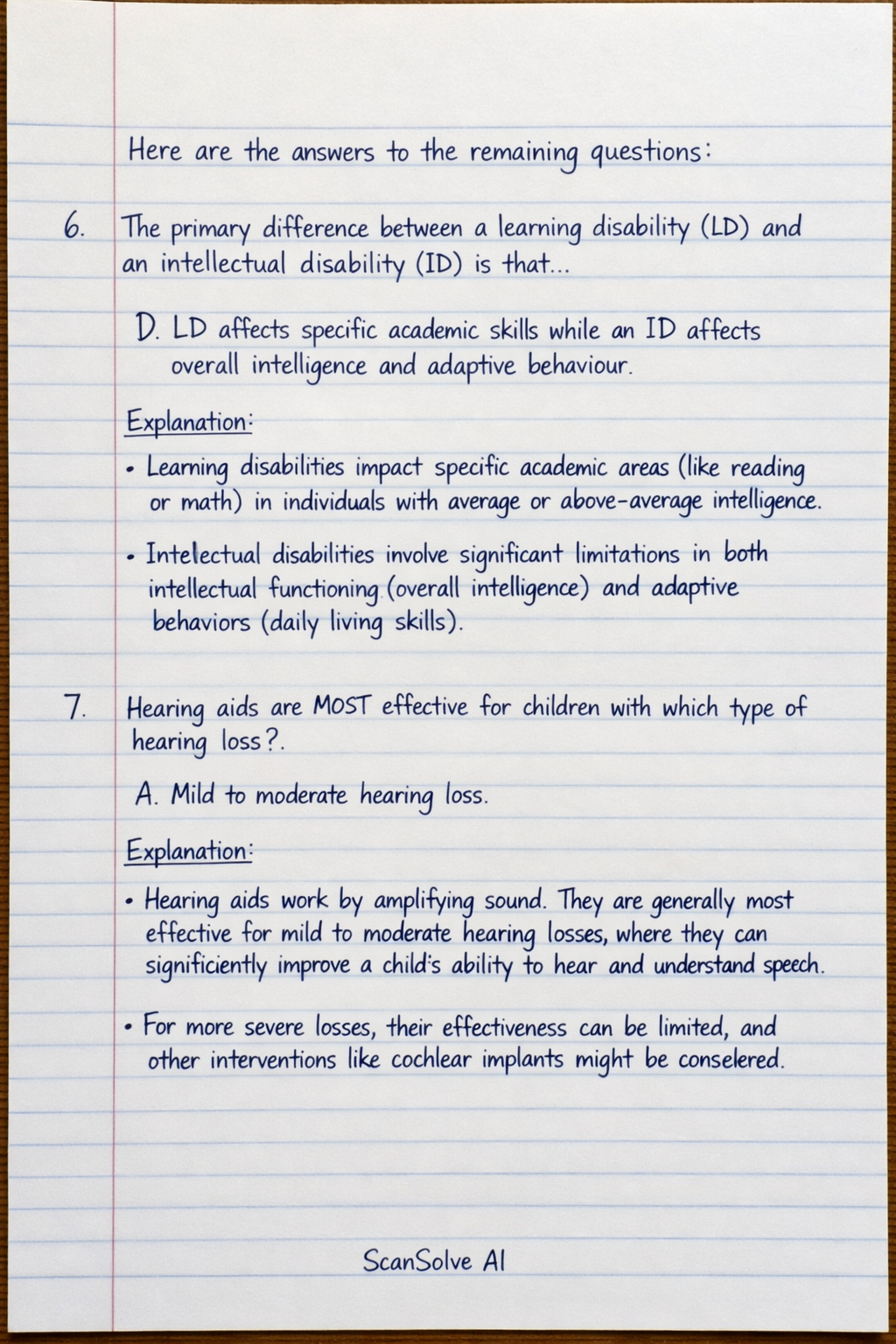
Here are the answers to the remaining questions:
-
The primary difference between a learning disability (LD) and an intellectual disability (ID) is that...
- D. LD affects specific academic skills while an ID affects overall intelligence and adaptive behaviour.
- Explanation: Learning disabilities impact specific academic areas (like reading or math) in individuals with average or above-average intelligence. Intellectual disabilities involve significant limitations in both intellectual functioning (overall intelligence) and adaptive behaviors (daily living skills).
-
Hearing aids are MOST effective for children with which type of hearing loss?
- A. Mild to moderate hearing loss
- Explanation: Hearing aids work by amplifying sound. They are generally most effective for mild to moderate hearing losses, where they can significantly improve a child's ability to hear and understand speech. For more severe losses, their effectiveness can be limited, and other interventions like cochlear implants might be considered.
-
A gifted/talented child who performs poorly in school may be considered as...
- D. underachiever.
- Explanation: An underachiever is an individual, often gifted, whose academic performance is significantly below their intellectual potential. This can be due to various factors such as boredom, lack of challenge, or motivational issues.
-
Which of the following assistive tools helps people with visual impairment move around independently?
- D. White cane
- Explanation: A white cane is a crucial mobility tool for individuals with visual impairment, allowing them to detect obstacles, changes in terrain, and navigate their environment safely and independently.
-
An example of an adaptive behaviour that learners with intellectual disabilities can be taught is...
- A. following social norms.
- Explanation: Adaptive behaviors are skills necessary for daily living and independent functioning. Following social norms is a key adaptive behavior that helps individuals interact appropriately within their community and society.
-
A child who has difficulty following directions and understanding spoken language is suffering from a...
- C. language disorder.
- Explanation: A language disorder involves difficulties in understanding (receptive language) or using (expressive language) spoken, written, or other symbol systems. Difficulty following directions and understanding spoken language are classic signs of a receptive language disorder.
-
The term "twice-exceptional" (2e) refers to students who are...
- B. gifted/talented and also have certain disabilities.
- Explanation: Twice-exceptional (2e) students are those who are identified as gifted or talented in one or more areas and also have one or more disabilities (e.g., learning disabilities, ADHD, autism spectrum disorder).
-
Individuals with intellectual disabilities often require support in which area?
- D. All of the above
- Explanation: Intellectual disabilities affect both intellectual functioning and adaptive behavior. This often means individuals require support across various domains, including executive functioning (planning, problem-solving), memory recall, and social interactions.
-
Which of the following eye diseases is characterised by increased pressure inside the eye?
- C. Glaucoma
- Explanation: Glaucoma is a group of eye conditions that damage the optic nerve, often caused by abnormally high pressure inside the eye (intraocular pressure). If left untreated, it can lead to permanent vision loss.
Still stuck on this one?
Ask a follow-up, and the answer starts from this question.
More Psychology Questions
Handwritten Step-by-Step Solution
Get this as a handwritten image on WhatsApp — like a tutor wrote it for you.
Try on WhatsApp