
We read your photo as:
What are the four primary scales of measurement, and what are examples of each?
ScanSolve AI Answer
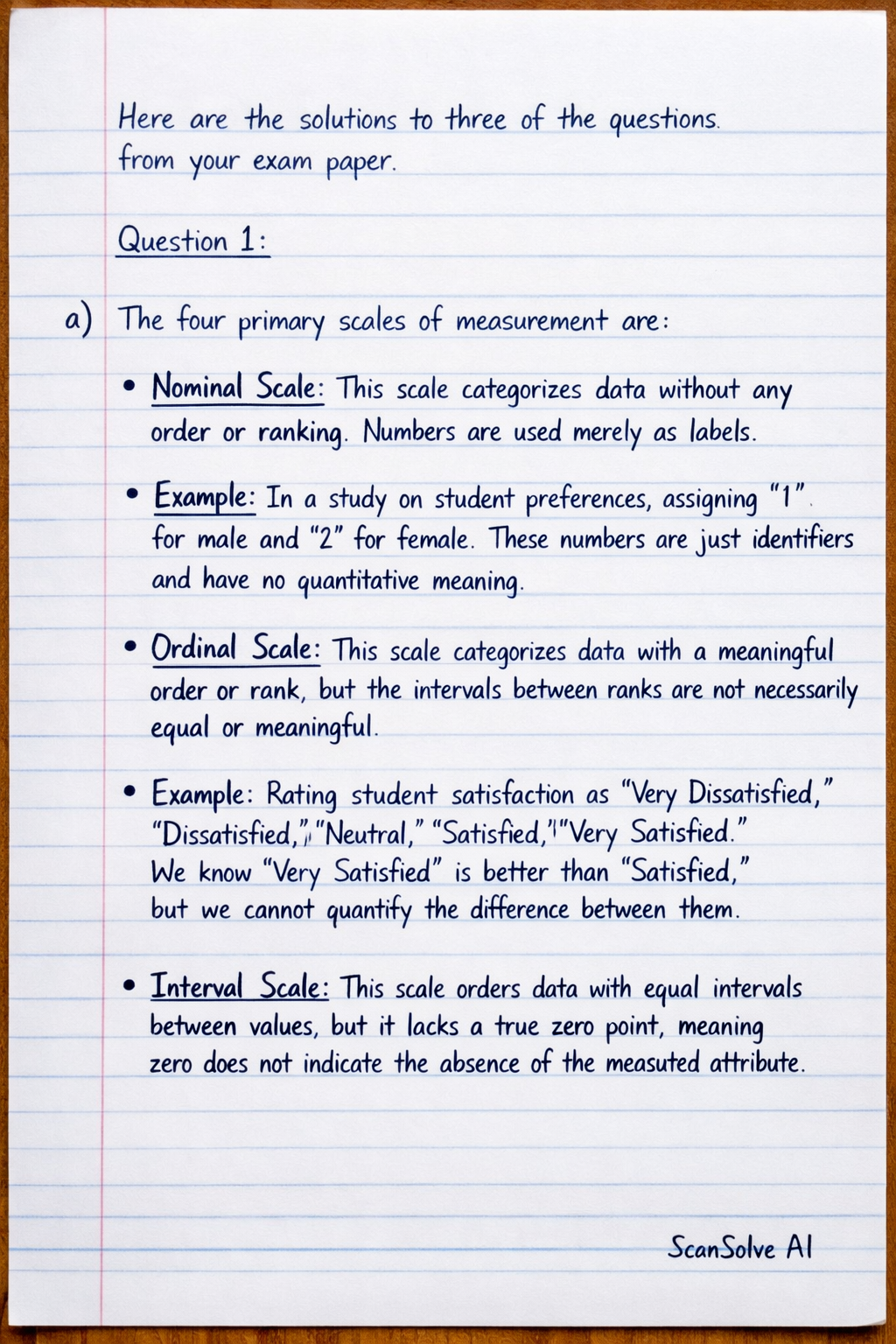
Here are the solutions to three of the questions from your exam paper.
Question 1:
a) The four primary scales of measurement are:
- Nominal Scale: This scale categorizes data without any order or ranking. Numbers are used merely as labels. Example: In a study on student preferences, assigning "1" for male and "2" for female. These numbers are just identifiers and have no quantitative meaning.
- Ordinal Scale: This scale categorizes data with a meaningful order or rank, but the intervals between ranks are not necessarily equal or meaningful. Example: Rating student satisfaction as "Very Dissatisfied," "Dissatisfied," "Neutral," "Satisfied," "Very Satisfied." We know "Very Satisfied" is better than "Satisfied," but we cannot quantify the difference between them.
- Interval Scale: This scale orders data with equal intervals between values, but it lacks a true zero point, meaning zero does not indicate the absence of the measured attribute. Example: Measuring temperature in Celsius or Fahrenheit. The difference between and is the same as between and , but does not mean there is no temperature.
- Ratio Scale: This scale has all the properties of an interval scale, but it also includes a true zero point, indicating the complete absence of the measured attribute. Ratios between values are meaningful. Example: Measuring the number of hours students spend studying per week. Zero hours means no studying, and 10 hours is twice as much as 5 hours.
b) Choosing the appropriate scale of measurement is crucial in research for several reasons:
- Determines Statistical Analysis: The scale of measurement dictates which statistical tests can be appropriately applied to the data. Using an incorrect scale can lead to invalid statistical conclusions.
- Ensures Data Validity and Reliability: Selecting the correct scale ensures that the data collected accurately represents the phenomenon being studied, enhancing the validity and reliability of the research findings.
- Facilitates Accurate Interpretation: An appropriate scale allows for meaningful interpretation of results, preventing misrepresentation or overstatement of findings. For instance, calculating a mean for nominal data is inappropriate.
- Guides Data Collection Methods: The chosen scale influences the design of survey questions, experimental procedures, and other data collection instruments, ensuring that the data gathered is suitable for the research objectives.
Question 2:
a) Writing the background to the study for a thesis involves a systematic process to establish the context and rationale for your research. Here are the step-by-step guidelines:
- Introduce the Broad Topic: Begin with a general overview of the research area, gradually narrowing down to your specific topic. This sets the stage for the reader.
- Provide Historical Context: Briefly discuss the historical development or evolution of the topic. This helps to show how the current understanding or problem has emerged over time.
- Review Existing Literature: Summarize key theories, concepts, and previous research findings related to your topic. Highlight what is already known and identify any gaps, inconsistencies, or debates in the literature.
- Identify the Research Problem: Clearly articulate the specific problem or issue that your study aims to address. This problem should logically emerge from the gaps identified in the literature review.
- Explain the Significance of the Study: Justify why your research is important. Discuss the potential contributions of your study to theory, practice, policy, or society, and explain who will benefit from the findings.
- Outline the Theoretical/Conceptual Framework (if applicable): Briefly introduce the theoretical or conceptual framework that underpins your study. Explain how this framework helps to understand and analyze your research problem.
b) Differentiating between sequential transformative design and sequential exploratory design:
- Sequential Transformative Design: This mixed methods design prioritizes a specific theoretical perspective, often related to social justice or advocacy. It involves collecting and analyzing either qualitative data followed by quantitative data (QUAL QUAN) or vice versa (QUAN QUAL). The primary goal is to use the research findings to advocate for change or address an inequality, with the theoretical lens guiding all stages of the research process.
- Sequential Exploratory Design: This mixed methods design begins with the collection and analysis of qualitative data (QUAL) to explore a phenomenon in depth, followed by the collection and analysis of quantitative data (QUAN). The purpose of the quantitative phase is to generalize the initial qualitative findings to a larger sample, test emergent theories, or measure the prevalence of themes identified in the qualitative phase. The qualitative phase is exploratory, and its results inform the development of the quantitative phase.
Question 3:
a) The step-by-step process of drawing a sample using a table of random numbers to select people for a study is as follows:
- Define the Population: Clearly identify the entire group of individuals from which you want to draw your sample.
- Assign Unique Numbers: Assign a unique numerical identifier to each individual in the defined population. Ensure these numbers cover the entire range of the population.
- Determine Sample Size: Decide on the number of participants required for your study based on statistical considerations and research objectives.
- Select a Starting Point: Randomly choose a starting point in the table of random numbers. This can be done by closing your eyes and pointing to a spot on the table.
- Read Numbers Systematically: From your starting point, read numbers in a consistent direction (e.g., across rows, down columns, or diagonally). The number of digits you read should match the number of digits in your population's assigned identifiers (e.g., if your population has 999 members, you would read 3-digit numbers).
- Select Participants: If a random number matches an assigned number in your population, that individual is selected for the sample.
- Handle Duplicates and Out-of-Range Numbers: If you encounter a number that has already been selected or a number that falls outside the range of your assigned population identifiers, simply skip it and continue to the next number in the table.
- Continue Until Sample Size is Met: Repeat steps 5-7 until you have selected the desired number of participants for your sample.
b) In-text citations in APA format play several crucial roles in academic writing:
- Acknowledge Sources: They give credit to the original authors of ideas, theories, or data that you have used in your work, upholding intellectual honesty.
- Avoid Plagiarism: By properly citing sources, you demonstrate that the information is not your own original thought, thereby preventing plagiarism.
- Provide Traceability: In-text citations direct readers to the full bibliographic entry in the reference list, allowing them to locate and verify the original source if they wish to explore it further.
- Support Claims and Arguments: Citing credible sources strengthens your arguments and provides evidence for your claims, enhancing the academic rigor and persuasiveness of your writing.
c) Here are examples of in-text citations in APA format for a book, a journal article, and a website:
- Book:
- According to Smith (2020), "research methods are essential for valid studies" (p. 45).
- The importance of research methods in ensuring valid studies has been widely discussed (Smith, 2020).
- Journal Article:
- Johnson and Lee (2019) found a significant correlation between study habits and academic performance.
- A significant correlation has been observed between study habits and academic performance (Johnson & Lee, 2019).
- Website:
- The World Health Organization (2021) reported an increase in global health awareness campaigns.
- Global health awareness campaigns have seen a notable increase in recent years (World Health Organization, 2021).
Still stuck on this one?
Ask a follow-up, and the answer starts from this question.
More Psychology Questions
Handwritten Step-by-Step Solution
Get this as a handwritten image on WhatsApp — like a tutor wrote it for you.
Try on WhatsApp