
We read your photo as:
Explain unequal power relations and their link to rape and incest, as well as the role of cultural practices in their promotion.
ScanSolve AI Answer
Here are the answers to Question 3:
-
Define "unequal power relations" Unequal power relations refer to an imbalance in the distribution of power, control, and influence between individuals or groups, where one party holds significantly more authority or dominance over another. This often leads to the subjugation or exploitation of the less powerful party.
-
Discuss how unequal power relations may lead to rape and or incest. Unequal power relations create an environment where the more powerful individual can exploit or coerce the less powerful one.
- In cases of rape, a perpetrator may use their position of physical, social, or economic dominance to force sexual acts upon a victim who is less able to resist or report due to fear of repercussions.
- For incest, the inherent power imbalance within family structures (e.g., adult over child, older relative over younger) allows the abuser to manipulate, threaten, or control the victim, making it difficult for the victim to disclose the abuse due to dependence, fear, or shame.
-
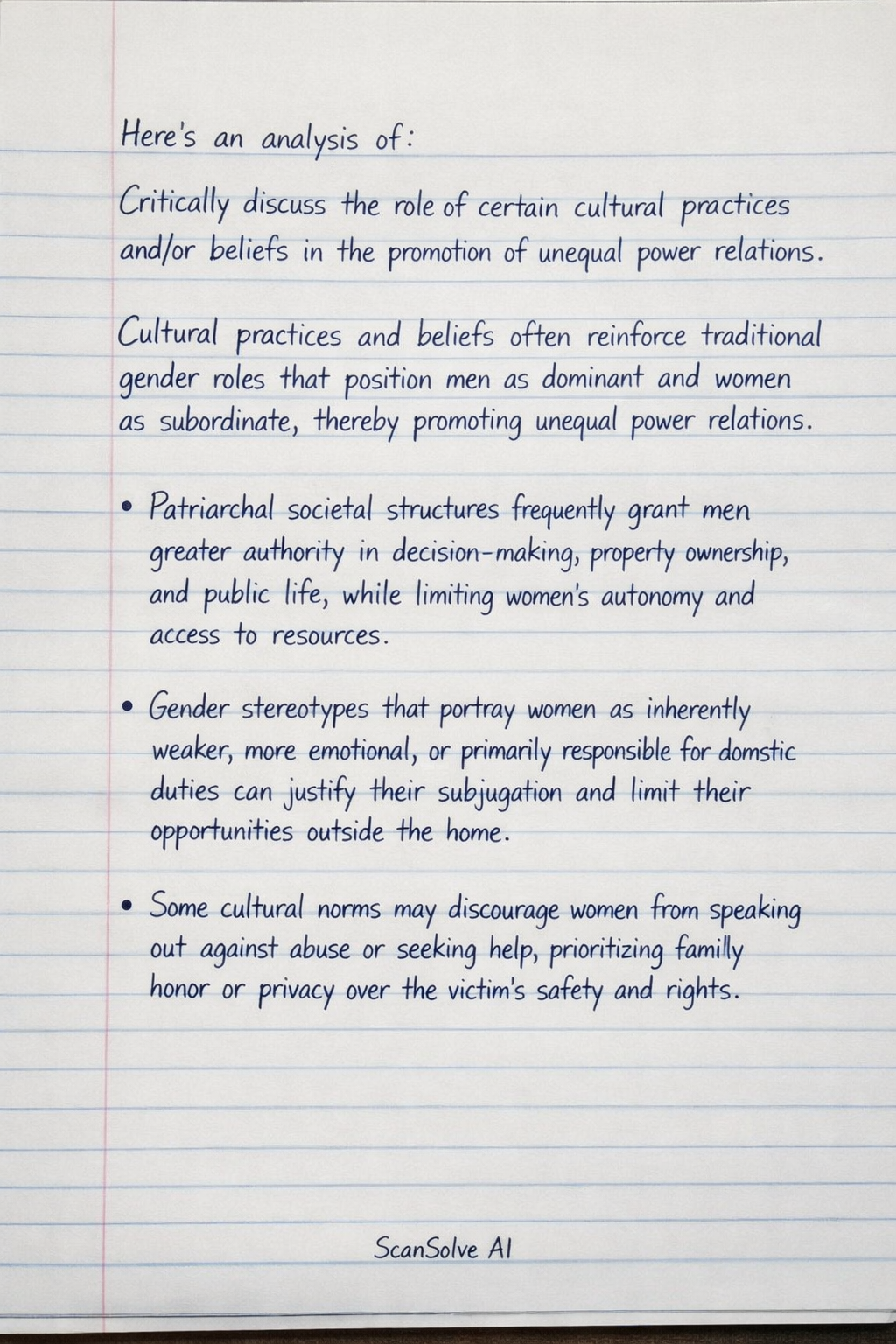
Critically discuss the role of certain cultural practices and or beliefs in the promotion of unequal power relations. Cultural practices and beliefs often reinforce traditional gender roles that position men as dominant and women as subordinate, thereby promoting unequal power relations.
- Patriarchal societal structures frequently grant men greater authority in decision-making, property ownership, and public life, while limiting women's autonomy and access to resources.
- Gender stereotypes that portray women as inherently weaker, more emotional, or primarily responsible for domestic duties can justify their subjugation and limit their opportunities outside the home.
- Some cultural norms may discourage women from speaking out against abuse or seeking help, prioritizing family honor or privacy over the victim's safety and rights.
-
Give reasons why some women do not report incidents of domestic violence There are several reasons why women may not report domestic violence:
- Fear of retaliation from the abuser, which could lead to more severe violence or harm to themselves or their children.
- Economic dependence on the abuser, making it difficult to leave or support themselves and their families if they report.
- Shame, stigma, or embarrassment associated with being a victim of abuse, often compounded by societal victim-blaming attitudes.
- Lack of trust in the justice system or fear that authorities will not take their claims seriously or provide adequate protection.
Still stuck on this one?
Ask a follow-up, and the answer starts from this question.
More Psychology Questions
Handwritten Step-by-Step Solution
Get this as a handwritten image on WhatsApp — like a tutor wrote it for you.
Try on WhatsApp