

This physics problem tests your understanding of fundamental physical laws and their applications. The step-by-step solution below breaks down the problem using relevant equations and physical reasoning.
ScanSolve AI Answer
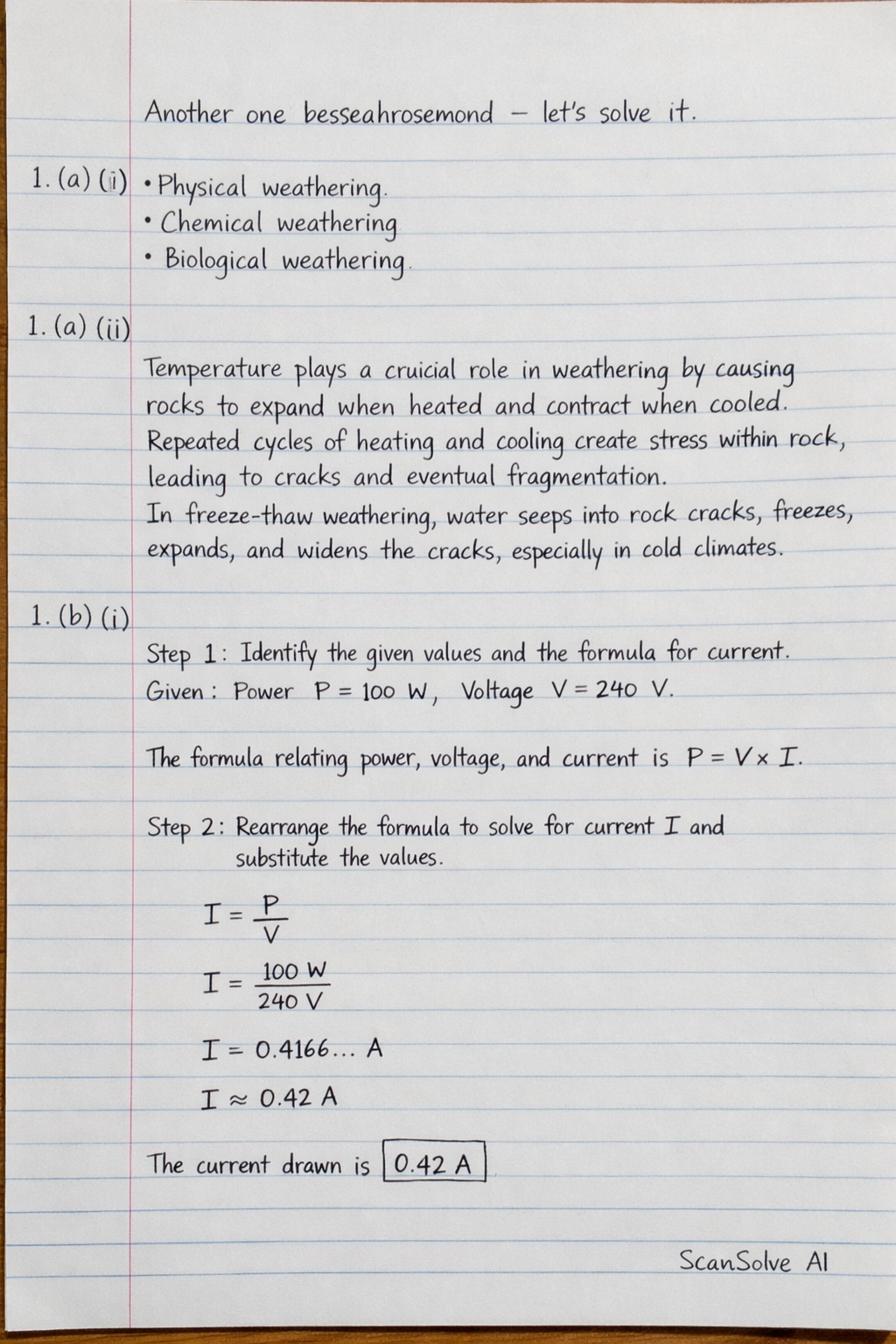
Another one besseahrosemond — let's solve it. 1. (a) (i) • Physical weathering • Chemical weathering • Biological weathering 1. (a) (ii) Temperature plays a crucial role in weathering by causing rocks to expand when heated and contract when cooled. Repeated cycles of heating and cooling create stress within the rock, leading to cracks and eventual fragmentation. In freeze-thaw weathering, water seeps into rock cracks, freezes, expands, and widens the cracks, especially in cold climates. 1. (b) (i) Step 1: Identify the given values and the formula for current. Given: Power P = 100 W, Voltage V = 240 V. The formula relating power, voltage, and current is P = V × I. Step 2: Rearrange the formula to solve for current I and substitute the values. I = (P)/(V) I = 100 W240 V I = 0.4166... A I ≈ 0.42 A The current drawn is 0.42 A. 1. (b) (ii) Step 1: Identify the given values and the formula for resistance. Given: Power P = 100 W, Voltage V = 240 V. The formula relating power, voltage, and resistance is P = (V^2)/(R). Step 2: Rearrange the formula to solve for resistance R and substitute the values. R = (V^2)/(P) R = (240 V)^2100 W R = 57600 V^2100 W R = 576 The resistance of the heater is 576 . 1. (c) (i) • Sodium chloride (NaCl) • Magnesium oxide (MgO) • Potassium iodide (KI) 1. (c) (ii) • They have high melting and boiling points. • They are generally soluble in polar solvents like water. 1. (d) (i) Rhesus factor (Rh factor) is an inherited protein found on the surface of red blood cells. Individuals who have the Rh protein are Rh-positive, while those who do not are Rh-negative. 1. (d) (ii) Rhesus factor incompatibility can lead to miscarriage when an Rh-negative mother carries an Rh-positive fetus. During pregnancy or childbirth, fetal blood can enter the mother's bloodstream, causing her immune system to produce antibodies against the Rh factor. In subsequent pregnancies with an Rh-positive fetus, these maternal antibodies can cross the placenta and attack the fetal red blood cells, leading to hemolytic disease of the newborn, which can result in miscarriage or stillbirth. 2. (a) (i) Solar energy is used to generate electricity primarily through photovoltaic (PV) cells (solar panels) which convert sunlight directly into direct current (DC) electricity. This DC electricity can then be converted to alternating current (AC) for use in homes and grids. Alternatively, concentrated solar power (CSP) systems use mirrors to focus sunlight to heat a fluid, producing steam that drives a turbine to generate electricity. 2. (a) (ii) • Solar water heating for domestic or industrial use. • Drying crops or other agricultural products. 2. (b) (i) • Taking shorter showers instead of baths. • Fixing leaky faucets and pipes promptly. • Turning off the tap while brushing teeth or washing dishes. • Using water-efficient appliances like washing machines and dishwashers. • Collecting rainwater for gardening or other non-potable uses. 2. (c) (i) • Using improved seed varieties. • Applying appropriate fertilizers and manure. • Practicing timely planting and proper spacing. 2. (c) (ii) • Using improved seed varieties ensures high yield because these seeds are often genetically selected for traits like disease resistance, faster growth, and higher productivity, leading to more maize per plant. • Applying appropriate fertilizers provides essential nutrients (like nitrogen, phosphorus, and potassium) that maize plants need for healthy growth and development, directly contributing to increased grain production and overall yield. 2. (d) (i) • Air masses bring specific weather conditions (e.g., hot, cold, humid, dry) to a region, influencing local temperatures and precipitation patterns. • They can contribute to the formation of severe weather events such as storms, hurricanes, or blizzards when different air masses collide. 2. (d) (ii) • Reducing the burning of fossil fuels by promoting renewable energy sources like solar and wind power. • Improving energy efficiency in homes, transportation, and industries to decrease overall energy consumption. • Implementing afforestation and reforestation programs to increase carbon dioxide absorption from the atmosphere. 3. (a) (i) Aluminium resists corrosion because it readily reacts with oxygen in the air to form a thin, dense, and impermeable layer of aluminium oxide (Al_2O_3) on its surface. This passive layer acts as a protective barrier, preventing further oxidation of the underlying metal. In contrast, iron's oxide (rust) is porous and flaky, allowing oxygen and moisture to penetrate and continuously corrode the metal beneath. 3. (a) (ii) • Painting or coating with a protective layer. • Galvanizing, which involves coating iron with a layer of zinc. 3. (b) (i) Culling, in livestock management, refers to the selective removal of animals from a herd based on specific criteria such as age, poor health, low productivity, or undesirable genetic traits. The purpose is to improve the overall quality, health, and economic efficiency of the remaining herd. 3. (b) (ii) • It improves the overall health of the herd by removing diseased or weak animals, preventing the spread of illness. • It increases productivity (e.g., milk, meat, eggs) by ensuring that only the most efficient and productive animals remain. • It allows for better utilization of resources (feed, space) by reducing the number of unproductive animals. 3. (c) (i) Grafting involves joining two plant parts, typically a scion (upper part with desired traits) and a rootstock (lower part with roots), so they grow as a single plant. Budding is a specific type of grafting where only a single bud (with a small piece of bark) from the scion is inserted into the rootstock. 3. (c) (ii) • To propagate plants that do not root easily from cuttings or seeds. • To combine desirable characteristics from two different plants, such as disease resistance from the rootstock and high fruit quality from the scion. • To repair damaged trees by grafting a new branch or bridge over an injured area. 3. (d) (i) The principle of conservation of energy states that energy cannot be created or destroyed, but it can be transformed from one form to another. The total amount of energy in an isolated system remains constant. 3. (d) (ii) (a) a moving motorcycle: Chemical energy (fuel) → Heat energy → Kinetic energy (engine parts) → Kinetic energy (motorcycle movement) + Sound energy + Heat energy (friction). (b) a television set in operation: Electrical energy → Light energy + Sound energy + Heat energy. 4. (a) (i) Secondary colours of light are colours formed by mixing two primary colours of light in equal proportions. The primary colours of light are red, green, and blue. 4. (a) (ii) (a) red and green: Yellow (b) blue and green: Cyan (c) red and blue: Magenta 4. (b) (i) The mole is the SI unit for the amount of substance.