

This computer science problem involves algorithmic thinking and programming concepts. The solution below explains the approach, logic, and implementation step by step.
ScanSolve AI Answer
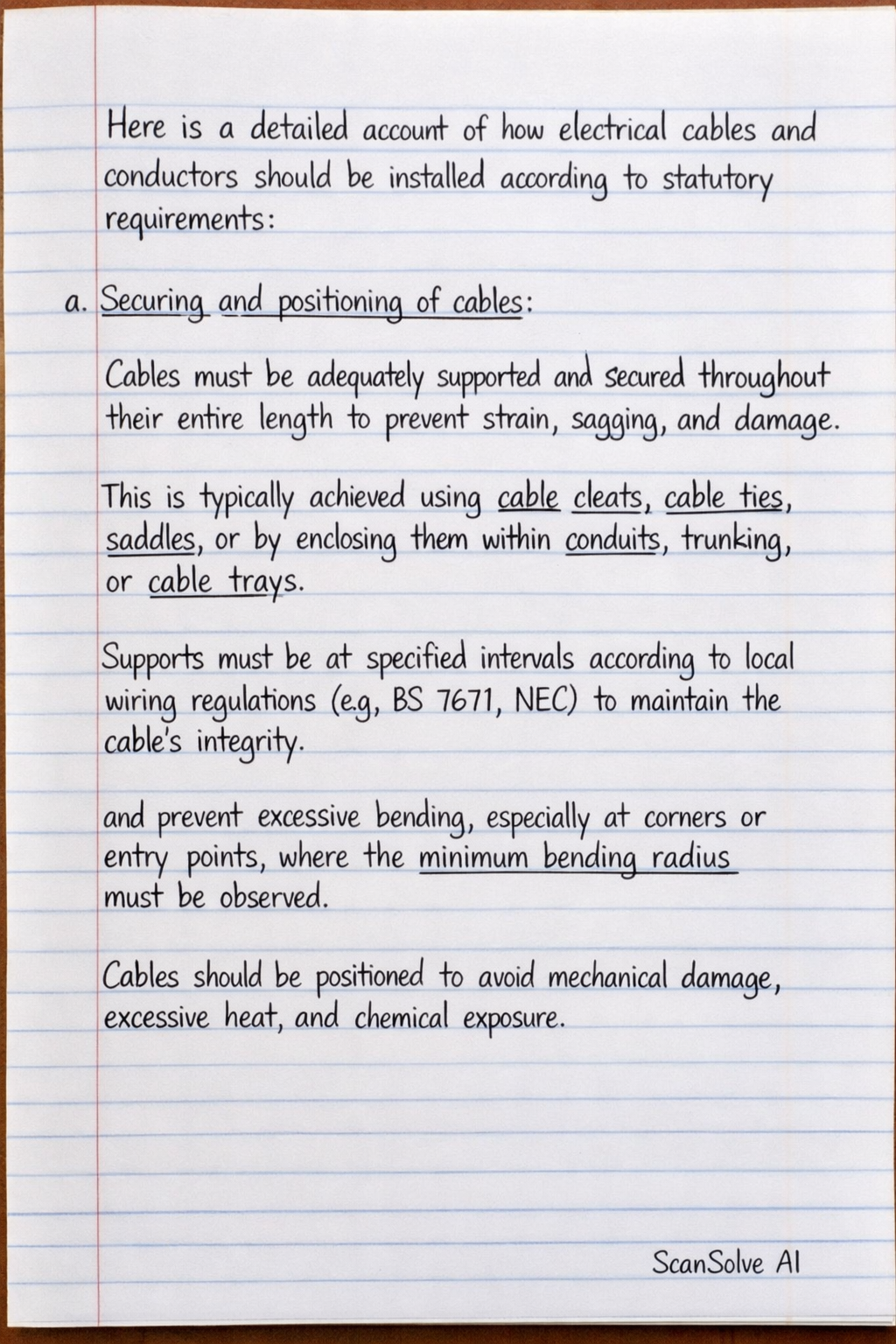
Here is a detailed account of how electrical cables and conductors should be installed according to statutory requirements: a. Securing and positioning of cables: Cables must be adequately supported and secured throughout their entire length to prevent strain, sagging, and damage. This is typically achieved using cable cleats, cable ties, saddles, or by enclosing them within conduits, trunking, or cable trays. Supports must be at specified intervals according to local wiring regulations (e.g., BS 7671, NEC) to maintain the cable's integrity and prevent excessive bending, especially at corners or entry points, where the minimum bending radius must be observed. Cables should be positioned to avoid mechanical damage, excessive heat, and chemical exposure. b. Tail length requirements for termination/joining: Sufficient tail length (slack) must be left at termination and joining points. This extra length allows for proper stripping, crimping, and connection without undue tension on the conductors. It also provides flexibility for future maintenance, re-termination, or modifications, ensuring that connections can be remade without having to pull new cable. Typically, enough slack is left to allow for at least one re-termination or to comfortably work on the connection. c. Marking and numbering procedures: All cables and conductors must be clearly and durably marked for identification. This includes circuit numbers, destination labels, and phase identification (e.g., using color codes like brown, black, grey for phases and blue for neutral in AC systems, or red for positive and black for negative in DC systems). Marking should be visible at all termination points, junctions, and at regular intervals along the cable run. This facilitates safe maintenance, fault finding, and future modifications, complying with statutory requirements for electrical installations. d. Safe use of tools and PPE during installation: During installation, only insulated tools rated for the voltage being worked on should be used. Tools must be in good condition and used correctly for their intended purpose. Personal Protective Equipment (PPE) is mandatory and includes safety glasses to protect against flying debris, insulated gloves for electrical protection, safety footwear with non-slip soles and toe protection, and a hard hat in areas with overhead hazards. Additional PPE like arc-flash protection may be required depending on the specific task and voltage levels. All personnel must be trained in the safe use of tools and PPE.