Describe the steps involved in preparing a worksite for the installation, joining, and termination of low voltage cables and conductors. Your answer should cover: a. Identification of installation points, b. Demarcation of the work area, c. Preparation of trenches, ducting, and kick pipes, d. Positioning of pulling devices, e. Handling of obstacles and compliance with statutory requirements.

Computer Science
Describe the steps involved in preparing a worksite for the installation, joining, and termination of low voltage cables and conductors. Your answer should cover: a. Identification of installation points, b. Demarcation of the work area, c. Preparation of trenches, ducting, and kick pipes, d. Positioning of pulling devices, e. Handling of obstacles and compliance with statutory requirements.

ScanSolve AI Answer

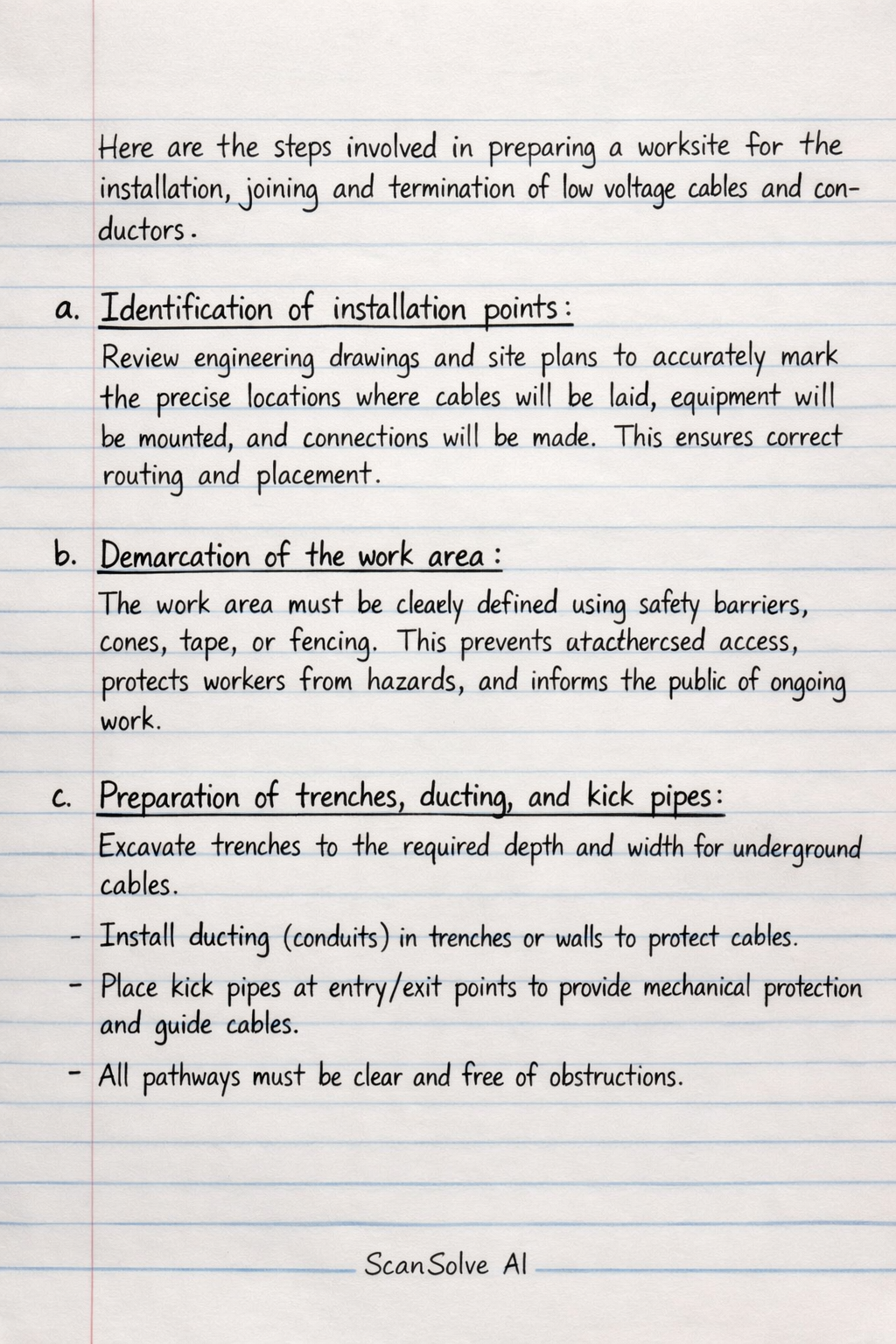
Here are the steps involved in preparing a worksite for the installation, joining, and termination of low voltage cables and conductors:

a. Identification of installation points: This involves reviewing engineering drawings and site plans to accurately mark the precise locations where cables will be laid, equipment will be mounted, and connections will be made. This ensures correct routing and placement.

b. Demarcation of the work area: The work area must be clearly defined using safety barriers, cones, tape, or fencing. This prevents unauthorized access, protects workers from hazards, and informs the public of ongoing work.

c. Preparation of trenches, ducting, and kick pipes: Trenches are excavated to the specified depth and width for underground cables. Ducting (conduits) is installed within trenches or walls to protect cables. Kick pipes are installed at entry/exit points to provide mechanical protection and guide cables. All pathways must be clear and free of obstructions.

d. Positioning of pulling devices: Cable pulling equipment, such as winches, rollers, and cable jacks, are strategically placed along the cable route. This ensures efficient and safe pulling of cables, minimizing stress on the cables and preventing damage during installation.

e. Handling of obstacles and compliance with statutory requirements: Potential obstacles like existing utilities (water, gas, other electrical lines) are identified and marked. Plans are made to work around or mitigate these obstacles. All work must comply with relevant local, national, and industry-specific safety regulations, permits, and environmental standards.

Was this helpful?

Need help with your own homework?

Get instant step-by-step solutions to any question. Free to start.

Ask Your Question
Handwritten step-by-step solution preview

Handwritten Step-by-Step Solution

Get this as a handwritten image on WhatsApp — like a tutor wrote it for you.

Try on WhatsApp

Still have questions?

Quick Answer

a. Identification of installation points: This involves reviewing engineering drawings and site plans to accurately mark the precise locations where cables will be laid, equipment will be mounted, and connections will be made.

Describe the steps involved in preparing a worksite for the installation, joining, and termination of low voltage cables and conductors. Your answer should cover: a. Identification of installation points, b. Demarcation of the work area, c. Preparation of trenches, ducting, and kick pipes, d. Positioning of pulling devices, e. Handling of obstacles and compliance with statutory requirements.
Computer Science

This computer science problem involves algorithmic thinking and programming concepts. The solution below explains the approach, logic, and implementation step by step.

ScanSolve AI Answer
Here are the steps involved in preparing a worksite for the installation, joining, and termination of low voltage cables and conductors: a. Identification of installation points: This involves reviewing engineering drawings and site plans to accurately mark the precise locations where cables will be laid, equipment will be mounted, and connections will be made. This ensures correct routing and placement. b. Demarcation of the work area: The work area must be clearly defined using safety barriers, cones, tape, or fencing. This prevents unauthorized access, protects workers from hazards, and informs the public of ongoing work. c. Preparation of trenches, ducting, and kick pipes: Trenches are excavated to the specified depth and width for underground cables. Ducting (conduits) is installed within trenches or walls to protect cables. Kick pipes are installed at entry/exit points to provide mechanical protection and guide cables. All pathways must be clear and free of obstructions. d. Positioning of pulling devices: Cable pulling equipment, such as winches, rollers, and cable jacks, are strategically placed along the cable route. This ensures efficient and safe pulling of cables, minimizing stress on the cables and preventing damage during installation. e. Handling of obstacles and compliance with statutory requirements: Potential obstacles like existing utilities (water, gas, other electrical lines) are identified and marked. Plans are made to work around or mitigate these obstacles. All work must comply with relevant local, national, and industry-specific safety regulations, permits, and environmental standards.