
We read your photo as:
A) Define the term earthing as applied to electrical installation. b) Describe three points of installations recommended for earthing.
ScanSolve AI Answer
Step-by-step solution
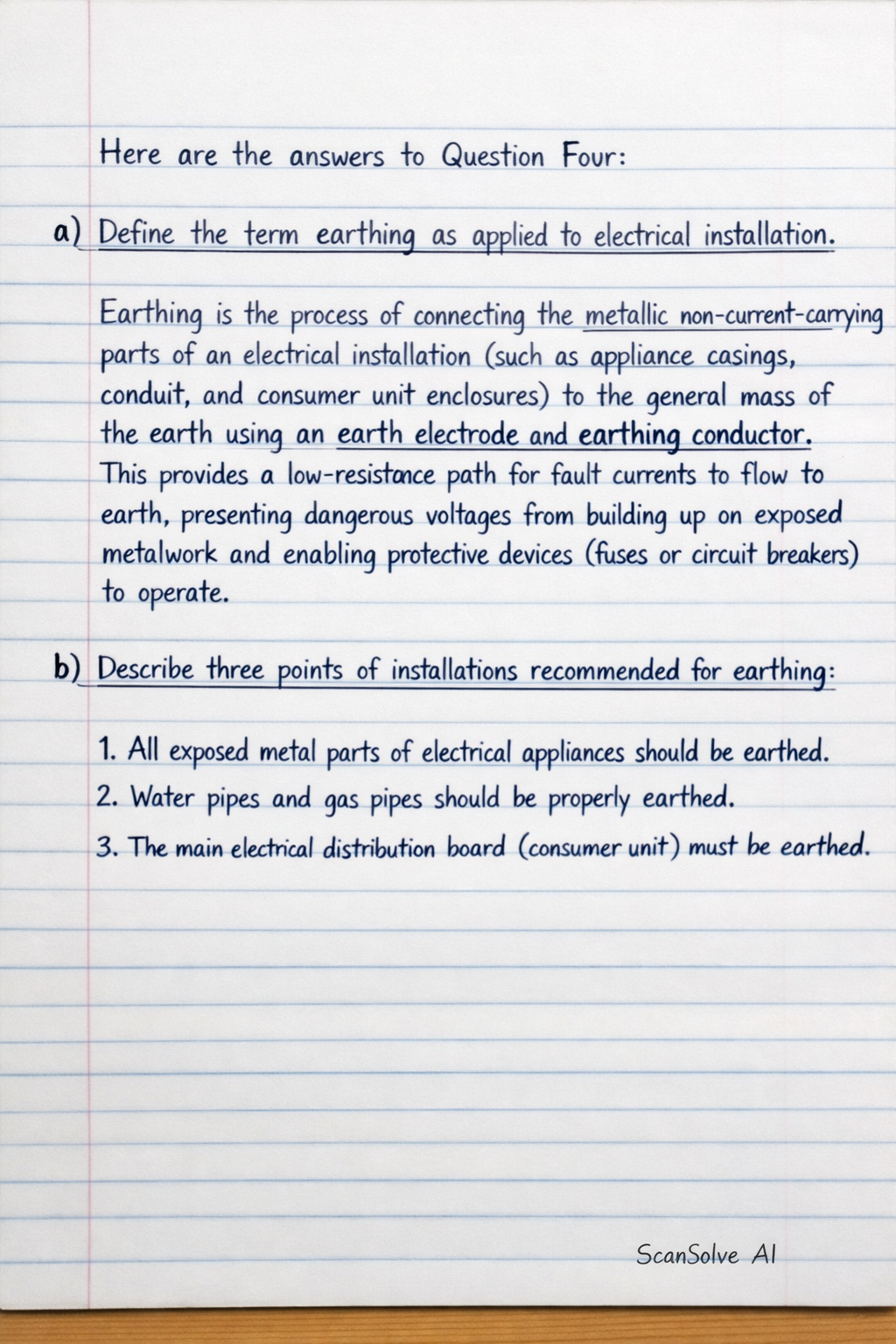
5 stepsHere are the answers to Question Four:
Part a
Define the term earthing as applied to electrical installation.
Earthing is the process of connecting the metallic non-current-carrying parts of an electrical installation (such as appliance casings, conduit, and consumer unit enclosures) to the general mass of the earth using an earth electrode and earthing conductor. This provides a low-resistance path for fault currents to flow to earth, preventing dangerous voltages from building up on exposed metalwork and enabling protective devices (fuses or circuit breakers) to operate.
Part b
Describe three points of installations recommended for earthing.
- Exposed Conductive Parts of Equipment: All metallic enclosures or frames of electrical equipment (e.g., washing machines, refrigerators, metal light fittings, motor casings) that are not intended to carry current but could become live in the event of an insulation fault must be earthed.
- Main Earthing Terminal/Bar: A dedicated terminal or bar within the consumer unit or near the main switch serves as the central point where the main earthing conductor from the earth electrode, circuit protective conductors, and main protective bonding conductors are connected.
- Main Protective Bonding Conductors: Large metallic services entering the building, such as incoming water pipes, gas pipes, and structural steelwork, must be bonded to the main earthing terminal. This ensures that all significant extraneous conductive parts are at the same earth potential, reducing the risk of electric shock.
Part c· 5 steps
Explain a step by step you will follow to carry out on effective earthing of a new electrical installation.
Select and Install Earth Electrode:** Choose an appropriate earth electrode (e.g., earth rod, earth plate, or earth mat) based on soil conditions and required resistance.
Drive the earth rod vertically into the ground or bury the earth plate/mat at a suitable depth, ensuring good contact with the soil.
Connect Main Earthing Conductor:** Run a suitably sized main earthing conductor from the earth electrode to the main earthing terminal or bar within the consumer unit.
Securely connect both ends using appropriate clamps or connectors.
Connect Circuit Protective Conductors (CPCs):** Connect the circuit protective conductors (earth wires) from each final circuit (e.g., lighting, sockets, cooker) to the main earthing terminal in the consumer unit.
These CPCs connect to the metallic enclosures of accessories and appliances on their respective circuits.
Install Main Protective Bonding Conductors:** Connect main protective bonding conductors from the main earthing terminal to all incoming metallic services (e.g., water, gas, oil pipes) and structural steelwork within the building, as close as possible to their point of entry.
Test the Earthing System:** Conduct an earth loop impedance test and an earth electrode resistance test to verify that the earthing system has a sufficiently low resistance to ensure the protective devices will operate within the required time during a fault.
Part d
Describe three methods you will use to lower earthing resistance.
- Increase the Length or Number of Earth Electrodes: Driving a longer earth rod deeper into the ground or installing multiple earth rods connected in parallel (spaced appropriately) increases the contact area with the soil, thereby reducing the overall earth resistance.
- Improve Soil Conductivity: Treat the soil around the earth electrode with chemical salts (e.g., common salt, magnesium sulfate, or calcium chloride). These chemicals dissolve in soil moisture, increasing the electrolyte content and thus improving the soil's conductivity, which lowers the earth resistance.
- Use Larger Surface Area Electrodes: Instead of a simple rod, use earth plates or earth mats, which have a larger surface area in contact with the soil. Burying these at a greater depth can also contribute to lower resistance due to more consistent moisture levels.
Still stuck on this one?
Ask a follow-up, and the answer starts from this question.
More Physics Questions
Handwritten Step-by-Step Solution
Get this as a handwritten image on WhatsApp — like a tutor wrote it for you.
Try on WhatsApp