ScanSolve logoScanSolve
Toggle sidebar
  • Homework
  • Tutor
  • Humanizer
  • AI Detector
  • Questions
  • Blog
  • History
  • Mobile App

  • Homework
  • Tutor
  • Humanizer
  • AI Detector

  • Questions
  • Math homework helpMath
    Physics homework helpPhysics
    Chemistry homework helpChemistry
    Biology homework helpBiology
    Computer Science homework helpComputer Science
    History homework helpHistory
    More homework helpMore
  • Blog
  • History

  • Mobile App
ScanSolvePLUS
  • Unlimited answers
  • ScanSolve AI Pro
Start Free Trial →
Try on WhatsApp
Home > Physics Homework Help > Solution

Explain two factors that affect sag in an overhead line. A tower of height 40 m and 100 m respectively supports a transmission line of line conductor of a water crossing. The horizontal distance between the tower is 600 m. If the tension in the line is 1580 kg and the weight of the conductor is 1.6 kg/m, determine the minimum clearance of the conductor and water.

Asked on March 26, 2026|Physics

This physics problem tests your understanding of fundamental physical laws and their applications. The step-by-step solution below breaks down the problem using relevant equations and physical reasoning.

ScanSolve AI AnswerAnswered on March 26, 2026
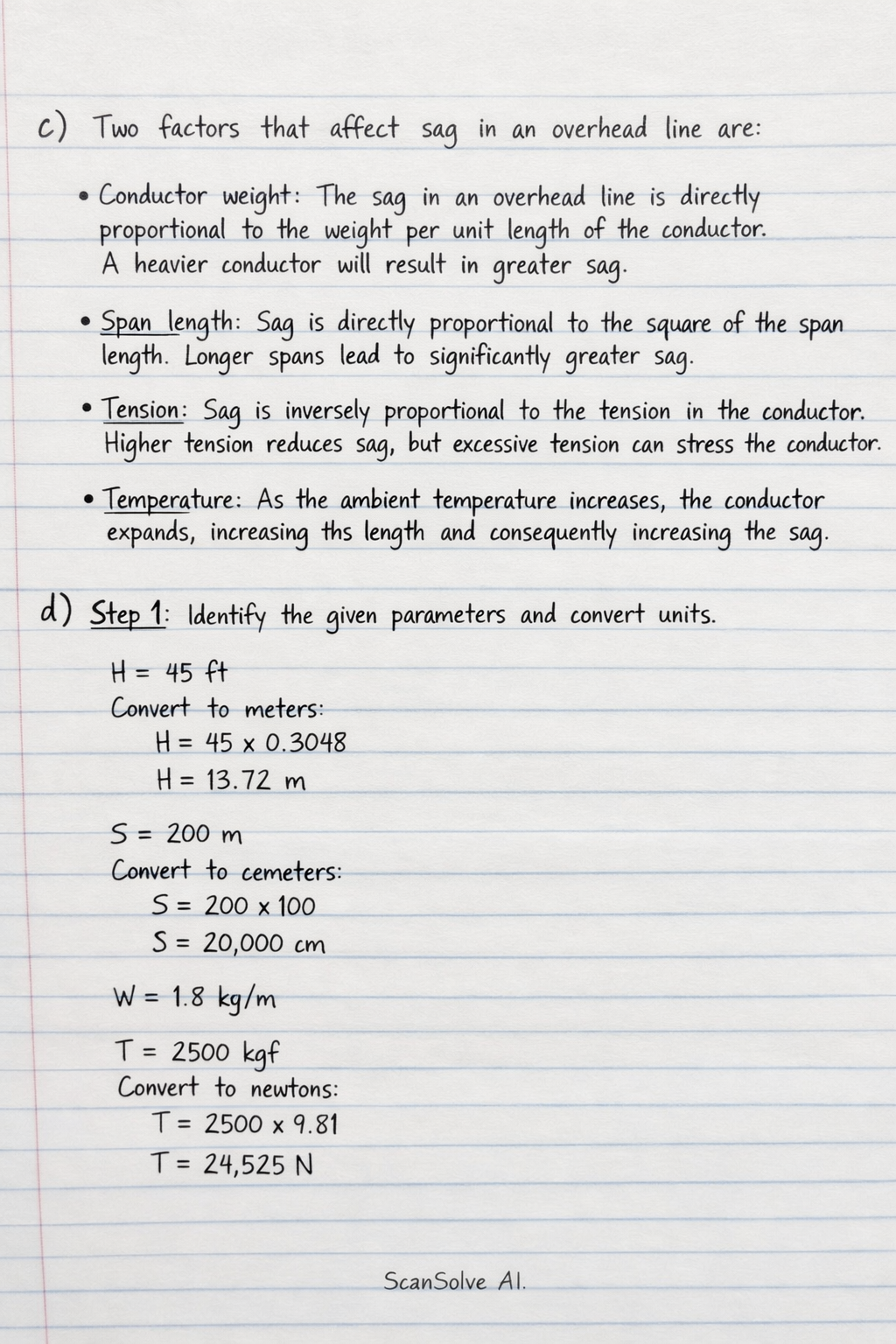
Here are the solutions to the problems: c) Two factors that affect sag in an overhead line are: • Conductor weight: The sag in an overhead line is directly proportional to the weight per unit length of the conductor. A heavier conductor will result in greater sag. • Span length: Sag is directly proportional to the square of the span length (the horizontal distance between supports). Longer spans lead to significantly greater sag. • Tension: Sag is inversely proportional to the tension in the conductor. Higher tension reduces sag, but excessive tension can stress the conductor. • Temperature: As the ambient temperature increases, the conductor expands, increasing its length and consequently increasing the sag. d) Step 1: Identify the given parameters and convert units. Height

Related Physics Questions

  • Calculate the speed of the 1.5 kg trolley at point P using the principle of conservation of mechanical energy.
  • Identify the circuit configuration when K is closed.
  • If a device that draws 8A is used in a circuit with a 5A fuse, the current will exceed the fuse's rating. The fuse wire...
  • 151. All components of the electromagnetic spectrum in vacuum have the same
  • Define variables for their current ages.
  • What is 1+1?
See all Physics questions

This step-by-step solution was generated by ScanSolve AI. Need help with more physics problems? Browse Physics solutions or ask your own question.

Home›Physics Homework Help›Explain two factors that affect sag in an overhead line. A t…
Q

Explain two factors that affect sag in an overhead line. A tower of height 40 m and 100 m respectively supports a transmission line of line conductor of a water crossing. The horizontal distance between the tower is 600 m. If the tension in the line is 1580 kg and the weight of the conductor is 1.6 kg/m, determine the minimum clearance of the conductor and water.

March 26, 2026|Physics
Explain two factors that affect sag in an overhead line. A tower of height 40 m and 100 m respectively supports a transmission line of line conductor of a water crossing. The horizontal distance between the tower is 600 m. If the tension in the line is 1580 kg and the weight of the conductor is 1.6 kg/m, determine the minimum clearance of the conductor and water.

Explain two factors that affect sag in an overhead line. A tower of height 40 m and 100 m respectively supports a transmission line of line conductor of a water crossing. The horizontal distance between the tower is 600 m. If the tension in the line is 1580 kg and the weight of the conductor is 1.6 kg/m, determine the minimum clearance of the conductor and water.

ScanSolve AI

ScanSolve AI Answer

Answered on March 26, 2026

Here are the solutions to the problems:

c) Two factors that affect sag in an overhead line are: • Conductor weight: The sag in an overhead line is directly proportional to the weight per unit length of the conductor. A heavier conductor will result in greater sag. • Span length: Sag is directly proportional to the square of the span length (the horizontal distance between supports). Longer spans lead to significantly greater sag. • Tension: Sag is inversely proportional to the tension in the conductor. Higher tension reduces sag, but excessive tension can stress the conductor. • Temperature: As the ambient temperature increases, the conductor expands, increasing its length and consequently increasing the sag.

d) Step 1: Identify the given parameters and convert units. Height

Need help with your own homework?

Get instant step-by-step solutions to any question. Free to start.

Ask Your Question
Handwritten step-by-step solution

Handwritten Step-by-Step Solution

Get this solution as a handwritten image on WhatsApp — just like a tutor wrote it for you.

Try on WhatsApp

More Physics Questions

Calculate the speed of the 1.5 kg trolley at point P using the principle of conservation of mechanic…Identify the circuit configuration when K is closed.If a device that draws 8A is used in a circuit with a 5A fuse, the current will exceed the fuse's ra…151. All components of the electromagnetic spectrum in vacuum have the sameDefine variables for their current ages.What is 1+1?
See all Physicsquestions →