
We read your photo as:
Explain the following accounting terms: Three column cashbook (ii) Cash discount (iii) Working capital (iv) Gross profit Net profit List ten users of accounting information.
ScanSolve AI Answer
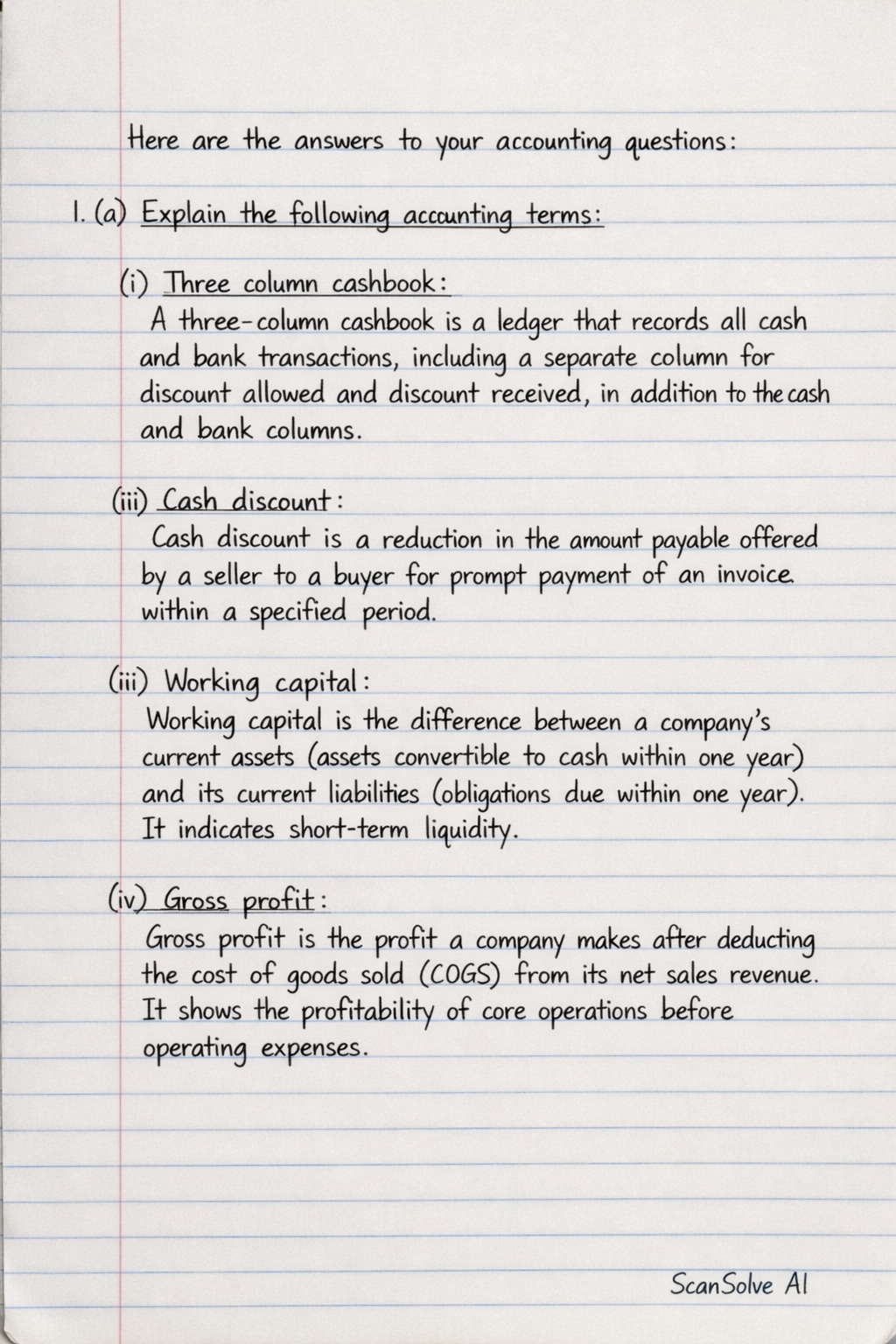
Here are the answers to your accounting questions:
1. (a) Explain the following accounting terms:
- (i) Three column cashbook: A three-column cashbook is a ledger that records all cash and bank transactions, including a separate column for discount allowed and discount received, in addition to the cash and bank columns.
- (ii) Cash discount: Cash discount is a reduction in the amount payable offered by a seller to a buyer for prompt payment of an invoice within a specified period.
- (iii) Working capital: Working capital is the difference between a company's current assets (assets convertible to cash within one year) and its current liabilities (obligations due within one year). It indicates short-term liquidity.
- (iv) Gross profit: Gross profit is the profit a company makes after deducting the cost of goods sold (COGS) from its net sales revenue. It shows the profitability of core operations before operating expenses.
- (v) Net profit: Net profit is the final profit remaining after all expenses, including operating expenses, interest, and taxes, have been deducted from total revenue. It represents the ultimate profitability of the business.
1. (b) List ten users of accounting information:
- Management
- Investors (shareholders)
- Creditors (lenders)
- Government (tax authorities)
- Employees
- Customers
- Suppliers
- Competitors
- Researchers
- Public/Community
2. (a) What is partnership?
Partnership is a business structure where two or more individuals agree to share in the profits or losses of a business that is carried on by all or any of them acting for all.
2. (b) State six contents of partnership deed:
- Name and nature of the business
- Names and addresses of all partners
- Capital contribution by each partner
- Profit and loss sharing ratio
- Salaries, commissions, or drawings allowed to partners
- Provisions for admission, retirement, or death of a partner
2. (c) Mention three differences and one similarity between receipts and payments account and income and expenditure account:
- Differences:
- Nature: Receipts and Payments Account is a summary of cash transactions (real account), while Income and Expenditure Account is similar to a Profit and Loss Account (nominal account).
- Capital vs. Revenue: Receipts and Payments Account records both capital and revenue items, whereas Income and Expenditure Account records only revenue items.
- Basis: Receipts and Payments Account is prepared on a cash basis, while Income and Expenditure Account is prepared on an accrual basis.
- Similarity:
- Both accounts are prepared by non-profit organizations to ascertain their financial performance or position.
3. (a) Define capital market.
The capital market is a financial market where long-term funds are raised by companies and governments through the issuance of stocks (equity) and bonds (debt), and where these securities are traded.
3. (b) Itemise and explain five reasons for disagreement between cashbook and bank statement:
- Cheques issued but not yet presented for payment: These are recorded in the cashbook as payments but not yet deducted by the bank.
- Cheques paid into bank but not yet credited by bank: These are recorded in the cashbook as receipts but not yet added by the bank.
- Bank charges: Charges levied by the bank (e.g., for services, overdrafts) are recorded in the bank statement but may not yet be in the cashbook.
- Direct debits/Standing orders: Payments made automatically by the bank on behalf of the account holder are in the bank statement but might not be in the cashbook.
- Interest allowed by bank: Interest earned on the bank balance is added by the bank but may not yet be recorded in the cashbook.
4. (a) Give four similarities between joint venture and partnership:
- Both involve two or more parties agreeing to carry on a business.
- Both aim to earn profits, which are shared among the parties.
- Both involve mutual agency, where each party can act on behalf of the others within the scope of the agreement.
- Both require an agreement (oral or written) outlining terms and conditions.
4. (b) Define trade discount.
Trade discount is a reduction in the list price of goods offered by a seller to a buyer, typically for bulk purchases or to specific trade customers, and it is not recorded in the accounting books.
4. (c) Classify the following items into assets and liabilities:
- (i) Land: Asset
- (ii) Premises: Asset
- (iii) Creditors: Liability
- (iv) Debtors: Asset
- (v) Bank overdraft: Liability
- (vi) Cash in hand: Asset
- (vii) Subscription in advance: Liability
- (viii) Subscription in arrears: Asset
- (ix) Debenture: Liability
- (x) Loan: Liability
- (xi) Stock: Asset
- (xii) Motor van: Asset
Still stuck on this one?
Ask a follow-up, and the answer starts from this question.
More Accounting Questions
Handwritten Step-by-Step Solution
Get this as a handwritten image on WhatsApp — like a tutor wrote it for you.
Try on WhatsApp