
We read your photo as:
Problem 3: Credit Creation Process
ScanSolve AI Answer
Step-by-step solution
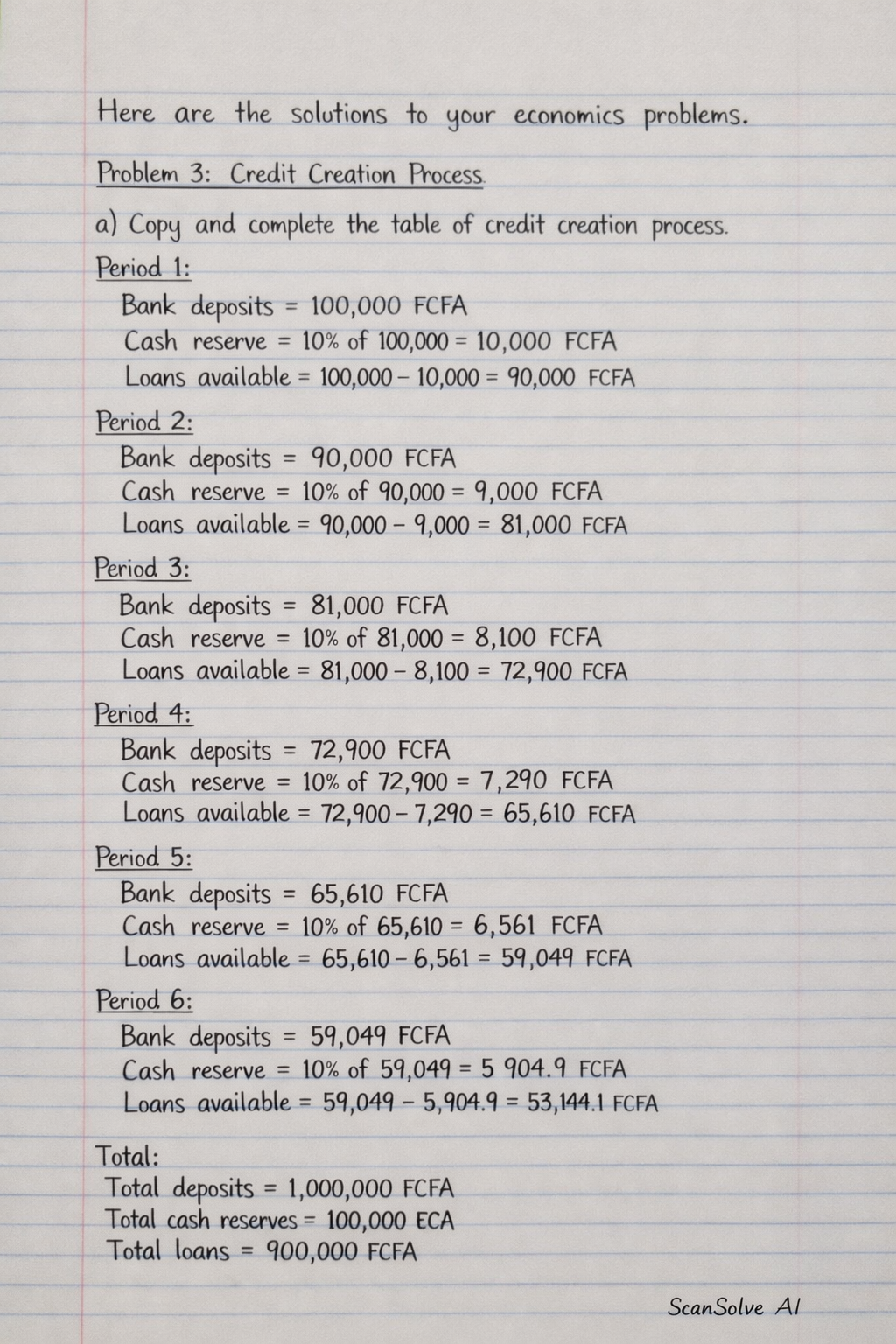
6 stepsHere are the solutions to your economics problems.
: Credit Creation Process
a) Copy and complete the table of credit creation process.
| Period | Bank deposits (FCFA) | Cash ratio 10% (FCFA) | Excess cash available for loans (FCFA) |
|---|---|---|---|
| 1 | 100,000 | 10,000 | 90,000 |
| 2 | 90,000 | 9,000 | 81,000 |
| 3 | 81,000 | 8,100 | 72,900 |
| 4 | 72,900 | 7,290 | 65,610 |
| 5 | 65,610 | 6,561 | 59,049 |
| 6 | 59,049 | 5,904.9 | 53,144.1 |
| Total | 1,000,000 | 100,000 | 900,000 |
b) Use the table to explain the process of credit creation.
Initial Deposit
An initial deposit of 100,000 FCFA is made into a bank (Period 1).
Reserve Requirement
The bank is required to hold 10% of this deposit as reserves (10,000 FCFA), as shown in the "Cash ratio 10%" column.
Lending Excess Reserves
The remaining 90,000 FCFA is excess cash, which the bank can lend out. When this amount is lent, it is typically redeposited into the banking system (Period 2).
Further Credit Creation
This redeposit of 90,000 FCFA becomes a new bank deposit. The bank then holds 10% (9,000 FCFA) as reserves and lends out the remaining 81,000 FCFA. This process continues, with each subsequent loan becoming a new deposit, leading to a continuous expansion of the money supply, as seen in Periods 3-6 and the "Total" row.
c) Calculate the bank multiplier and state its significance.
Calculate the bank multiplier.
The bank multiplier (or money multiplier) is calculated as the reciprocal of the cash ratio (reserve ratio).
State its significance.
The bank multiplier of 10 signifies that for every 1 FCFA of initial deposit, the banking system can potentially create 10 FCFA of new money through the process of lending and redepositing. This indicates the maximum potential expansion of the money supply.
d) State two limitations of credit creation.
- Public holding cash: If individuals or businesses choose to hold a portion of their loans as cash instead of redepositing it into banks, the actual amount of credit created will be less than the potential maximum.
- Lack of demand for loans: If banks have excess reserves but there is insufficient demand from creditworthy borrowers, banks cannot lend out all their excess cash, thus limiting the credit creation process.
e) How does the profitability objective of commercial banks conflict with security?
Commercial banks aim for profitability by lending out as much money as possible to earn interest. However, this objective can conflict with security, which requires banks to maintain sufficient liquidity and minimize risk. Lending too much, especially to high-risk borrowers, increases the chances of loan defaults and liquidity crises, threatening the bank's stability and security. Conversely, being overly cautious by holding excessive reserves or lending only to very low-risk borrowers reduces potential profits.
: Market Structures and Firm Behavior
a) Identify the four market structures described above.
- (i) A market for smartphones: Monopolistic Competition
- (ii) A single company holds exclusive rights to provide electricity: Monopoly
- (iii) The market for wheat: Perfect Competition
- (iv) A market for airline services: Oligopoly
b) Outline four conditions necessary for a market structure to be referred to as a perfect market.
- A large number of buyers and sellers, none of whom can influence the market price.
- Homogeneous products, meaning all goods offered by different sellers are identical.
- Free entry and exit for firms, with no barriers to joining or leaving the market.
- Perfect information for both buyers and sellers regarding prices, products, and market conditions.
c) State the conditions under which a firm will cease production in:
-
(i) The short run: A firm will cease production in the short run if the market price falls below its average variable cost (AVC). This means the firm cannot even cover its day-to-day operating expenses, and continuing production would lead to greater losses than shutting down temporarily.
-
(ii) In the long run: A firm will cease production in the long run if the market price falls below its average total cost (ATC). In the long run, all costs are variable, and if the firm cannot cover its total costs, it will exit the industry to avoid sustained losses.
Still stuck on this one?
Ask a follow-up, and the answer starts from this question.
More Accounting Questions
Handwritten Step-by-Step Solution
Get this as a handwritten image on WhatsApp — like a tutor wrote it for you.
Try on WhatsApp