We read your photo as:

Which ratio measures a firm's ability to meet its short-term obligations without relying on inventory?

Accounting

ScanSolve AI Answer

Step-by-step solution

10 steps

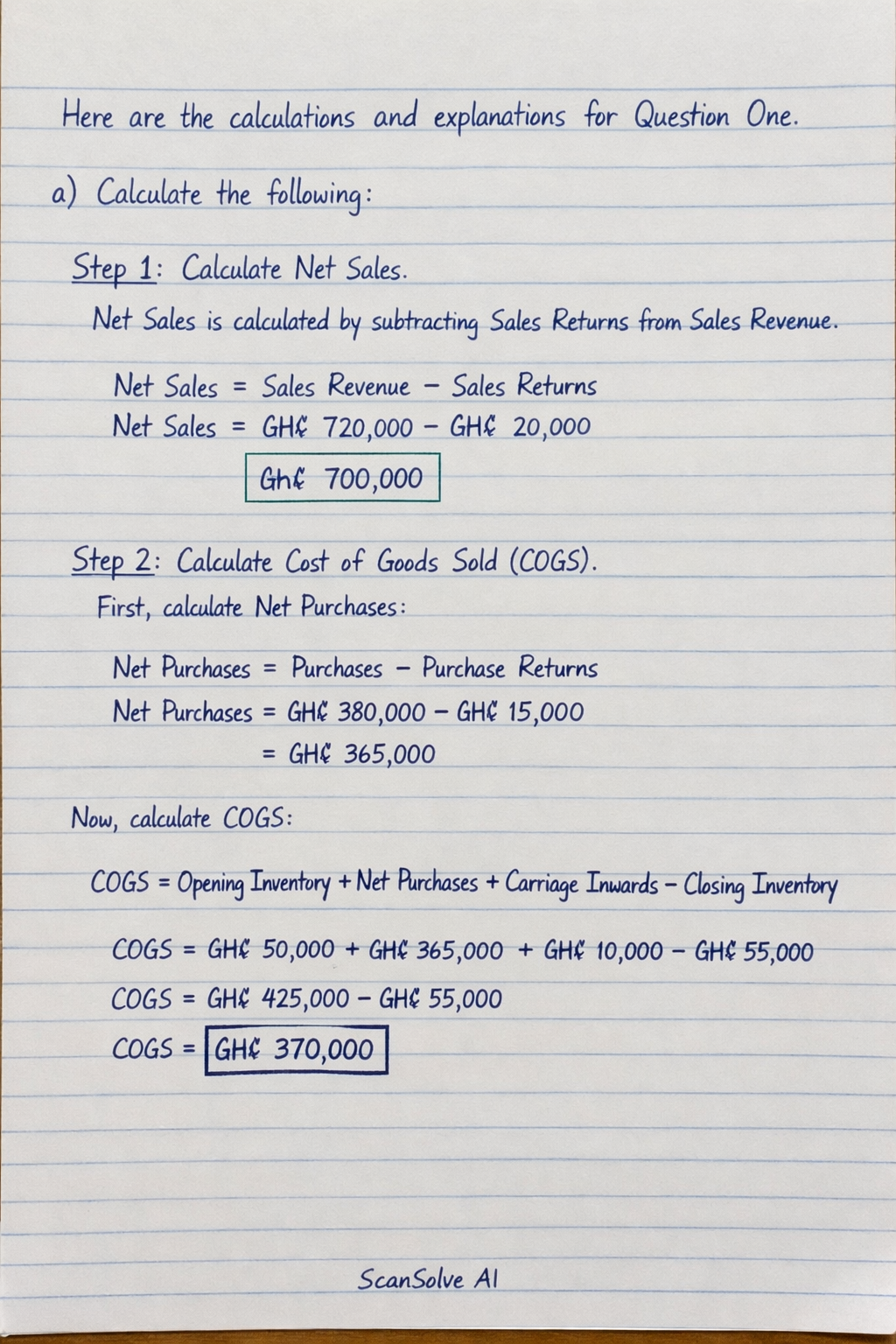
Here are the calculations and explanations for Question One.

Part a· 6 steps

Calculate the following

  1. Calculate Net Sales.

    Net Sales is calculated by subtracting Sales Returns from Sales Revenue.

    Net Sales=Sales Revenue−Sales Returns\text{Net Sales} = \text{Sales Revenue} - \text{Sales Returns} Net Sales=GH¢ 720,000−GH¢ 20,000\text{Net Sales} = \text{GH¢ } 720,000 - \text{GH¢ } 20,000 Net Sales=GH¢ 700,000\text{Net Sales} = \boxed{\text{GH¢ } \textbf{700,000}}
  2. Calculate Cost of Goods Sold (COGS).

    First, calculate Net Purchases.

    Net Purchases=Purchases−Purchase Returns\text{Net Purchases} = \text{Purchases} - \text{Purchase Returns} Net Purchases=GH¢ 380,000−GH¢ 15,000=GH¢ 365,000\text{Net Purchases} = \text{GH¢ } 380,000 - \text{GH¢ } 15,000 = \text{GH¢ } 365,000

    Now, calculate COGS.

    COGS=Opening Inventory+Net Purchases+Carriage Inwards−Closing Inventory\text{COGS} = \text{Opening Inventory} + \text{Net Purchases} + \text{Carriage Inwards} - \text{Closing Inventory} COGS=GH¢ 50,000+GH¢ 365,000+GH¢ 10,000−GH¢ 55,000\text{COGS} = \text{GH¢ } 50,000 + \text{GH¢ } 365,000 + \text{GH¢ } 10,000 - \text{GH¢ } 55,000 COGS=GH¢ 425,000−GH¢ 55,000\text{COGS} = \text{GH¢ } 425,000 - \text{GH¢ } 55,000 COGS=GH¢ 370,000\text{COGS} = \boxed{\text{GH¢ } \textbf{370,000}}
  3. Calculate Gross Profit.

    Gross Profit is Net Sales minus Cost of Goods Sold.

    Gross Profit=Net Sales−Cost of Goods Sold\text{Gross Profit} = \text{Net Sales} - \text{Cost of Goods Sold} Gross Profit=GH¢ 700,000−GH¢ 370,000\text{Gross Profit} = \text{GH¢ } 700,000 - \text{GH¢ } 370,000 Gross Profit=GH¢ 330,000\text{Gross Profit} = \boxed{\text{GH¢ } \textbf{330,000}}
  4. Calculate Net Profit after Tax.

    First, calculate Profit Before Tax.

    Profit Before Tax=Gross Profit−Operating Expenses−Interest Expense\text{Profit Before Tax} = \text{Gross Profit} - \text{Operating Expenses} - \text{Interest Expense} Profit Before Tax=GH¢ 330,000−GH¢ 110,000−GH¢ 15,000\text{Profit Before Tax} = \text{GH¢ } 330,000 - \text{GH¢ } 110,000 - \text{GH¢ } 15,000 Profit Before Tax=GH¢ 205,000\text{Profit Before Tax} = \text{GH¢ } 205,000

    Now, calculate Net Profit after Tax.

    Net Profit after Tax=Profit Before Tax−Income Tax Expense\text{Net Profit after Tax} = \text{Profit Before Tax} - \text{Income Tax Expense} Net Profit after Tax=GH¢ 205,000−GH¢ 12,000\text{Net Profit after Tax} = \text{GH¢ } 205,000 - \text{GH¢ } 12,000 Net Profit after Tax=GH¢ 193,000\text{Net Profit after Tax} = \boxed{\text{GH¢ } \textbf{193,000}}
  5. Calculate Total Current Assets.

    Total Current Assets include Cash, Trade Receivables, and Closing Inventory.

    Total Current Assets=Cash+Trade Receivables+Inventory\text{Total Current Assets} = \text{Cash} + \text{Trade Receivables} + \text{Inventory} Total Current Assets=GH¢ 40,000+GH¢ 90,000+GH¢ 55,000\text{Total Current Assets} = \text{GH¢ } 40,000 + \text{GH¢ } 90,000 + \text{GH¢ } 55,000 Total Current Assets=GH¢ 185,000\text{Total Current Assets} = \boxed{\text{GH¢ } \textbf{185,000}}
  6. Calculate Total Assets.

    Total Assets are the sum of Total Current Assets and Non-current Assets.

    Total Assets=Total Current Assets+Non-current Assets\text{Total Assets} = \text{Total Current Assets} + \text{Non-current Assets} Total Assets=GH¢ 185,000+GH¢ 480,000\text{Total Assets} = \text{GH¢ } 185,000 + \text{GH¢ } 480,000 Total Assets=GH¢ 665,000\text{Total Assets} = \boxed{\text{GH¢ } \textbf{665,000}}

Part b· 4 steps

Calculate the following ratios

  1. Calculate Quick Ratio.

    Quick Ratio=Cash+Trade ReceivablesCurrent Liabilities\text{Quick Ratio} = \frac{\text{Cash} + \text{Trade Receivables}}{\text{Current Liabilities}} Quick Ratio=GH¢ 40,000+GH¢ 90,000GH¢ 125,000\text{Quick Ratio} = \frac{\text{GH¢ } 40,000 + \text{GH¢ } 90,000}{\text{GH¢ } 125,000} Quick Ratio=GH¢ 130,000GH¢ 125,000\text{Quick Ratio} = \frac{\text{GH¢ } 130,000}{\text{GH¢ } 125,000} Quick Ratio=1.04 times\text{Quick Ratio} = \boxed{\textbf{1.04 times}}
  2. Calculate Gross Profit Margin.

    Gross Profit Margin=Gross ProfitNet Sales×100%\text{Gross Profit Margin} = \frac{\text{Gross Profit}}{\text{Net Sales}} \times 100\% Gross Profit Margin=GH¢ 330,000GH¢ 700,000×100%\text{Gross Profit Margin} = \frac{\text{GH¢ } 330,000}{\text{GH¢ } 700,000} \times 100\% Gross Profit Margin=0.471428×100%\text{Gross Profit Margin} = 0.471428 \times 100\% Gross Profit Margin=47.14%\text{Gross Profit Margin} = \boxed{\textbf{47.14\%}}
  3. Calculate Inventory Turnover.

    First, calculate Average Inventory.

    Average Inventory=Opening Inventory+Closing Inventory2\text{Average Inventory} = \frac{\text{Opening Inventory} + \text{Closing Inventory}}{2} Average Inventory=GH¢ 50,000+GH¢ 55,0002\text{Average Inventory} = \frac{\text{GH¢ } 50,000 + \text{GH¢ } 55,000}{2} Average Inventory=GH¢ 105,0002=GH¢ 52,500\text{Average Inventory} = \frac{\text{GH¢ } 105,000}{2} = \text{GH¢ } 52,500

    Now, calculate Inventory Turnover.

    Inventory Turnover=Cost of Goods SoldAverage Inventory\text{Inventory Turnover} = \frac{\text{Cost of Goods Sold}}{\text{Average Inventory}} Inventory Turnover=GH¢ 370,000GH¢ 52,500\text{Inventory Turnover} = \frac{\text{GH¢ } 370,000}{\text{GH¢ } 52,500} Inventory Turnover=7.05 times\text{Inventory Turnover} = \boxed{\textbf{7.05 times}}
  4. Calculate Interest Coverage Ratio.

    First, calculate Earnings Before Interest and Taxes (EBIT).

    EBIT=Gross Profit−Operating Expenses\text{EBIT} = \text{Gross Profit} - \text{Operating Expenses} EBIT=GH¢ 330,000−GH¢ 110,000=GH¢ 220,000\text{EBIT} = \text{GH¢ } 330,000 - \text{GH¢ } 110,000 = \text{GH¢ } 220,000

    Now, calculate Interest Coverage Ratio.

    Interest Coverage Ratio=EBITInterest Expense\text{Interest Coverage Ratio} = \frac{\text{EBIT}}{\text{Interest Expense}} Interest Coverage Ratio=GH¢ 220,000GH¢ 15,000\text{Interest Coverage Ratio} = \frac{\text{GH¢ } 220,000}{\text{GH¢ } 15,000} Interest Coverage Ratio=14.67 times\text{Interest Coverage Ratio} = \boxed{\textbf{14.67 times}}

Part c(i)

Explain TWO (2) objectives of Financial Management.

Answer the following theory questions

  • Wealth Maximization: The primary objective of financial management is to maximize the wealth of the shareholders. This is achieved by increasing the market value of the company's shares, considering both risk and the time value of money.
  • Profit Maximization: This objective aims to maximize the firm's profits. While important for business survival, it is often considered a short-term goal and does not account for risk or the timing of returns.

Part c(ii)

State FOUR (4) factors that influence financing decisions.

  • Cost of Financing: The interest rate or dividend yield associated with different sources of funds.
  • Risk: The level of financial risk introduced by debt (fixed payments) versus equity (no fixed payments).
  • Control: The impact of new financing on the ownership and control structure of the company.
  • Flexibility: The ability to raise additional funds in the future and adapt to changing financial needs.
Was this helpful?

Still stuck on this one?

Ask a follow-up, and the answer starts from this question.

Got a different question?Ask your own question
Handwritten step-by-step solution preview

Handwritten Step-by-Step Solution

Get this as a handwritten image on WhatsApp — like a tutor wrote it for you.

Try on WhatsApp