
We read your photo as:
1a) Define carbohydrates and classify them with suitable examples. 1b) Outline the major steps of glycolysis.
ScanSolve AI Answer
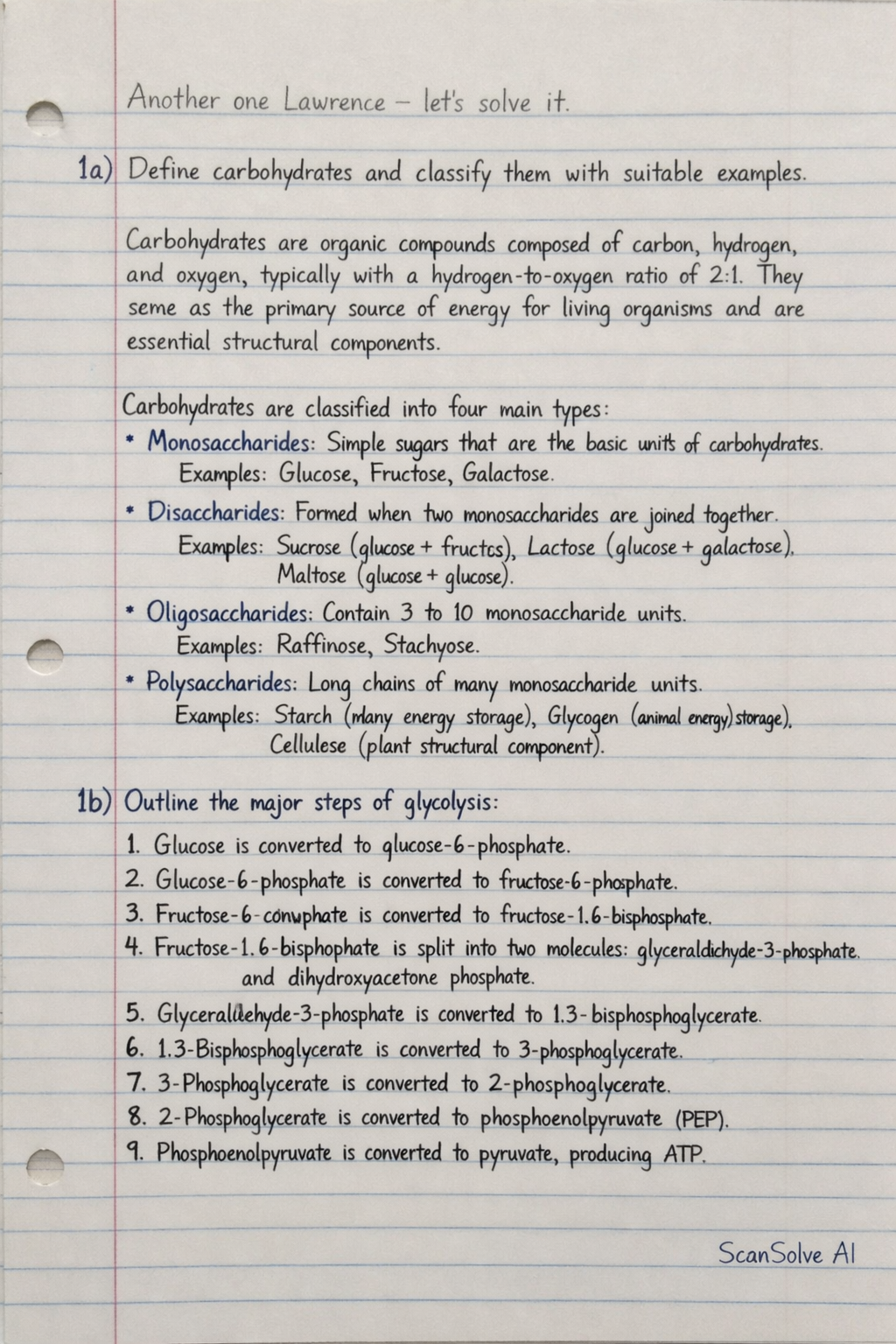
1a) Define carbohydrates and classify them with suitable examples.
Carbohydrates are organic compounds composed of carbon, hydrogen, and oxygen, typically with a hydrogen-to-oxygen ratio of 2:1. They serve as the primary source of energy for living organisms and are essential structural components.
Carbohydrates are classified into four main types:
- Monosaccharides: Simple sugars that are the basic units of carbohydrates.
- Examples: Glucose, Fructose, Galactose.
- Disaccharides: Formed when two monosaccharides are joined together.
- Examples: Sucrose (glucose + fructose), Lactose (glucose + galactose), Maltose (glucose + glucose).
- Oligosaccharides: Contain 3 to 10 monosaccharide units.
- Examples: Raffinose, Stachyose.
- Polysaccharides: Long chains of many monosaccharide units.
- Examples: Starch (plant energy storage), Glycogen (animal energy storage), Cellulose (plant structural component).
1b) Outline the major steps of glycolysis.
Glycolysis is a metabolic pathway that converts glucose into pyruvate, producing ATP and NADH. It occurs in the cytoplasm and consists of 10 steps, broadly divided into two phases:
Energy-Investment Phase:
- Phosphorylation of Glucose: Glucose is phosphorylated by hexokinase, using 1 ATP, to form Glucose-6-phosphate.
- Isomerization: Glucose-6-phosphate is converted to Fructose-6-phosphate.
- Phosphorylation of Fructose-6-phosphate: Fructose-6-phosphate is phosphorylated by phosphofructokinase-1, using another 1 ATP, to form Fructose-1,6-bisphosphate.
- Cleavage: Fructose-1,6-bisphosphate is split into two 3-carbon molecules: Dihydroxyacetone phosphate (DHAP) and Glyceraldehyde-3-phosphate (G3P).
- Isomerization: DHAP is converted to G3P, resulting in two molecules of G3P.
Energy-Payoff Phase (occurs twice for each glucose molecule): 6. Oxidation and Phosphorylation: Each G3P is oxidized and phosphorylated to 1,3-Bisphosphoglycerate, producing 1 NADH. 7. ATP Production: 1,3-Bisphosphoglycerate transfers a phosphate group to ADP, forming 1 ATP and 3-Phosphoglycerate. 8. Rearrangement: 3-Phosphoglycerate is converted to 2-Phosphoglycerate. 9. Dehydration: 2-Phosphoglycerate is dehydrated to Phosphoenolpyruvate (PEP). 10. ATP Production: PEP transfers a phosphate group to ADP, forming 1 ATP and Pyruvate.
Net products per glucose molecule:
Still stuck on this one?
Ask a follow-up, and the answer starts from this question.
More Biology Questions
Handwritten Step-by-Step Solution
Get this as a handwritten image on WhatsApp — like a tutor wrote it for you.
Try on WhatsApp