
We read your photo as:
Outline the glycolytic pathway, indicate the regulatory and energy-related steps, and define substrate-level phosphorylation and enumerate the two high-energy compounds in the pathway.
ScanSolve AI Answer
Answer
Step-by-step solution
3 stepsHere are the answers to the biochemistry test questions.
1. Glycolysis
Part a
Outline the glycolytic pathway.
Glycolysis is a 10-step metabolic pathway that breaks down one molecule of glucose into two molecules of pyruvate, producing ATP and NADH. It occurs in the cytoplasm.
The pathway involves two main phases:
- Energy-investment phase (Steps 1-5): Glucose is phosphorylated twice and cleaved into two molecules of glyceraldehyde-3-phosphate, consuming 2 ATP.
- Energy-payoff phase (Steps 6-10): The two glyceraldehyde-3-phosphate molecules are converted to pyruvate, producing 4 ATP (via substrate-level phosphorylation) and 2 NADH.
Part b· 3 steps
Indicate the regulatory and energy-related steps.
- Regulatory steps (irreversible steps):
Glucose to Glucose-6-phosphate (catalyzed by Hexokinase).
Fructose-6-phosphate to Fructose-1,6-bisphosphate (catalyzed by Phosphofructokinase-1).
Phosphoenolpyruvate to Pyruvate (catalyzed by Pyruvate Kinase).
- Energy-related steps:
- ATP consumption: Step 1 (Hexokinase) and Step 3 (Phosphofructokinase-1).
- ATP production: Step 7 (Phosphoglycerate Kinase) and Step 10 (Pyruvate Kinase).
- NADH production: Step 6 (Glyceraldehyde-3-phosphate Dehydrogenase).
- Energy-related steps:
Part c
Define substrate-level phosphorylation and enumerate the two high-energy compounds in the pathway.
- Substrate-level phosphorylation is a metabolic reaction that produces ATP (or GTP) by the direct transfer of a phosphate group from a high-energy substrate molecule to ADP (or GDP). It does not require oxygen or an electron transport chain.
- The two high-energy compounds in glycolysis that participate in substrate-level phosphorylation are:
- 1,3-Bisphosphoglycerate
- Phosphoenolpyruvate (PEP)
Part d
Calculate the net ATP molecules produced, assuming two molecules of glucose are oxidized anaerobically.
For one molecule of glucose oxidized anaerobically:
- ATP consumed: 2
- ATP produced via substrate-level phosphorylation: 4
- Net ATP per glucose: ATP For two molecules of glucose oxidized anaerobically:
Part e
Explain, with reasons, how the pathway can lead to lactic acidosis.
Under anaerobic conditions (e.g., intense exercise, hypoxia), the electron transport chain cannot reoxidize NADH to . To sustain glycolysis and continue ATP production, pyruvate is converted to lactate by the enzyme lactate dehydrogenase. This reaction regenerates from NADH. The accumulation of lactate (lactic acid) in the blood lowers the blood pH, leading to a condition called lactic acidosis.
Part f
How can you diagnose lactic acidosis when anaerobic glycolysis is the cause?
Lactic acidosis can be diagnosed by measuring:
- Elevated blood lactate levels (typically above 4-5 mmol/L).
- Decreased blood pH (acidemia, usually below 7.35).
- Decreased serum bicarbonate levels (due to buffering of the excess acid).
- An increased anion gap in blood tests.
2. Gluconeogenesis is not a reversal of glycolysis. Discuss.
Gluconeogenesis is the metabolic pathway that synthesizes glucose from non-carbohydrate precursors. While it shares many enzymes with glycolysis, it is not a simple reversal because it bypasses the three irreversible steps of glycolysis using different enzymes. These irreversible steps in glycolysis are catalyzed by hexokinase, phosphofructokinase-1, and pyruvate kinase.
The bypass reactions in gluconeogenesis are:
- Pyruvate to Phosphoenolpyruvate (PEP): This involves two steps. Pyruvate is first converted to oxaloacetate by pyruvate carboxylase (in mitochondria), then oxaloacetate is converted to PEP by PEP carboxykinase (in cytoplasm or mitochondria). This bypasses the pyruvate kinase step of glycolysis.
- Fructose-1,6-bisphosphate to Fructose-6-phosphate: This is catalyzed by fructose-1,6-bisphosphatase, bypassing the phosphofructokinase-1 step.
- Glucose-6-phosphate to Glucose: This is catalyzed by glucose-6-phosphatase (primarily in the liver and kidney), bypassing the hexokinase step.
These bypasses are crucial because the glycolytic reactions they replace are highly exergonic and irreversible, making a direct reversal energetically unfavorable. Using different enzymes for these steps allows for independent regulation of glycolysis and gluconeogenesis, preventing a futile cycle where both pathways operate simultaneously and waste energy.
Try one yourself
A new problem that tests the same skill.
Still stuck on this one?
Ask a follow-up, and the answer starts from this question.
More Chemistry Questions
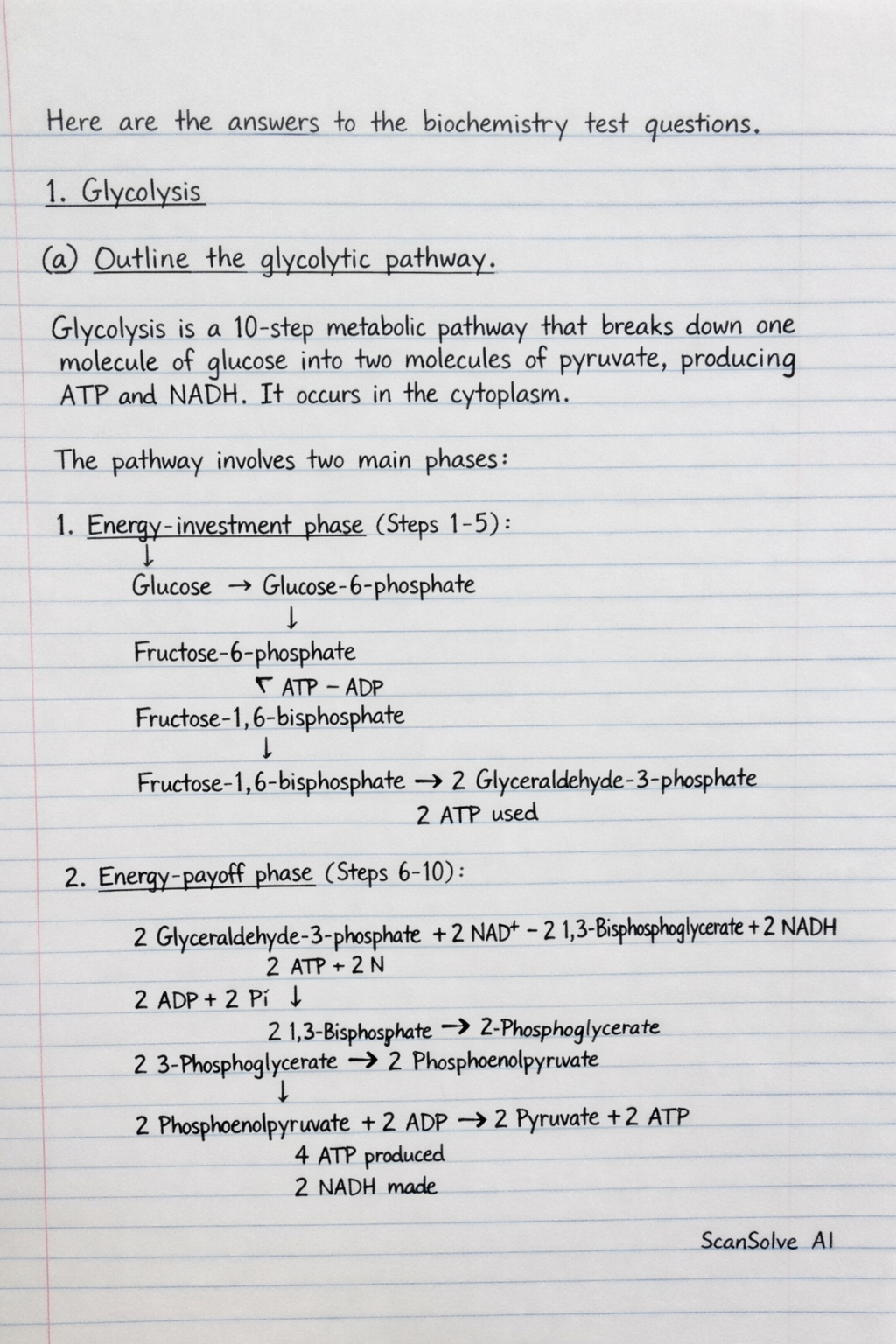
Handwritten Step-by-Step Solution
Get this as a handwritten image on WhatsApp — like a tutor wrote it for you.
Try on WhatsApp