
We read your photo as:
A) To explain how a useful gene can be transferred from a human pancreas cell into a bacterium and cultured to produce a useful product:
ScanSolve AI Answer
Step-by-step solution
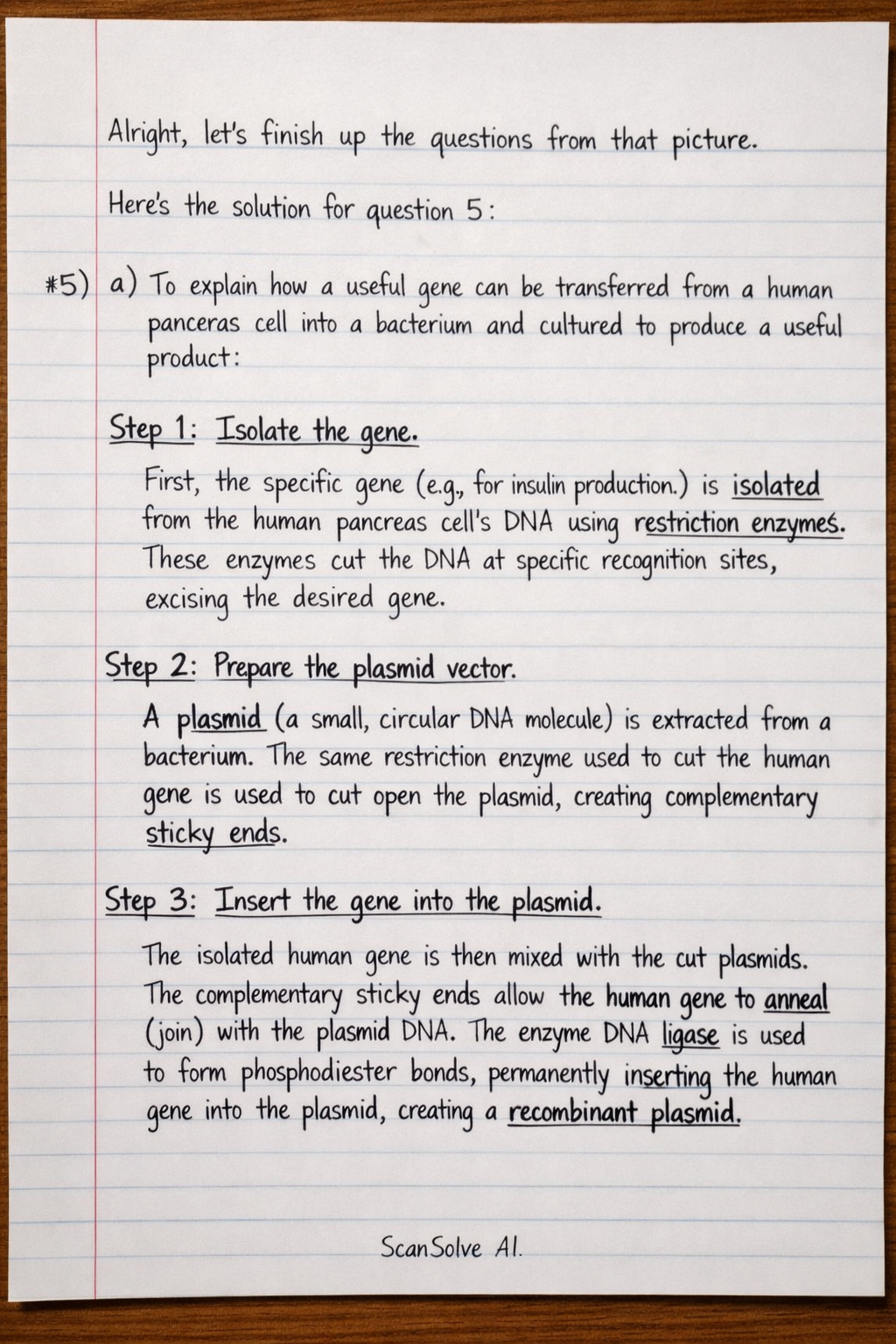
6 stepsAlright, let's finish up the questions from that picture.
Here's the solution for question 5:
5) a) To explain how a useful gene can be transferred from a human pancreas cell into a bacterium and cultured to produce a useful product:
Isolate the gene.
First, the specific gene (e.g., for insulin production) is isolated from the human pancreas cell's DNA using restriction enzymes. These enzymes cut the DNA at specific recognition sites, excising the desired gene.
Prepare the plasmid vector.
A plasmid (a small, circular DNA molecule) is extracted from a bacterium. The same restriction enzyme used to cut the human gene is used to cut open the plasmid, creating complementary sticky ends.
Insert the gene into the plasmid.
The isolated human gene is then mixed with the cut plasmids. The complementary sticky ends allow the human gene to anneal (join) with the plasmid DNA. The enzyme DNA ligase is used to form phosphodiester bonds, permanently inserting the human gene into the plasmid, creating a recombinant plasmid.
Transform the bacterium.
The recombinant plasmid is then introduced back into a host bacterium (e.g., E. coli) through a process called transformation. The bacteria are often treated to make their cell membranes permeable, allowing the plasmid to enter.
Culture in a bioreactor.
The transformed bacteria are then grown in large quantities in an industrial bioreactor. The bioreactor provides optimal conditions (temperature, pH, nutrients, oxygen) for bacterial growth and reproduction. As the bacteria multiply, they express the inserted human gene, producing the desired protein (e.g., human insulin).
Harvest and purify the product.
Once sufficient product has been synthesized, the bacteria are harvested, and the desired product (e.g., insulin) is extracted and purified for use.
b) Four reasons for using microorganisms in biotechnological processes are:
- Rapid growth rate: Microorganisms reproduce very quickly, allowing for large quantities of products to be generated in a short time.
- Simple nutritional requirements: They can often grow on relatively inexpensive and simple nutrient media, making large-scale production cost-effective.
- Genetic manipulability: Their simple genetic structure makes them easy to genetically engineer, allowing for the introduction of foreign genes to produce desired products.
- Production of complex molecules: Microorganisms can synthesize complex organic molecules, including proteins, enzymes, and antibiotics, which are difficult or impossible to produce through chemical synthesis.
Here's the solution for question 6:
6) a) Biotechnology is the application of biological organisms, systems, or processes to develop or make products for specific uses. It involves using living systems and organisms to create or modify products or processes for practical purposes.
b) The value of biotechnology in a biotechnological process lies in its ability to harness the natural capabilities of living organisms to produce substances or perform tasks that are beneficial to humans. For example, it enables the efficient production of pharmaceuticals like insulin and vaccines, the development of genetically modified crops with improved yields or pest resistance, and the creation of bioremediation solutions for environmental cleanup. It offers sustainable and often more efficient alternatives to traditional chemical or mechanical processes.
Still stuck on this one?
Ask a follow-up, and the answer starts from this question.
More Biology Questions
Handwritten Step-by-Step Solution
Get this as a handwritten image on WhatsApp — like a tutor wrote it for you.
Try on WhatsApp