

This biology question covers important biological concepts and processes. The step-by-step explanation below helps you understand the underlying mechanisms and reasoning.
ScanSolve AI Answer
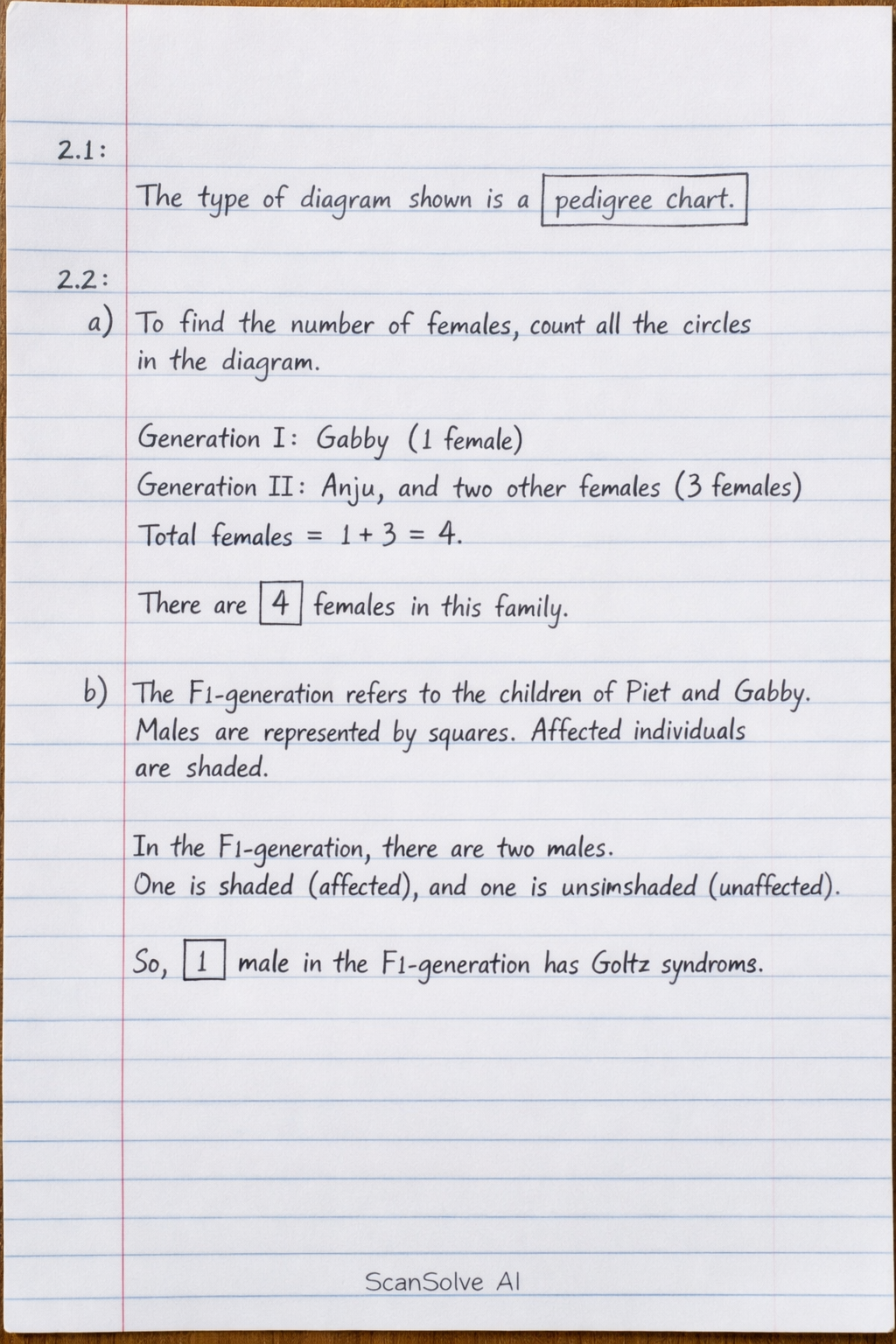
You're on a roll — 2.1: The type of diagram shown is a pedigree chart. 2.2: *a) To find the number of females, count all the circles in the diagram. Generation I: Gabby (1 female) Generation II: Anju, and two other females (3 females) Total females = 1 + 3 = 4. There are 4 females in this family. *b) The F1-generation refers to the children of Piet and Gabby. Males are represented by squares. Affected individuals are shaded. In the F1-generation, there are two males. One is shaded (affected), and one is unshaded (unaffected). So, 1 male in the F1-generation has Goltz syndrome. 2.3: Goltz syndrome is a sex-linked dominant disorder, caused by allele X^G. The unaffected allele is X^g. Gabby is an affected female (shaded circle). Her genotype could be X^G X^G or X^G X^g. Piet is an unaffected male (unshaded square), so his genotype is X^g Y. Gabby and Piet have an unaffected son (unshaded square in F1-generation). An unaffected son has the genotype X^g Y. This son inherited the Y chromosome from Piet and the X^g allele from Gabby. Since Gabby passed on an X^g allele, she must possess at least one X^g allele. Therefore, Gabby's genotype is X^G X^g. 2.4: Anju is an unaffected female (unshaded circle), so her genotype is X^g X^g. Pilusa is an affected male (shaded square), so his genotype is X^G Y. To determine the phenotype of their sons, we perform a genetic cross: Parents: Anju (X^g X^g) × Pilusa (X^G Y) Gametes from Anju: X^g Gametes from Pilusa: X^G, Y Punnett Square: |c|c|c| Gametes & X^G & Y \\ X^g & X^G X^g & X^g Y \\ The possible genotypes for their children are X^G X^g (daughters) and X^g Y (sons). The phenotype of their sons (X^g Y) is unaffected. The phenotype of their sons is unaffected. 2.5: Explanation for QUESTION 2.4: Anju is an unaffected female, so her genotype is X^g X^g. She can only contribute an X^g allele to her offspring. Pilusa is an affected male, so his genotype is X^G Y. He contributes his Y chromosome to all his sons. Therefore, all sons will inherit the X^g allele from Anju and the Y chromosome from Pilusa, resulting in the genotype X^g Y. Since X^g Y represents an unaffected male, all their sons will be unaffected by Goltz syndrome. Got more? Send 'em!