
We read your photo as:
Explain the inheritance pattern of Congenital Adrenal Hyperplasia (CAH), assuming it's an autosomal recessive condition.
ScanSolve AI Answer
Step-by-step solution
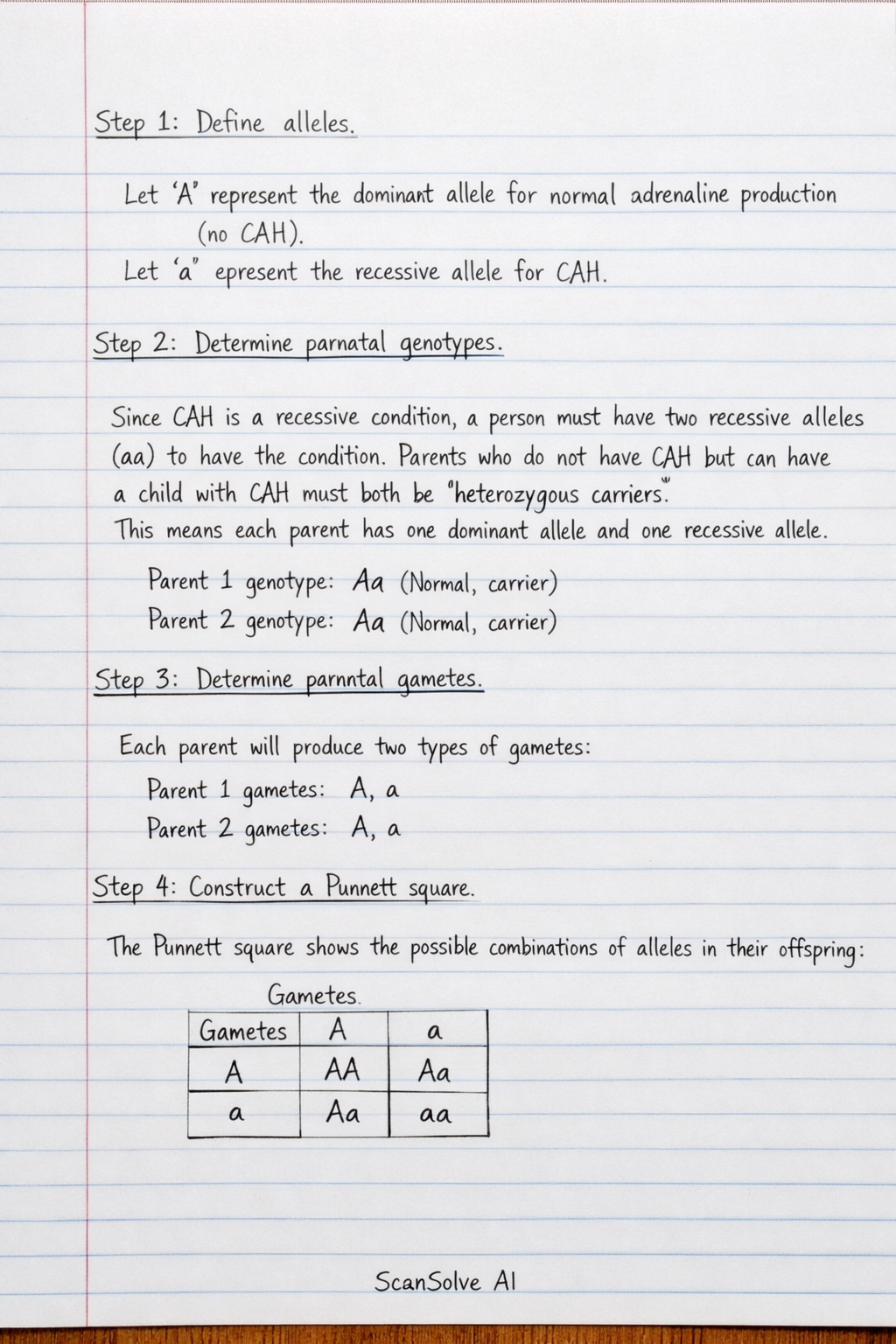
5 stepsDefine alleles.
Let 'A' represent the dominant allele for normal adrenaline production (no CAH).
Let 'a' represent the recessive allele for CAH.Determine parental genotypes.
Since CAH is a recessive condition, a person must have two recessive alleles () to have the condition. Parents who do not have CAH but can have a child with CAH must both be heterozygous carriers. This means each parent has one dominant allele and one recessive allele.
Parent 1 genotype: (Normal, carrier)
Parent 2 genotype: (Normal, carrier)Determine parental gametes.
Each parent will produce two types of gametes:
Parent 1 gametes: A, a
Parent 2 gametes: A, aConstruct a Punnett square.
The Punnett square shows the possible combinations of alleles in their offspring.
Explain offspring genotypes and phenotypes.
From the Punnett square, the possible genotypes for the offspring are:
- : 25% chance (Normal, non-carrier)
- : 50% chance (Normal, carrier)
- : 25% chance (Has CAH)
Explanation:
When both parents are heterozygous carriers (), there is a 25% probability that their child will inherit the recessive allele () from each parent, resulting in the genotype . A child with the genotype will express the recessive condition, CAH, even though neither parent has the condition themselves.Here is the genetic diagram:
Parents' phenotypes: Normal (no CAH) Normal (no CAH)
Parents' genotypes:
Parents' gametes:Punnett Square:
Offspring genotypes:
Offspring phenotypes: 3 Normal (no CAH) : 1 CAHThis diagram shows that there is a 1 in 4 chance for parents who are both carriers () to have a child with CAH ().
Still stuck on this one?
Ask a follow-up, and the answer starts from this question.
More Biology Questions
Handwritten Step-by-Step Solution
Get this as a handwritten image on WhatsApp — like a tutor wrote it for you.
Try on WhatsApp