
We read your photo as:
Which of the following questions is the solution answering: 15. "Brian is pressing a shell into clay." What type of fossil is Brian trying to make? 16. "A paleontologist found the droppings of a dinos
ScanSolve AI Answer
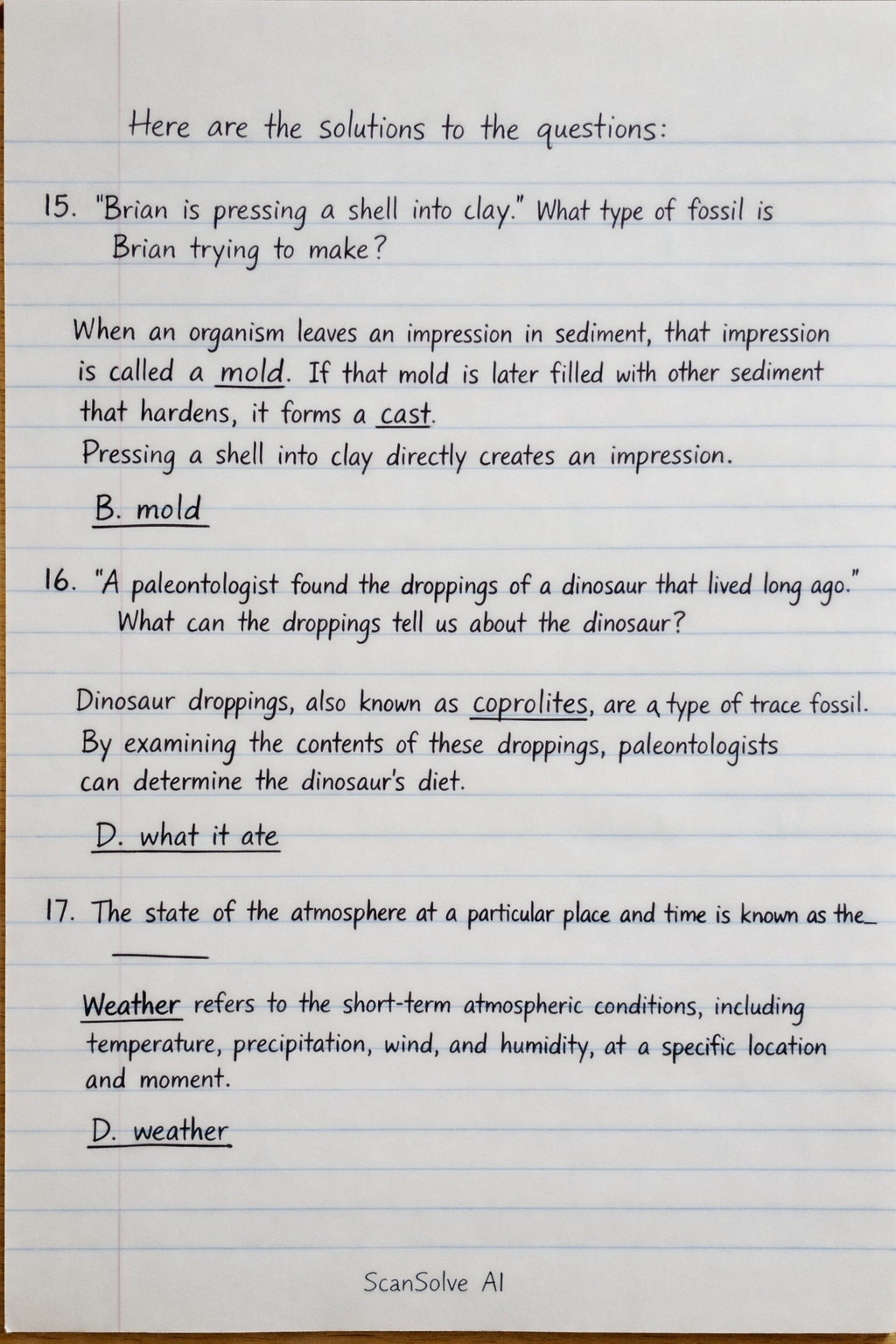
Here are the solutions to the questions:
-
"Brian is pressing a shell into clay." What type of fossil is Brian trying to make? When an organism leaves an impression in sediment, that impression is called a mold. If that mold is later filled with other sediment that hardens, it forms a cast. Pressing a shell into clay directly creates an impression. B. mold
-
"A paleontologist found the droppings of a dinosaur that lived long ago." What can the droppings tell us about the dinosaur? Dinosaur droppings, also known as coprolites, are a type of trace fossil. By examining the contents of these droppings, paleontologists can determine the dinosaur's diet. D. what it ate
-
The state of the atmosphere at a particular place and time is known as the ____. Weather refers to the short-term atmospheric conditions, including temperature, precipitation, wind, and humidity, at a specific location and moment. D. weather.
-
"In The Bahamas, the temperature always reaches over 80° during the summertime." What does this statement describe? This statement describes a general, long-term pattern of temperature for a specific season in a particular geographical area. This long-term pattern is known as climate. B. climate
The final answer for 15 is
The final answer for 16 is
The final answer for 17 is
The final answer for 18 is
Still stuck on this one?
Ask a follow-up, and the answer starts from this question.
More Biology Questions
Handwritten Step-by-Step Solution
Get this as a handwritten image on WhatsApp — like a tutor wrote it for you.
Try on WhatsApp