

This biology question covers important biological concepts and processes. The step-by-step explanation below helps you understand the underlying mechanisms and reasoning.
ScanSolve AI Answer
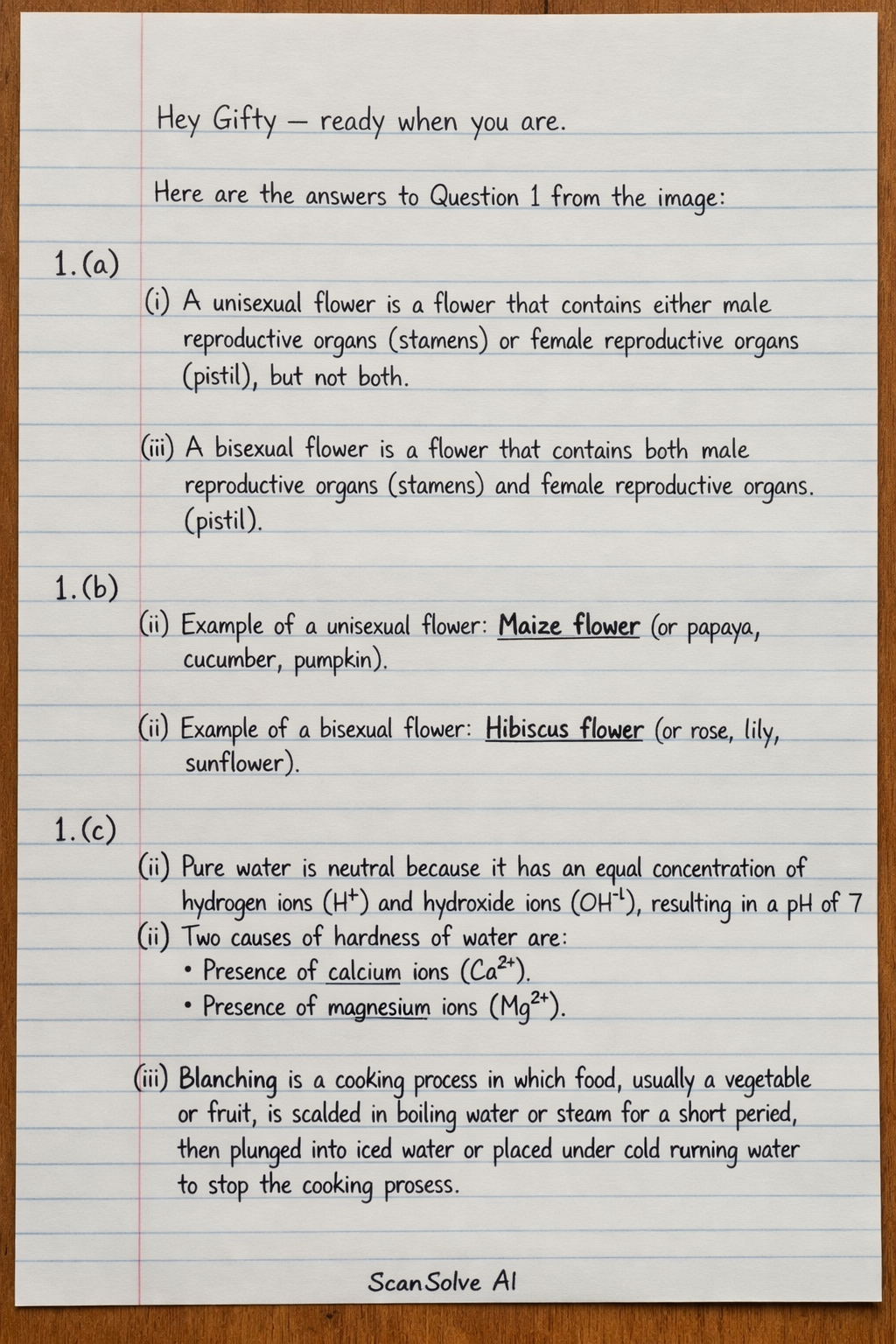
Hey Gifty — ready when you are. Here are the answers to Question 1 from the image: 1. (a) (i) A unisexual flower is a flower that contains either male reproductive organs (stamens) or female reproductive organs (pistil), but not both. (ii) A bisexual flower is a flower that contains both male reproductive organs (stamens) and female reproductive organs (pistil). 1. (b) (i) Example of a unisexual flower: Maize flower (or papaya, cucumber, pumpkin). (ii) Example of a bisexual flower: Hibiscus flower (or rose, lily, sunflower). 1. (c) (i) Pure water is neutral because it has an equal concentration of hydrogen ions (H^+) and hydroxide ions (OH^-), resulting in a pH of 7. (ii) Two causes of hardness of water are: • Presence of calcium ions (Ca^2+) • Presence of magnesium ions (Mg^2+) (iii) Blanching is a cooking process in which food, usually a vegetable or fruit, is scalded in boiling water or steam for a short period, then plunged into iced water or placed under cold running water to stop the cooking process. 1. (d) (i) Three reasons for weaning piglets: • To reduce stress on the sow (mother pig) and allow her to recover and prepare for the next breeding cycle. • To allow piglets to transition to solid food, promoting faster growth and development. • To prevent the spread of diseases from the sow to the piglets. (ii) Three components of the middle ear of humans: • Malleus (hammer) • Incus (anvil) • Stapes (stirrup) (iii) Function of two of the components named in (ii): • Malleus: Transmits sound vibrations from the eardrum to the incus. • Stapes: Transmits sound vibrations from the incus to the oval window of the inner ear. Drop the next question.