
We read your photo as:
Answer the following questions: (a) State four reasons why farmers should be discouraged from using chemical fertilizers. (b) Define temporary hard water and show the chemical equation for softening i
ScanSolve AI Answer
here are the answers to question 2:
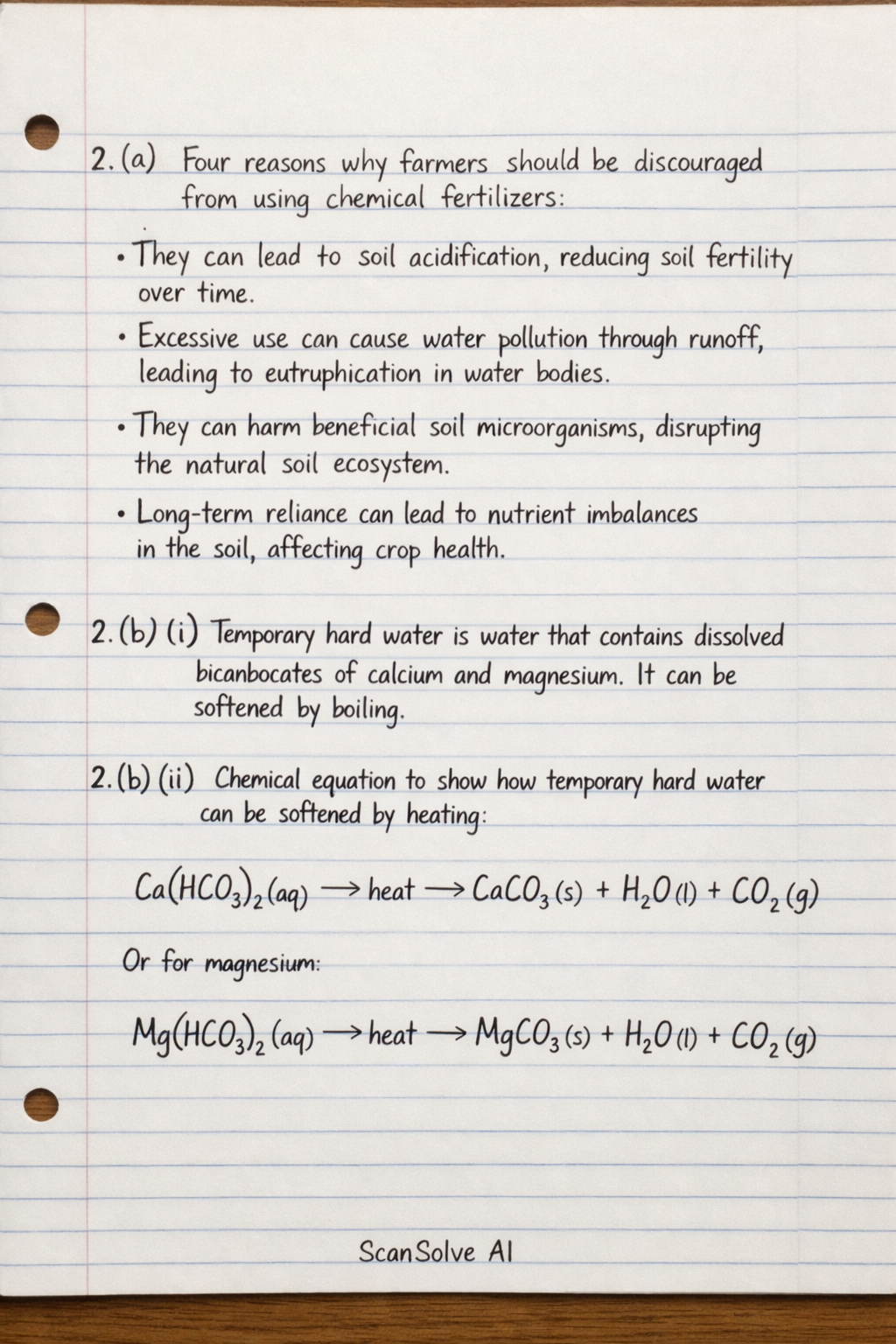
2. (a) Four reasons why farmers should be discouraged from using chemical fertilizers:
- They can lead to soil acidification, reducing soil fertility over time.
- Excessive use can cause water pollution through runoff, leading to eutrophication in water bodies.
- They can harm beneficial soil microorganisms, disrupting the natural soil ecosystem.
- Long-term reliance can lead to nutrient imbalances in the soil, affecting crop health.
2. (b) (i) Temporary hard water is water that contains dissolved bicarbonates of calcium and magnesium. It can be softened by boiling.
2. (b) (ii) Chemical equation to show how temporary hard water can be softened by heating:
Or for magnesium:
2. (c) (i) A lever is a simple machine consisting of a rigid bar that pivots around a fixed point called a fulcrum, used to multiply force or change the direction of force.
2. (c) (ii) Explanation of terms as applied to simple machines:
- (α) Mechanical advantage: This is the ratio of the load (resistance force) to the effort (applied force). It indicates how much a machine multiplies the input force.
- (β) Velocity ratio: This is the ratio of the distance moved by the effort to the distance moved by the load in the same time. It is a theoretical value that depends only on the geometry of the machine.
2. (d) (i) Food processing is any method used to transform raw ingredients into food or to transform food into other forms for consumption by humans or animals. It involves various physical and chemical operations.
2. (d) (ii)
- (α) Two advantages of food processing:
- It preserves food, extending its shelf life and reducing spoilage.
- It makes food safer by eliminating harmful microorganisms and toxins.
- (β) One disadvantage of food processing:
- It can lead to a loss of nutrients (e.g., vitamins) during processing.
Still stuck on this one?
Ask a follow-up, and the answer starts from this question.
More Chemistry Questions
Handwritten Step-by-Step Solution
Get this as a handwritten image on WhatsApp — like a tutor wrote it for you.
Try on WhatsApp