
We read your photo as:
Explain the disadvantages of chemical fertilizers and the process of softening temporary hard water, including its chemical equation.
ScanSolve AI Answer
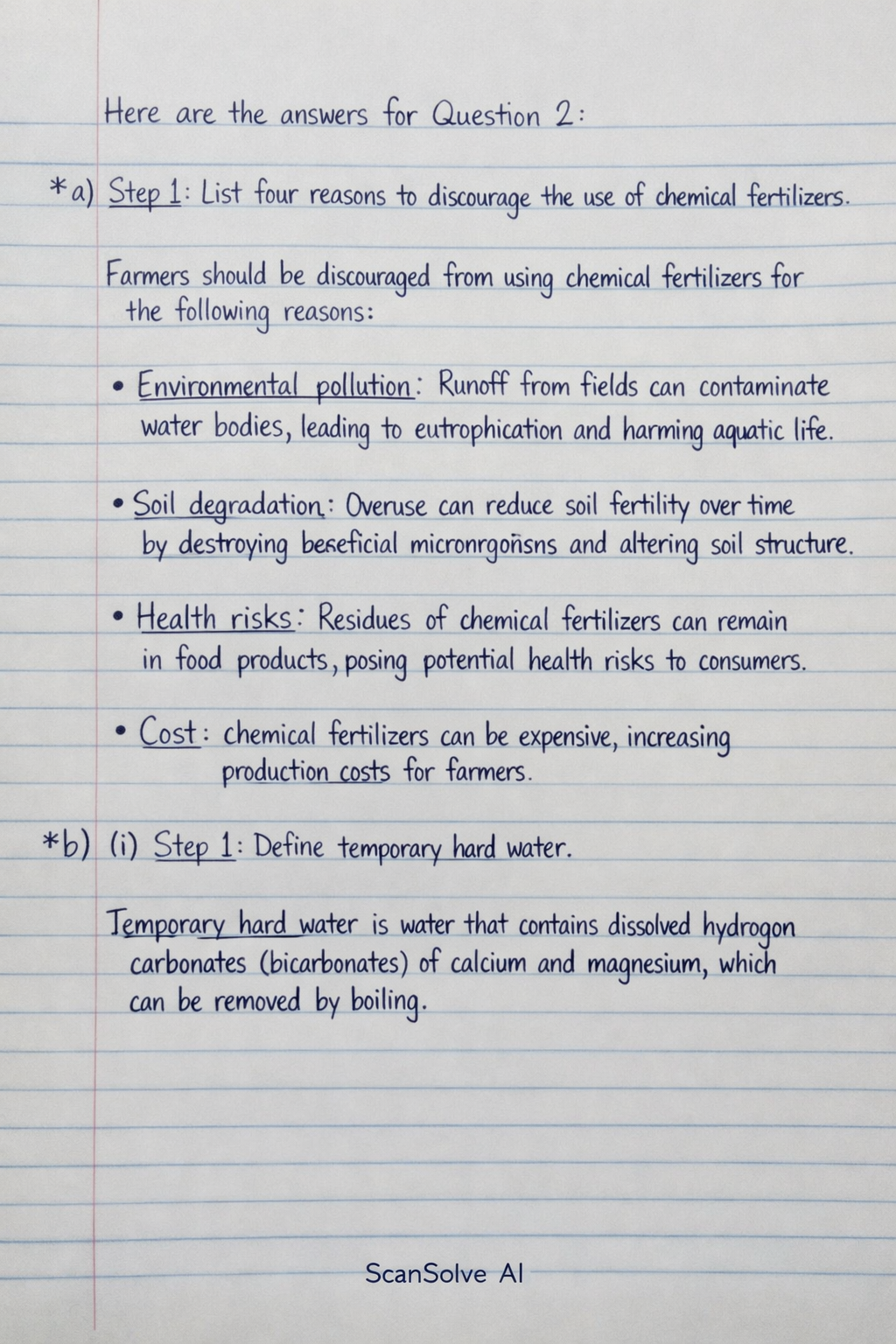
Here are the answers for Question 2:
a) Step 1: List four reasons to discourage the use of chemical fertilizers.
Farmers should be discouraged from using chemical fertilizers for the following reasons:
- Environmental pollution: Runoff from fields can contaminate water bodies, leading to eutrophication and harming aquatic life.
- Soil degradation: Overuse can reduce soil fertility over time by destroying beneficial microorganisms and altering soil structure.
- Health risks: Residues of chemical fertilizers can remain in food products, posing potential health risks to consumers.
- Cost: Chemical fertilizers can be expensive, increasing production costs for farmers.
b) (i) Step 1: Define temporary hard water.
Temporary hard water is water that contains dissolved hydrogen carbonates (bicarbonates) of calcium and magnesium, which can be removed by boiling.
b) (ii) Step 2: Write the chemical equation for softening temporary hard water by heating.
When temporary hard water containing calcium hydrogen carbonate is heated, it decomposes to form insoluble calcium carbonate, carbon dioxide, and water, thus removing the hardness.
c) (i) Step 1: Define a lever.
A lever is a simple machine consisting of a rigid bar that pivots around a fixed point called a fulcrum, used to multiply force or change the direction of force.
c) (ii) Step 2: Explain mechanical advantage and velocity ratio.
() Mechanical advantage (MA) is the ratio of the load (output force) to the effort (input force) in a machine. It indicates how much a machine multiplies the applied force.
() Velocity ratio (VR) is the ratio of the distance moved by the effort to the distance moved by the load in a machine. It is a theoretical value that depends on the geometry of the machine.
d) (i) Step 1: Define food processing.
Food processing is the transformation of raw ingredients into food, or of food into other forms, through physical or chemical means, to make it more palatable, digestible, or safe for consumption, or to extend its shelf life.
d) (ii) Step 2: State two advantages and one disadvantage of food processing.
() Two advantages of food processing:
- Increased shelf life: Processing methods like canning, freezing, or drying preserve food for longer periods.
- Improved safety: Processing can eliminate harmful microorganisms and toxins, making food safer to eat. () One disadvantage of food processing:
- Nutrient loss: Some processing methods can reduce the nutritional content of food, such as vitamins and minerals.
Still stuck on this one?
Ask a follow-up, and the answer starts from this question.
More Chemistry Questions
Handwritten Step-by-Step Solution
Get this as a handwritten image on WhatsApp — like a tutor wrote it for you.
Try on WhatsApp