
We read your photo as:
Describe the physical and chemical properties of water, the difference between hard and soft water, and methods for softening water.
Chemistry
ScanSolve AI Answer
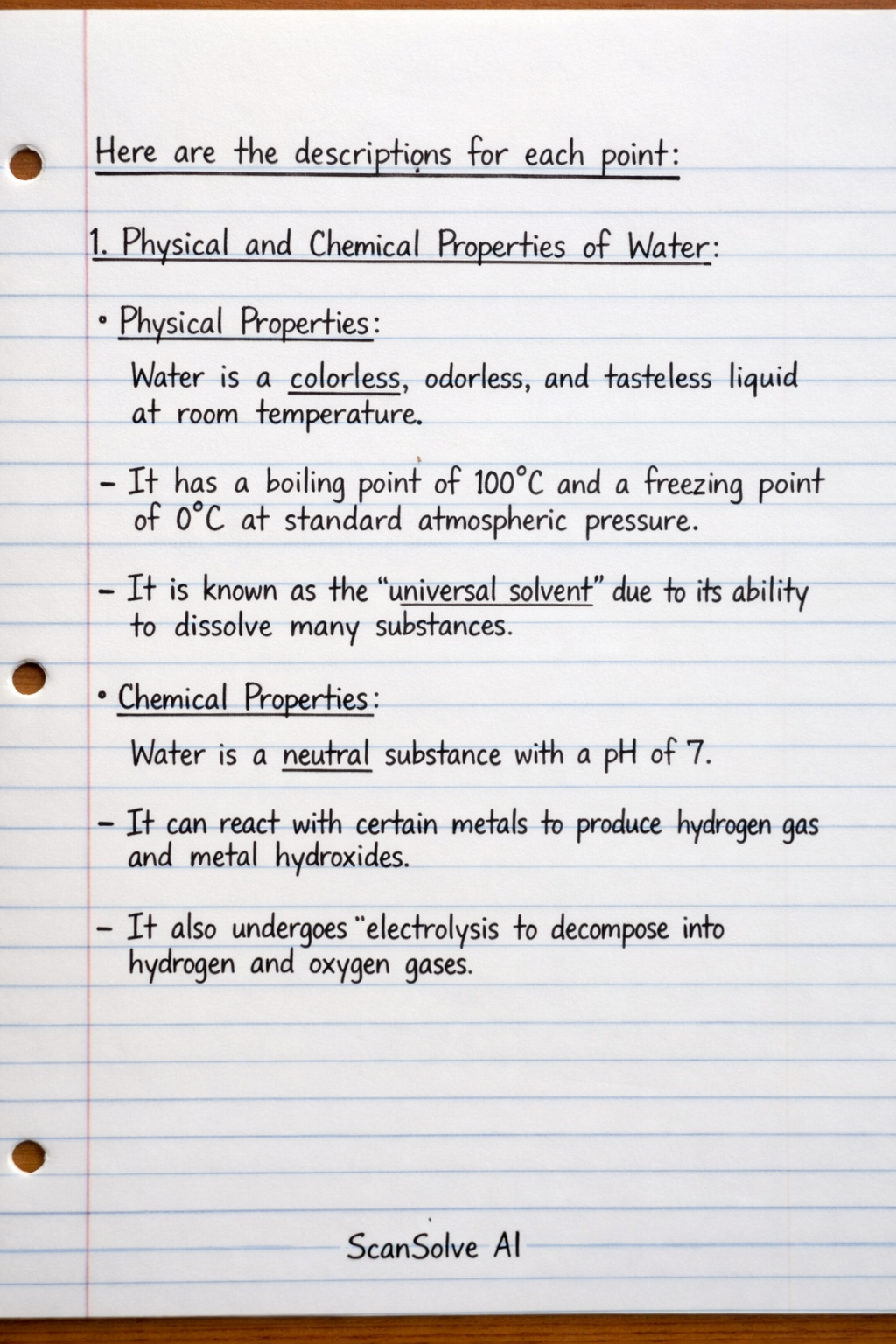
Here are the descriptions for each point:
-
Physical and Chemical Properties of Water:
- Physical Properties: Water is a colorless, odorless, and tasteless liquid at room temperature. It has a boiling point of and a freezing point of at standard atmospheric pressure. It is known as the universal solvent due to its ability to dissolve many substances.
- Chemical Properties: Water is a neutral substance with a pH of 7. It can react with certain metals to produce hydrogen gas and metal hydroxides. It also undergoes electrolysis to decompose into hydrogen and oxygen gases.
-
Distinction between Hard and Soft Water:
- Soft water readily forms a lather with soap because it contains very low concentrations of dissolved mineral ions, primarily calcium () and magnesium () ions.
- Hard water does not readily form a lather with soap; instead, it forms an insoluble scum. This is due to the presence of high concentrations of dissolved calcium () and magnesium () ions.
-
How to Soften Water:
- For Temporary Hardness (caused by bicarbonates):
- Boiling: Heating the water causes the soluble bicarbonates to decompose into insoluble carbonates, which precipitate out.
- Adding Calcium Hydroxide (Clark's Process): Adding a calculated amount of slaked lime () precipitates the calcium and magnesium ions as carbonates.
- For Permanent Hardness (caused by sulfates and chlorides):
- Adding Washing Soda (Sodium Carbonate): Sodium carbonate () reacts with calcium and magnesium ions to form insoluble calcium carbonate and magnesium carbonate, which then precipitate.
- Ion-Exchange Method: Water is passed through a column containing ion-exchange resins that replace calcium and magnesium ions with sodium ions.
- For Temporary Hardness (caused by bicarbonates):
-
Steps Involved in the Treatment of Water for Public Consumption:
- Screening: Large debris like leaves, sticks, and plastic are removed by passing the water through screens.
- Aeration: Water is exposed to air to remove dissolved gases and oxidize dissolved metals like iron and manganese.
- Coagulation/Flocculation: Chemicals (e.g., alum) are added to make small suspended particles clump together into larger, heavier particles called flocs.
- Sedimentation: The water is allowed to stand in large tanks, enabling the heavy flocs to settle at the bottom.
- Filtration: Water is passed through layers of sand, gravel, and charcoal to remove remaining suspended particles, protozoa, and some bacteria.
- Disinfection: Chlorine, ozone, or ultraviolet (UV) light is used to kill harmful bacteria and viruses.
- Fluoridation (Optional): Fluoride may be added to help prevent tooth decay.
- Storage and Distribution: The treated water is stored in reservoirs and then distributed to consumers through a network of pipes.
Was this helpful?
Still stuck on this one?
Ask a follow-up, and the answer starts from this question.
Got a different question?Ask your own question
More Chemistry Questions
QExplain the disadvantages of chemical fertilizers and the process of softening temporary hard water…QQuestion 2: Discuss the disadvantages of chemical fertilizers and explain temporary hard water and…QExplain methods for water purification, water softening, air drying, and the properties and uses of…QDetermine which salt crystallizes at 20 °C and calculate the mass crystallized. Define hard water…QState any two uses of sodium, magnesium, copper, zinc, aluminium, iron, gold, and silver…
Handwritten Step-by-Step Solution
Get this as a handwritten image on WhatsApp — like a tutor wrote it for you.
Try on WhatsApp