
We read your photo as:
Provide solutions for the following questions: a) (i) List three causes of genetic variation. a) (ii) Describe two effects of genetic variation. b) (i) Explain trade winds and storms. b) (ii) How do y
ScanSolve AI Answer
Step-by-step solution
4 stepsHere are the solutions to your questions:
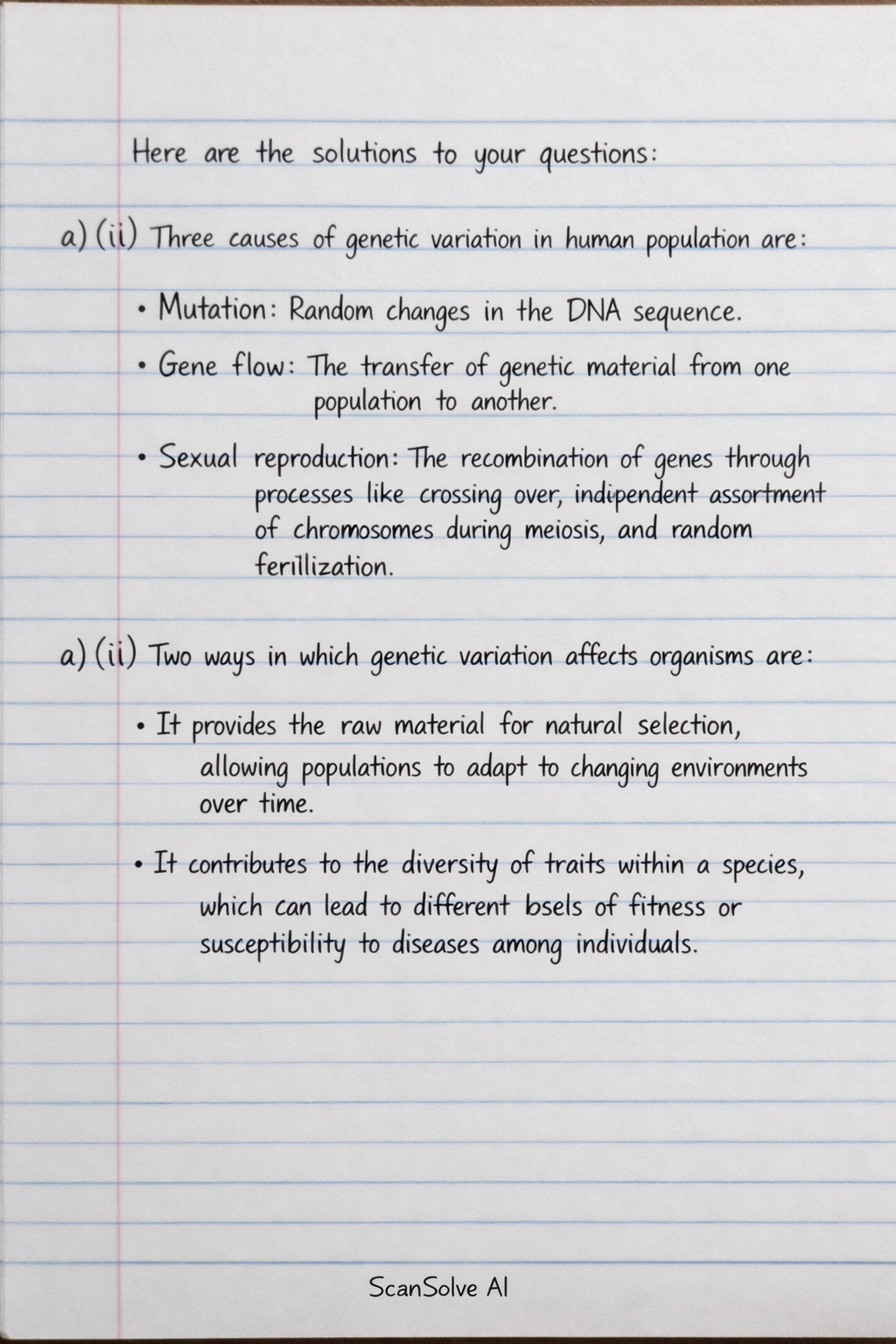
a) (i) Three causes of genetic variation in human population are:
- Mutation: Random changes in the DNA sequence.
- Gene flow: The transfer of genetic material from one population to another.
- Sexual reproduction: The recombination of genes through processes like crossing over, independent assortment of chromosomes during meiosis, and random fertilization.
a) (ii) Two ways in which genetic variation affects organisms are:
- It provides the raw material for natural selection, allowing populations to adapt to changing environments over time.
- It contributes to the diversity of traits within a species, which can lead to different levels of fitness or susceptibility to diseases among individuals.
b) (i) Explanation of terms associated with air movement:
- (α) Trade winds: These are prevailing easterly surface winds that blow from the subtropical high-pressure belts towards the equator in both the Northern and Southern Hemispheres. They are consistent and were historically important for sailing ships.
- (β) Storm: A storm is a violent disturbance of the atmosphere characterized by strong winds, and often accompanied by rain, thunder, lightning, or snow. It represents a significant deviation from average weather conditions.
b) (ii) To find out how far the storm would reach, we use the formula: distance = speed time.
Convert the time from minutes to seconds.
Given time .
State the given speed.
Given speed .
Calculate the distance using the formula .
Convert the distance to kilometers for a more practical unit.
The storm would reach a distance of .
c) (i) Radioisotopes are atoms of an element that have an unstable nucleus and emit radiation (such as alpha, beta, or gamma particles) as they undergo radioactive decay to become more stable.
c) (ii) Three uses of radioisotopes are:
- In medicine, for diagnostic imaging (e.g., PET scans, X-rays) and cancer treatment (radiotherapy).
- In archaeology and geology, for carbon dating and determining the age of rocks and fossils.
- In industry, for sterilizing medical equipment and food, detecting leaks in pipes, and gauging the thickness of materials.
Still stuck on this one?
Ask a follow-up, and the answer starts from this question.
More Biology Questions
Handwritten Step-by-Step Solution
Get this as a handwritten image on WhatsApp — like a tutor wrote it for you.
Try on WhatsApp