
We read your photo as:
Summarize the key features of Sickle Cell Anemia, including common crises, laboratory diagnosis, and complications, based on the provided information and images.
Biology
ScanSolve AI Answer
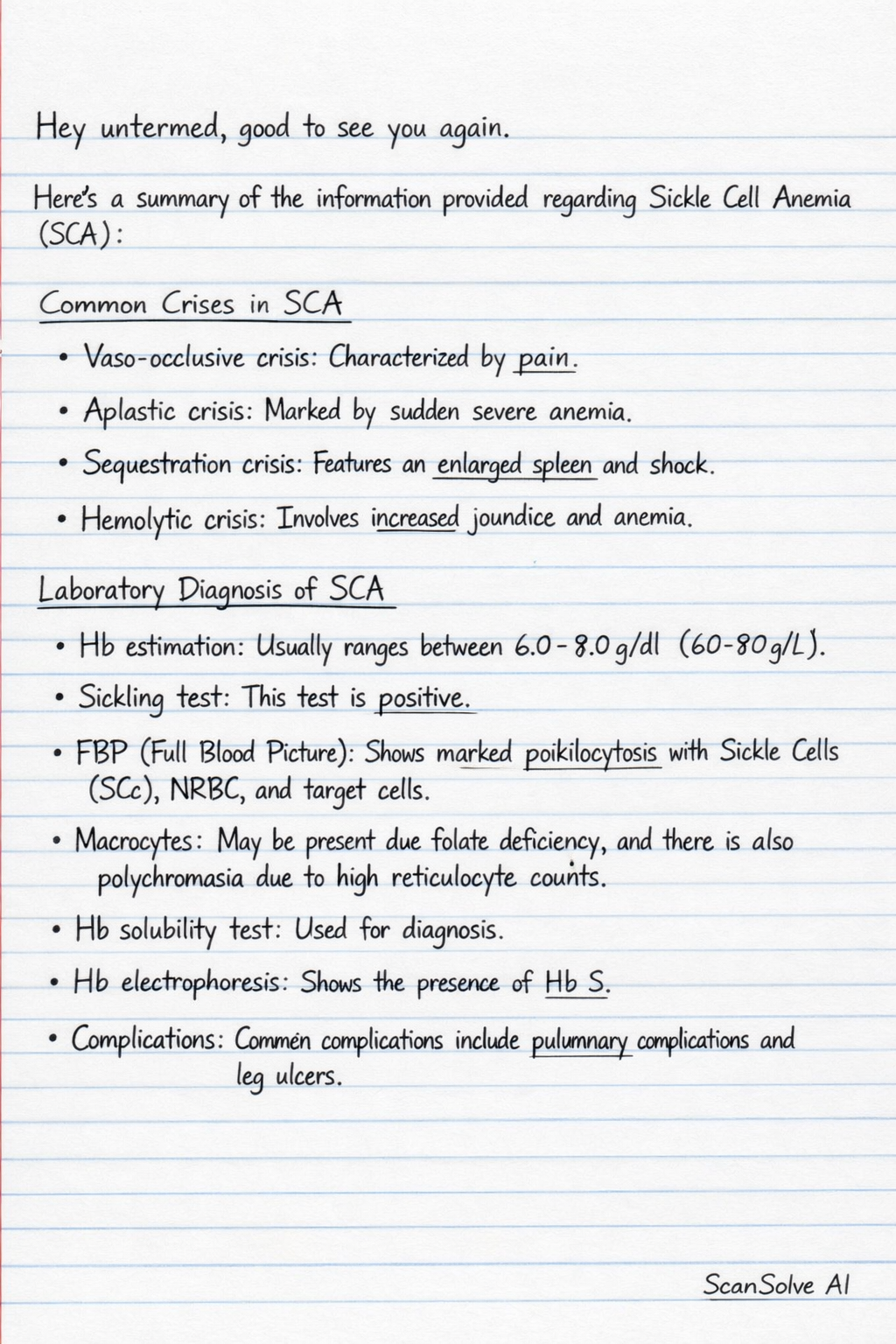
Here's a summary of the information provided regarding Sickle Cell Anemia (SCA):
-
Common Crises in SCA
- Vaso-occlusive crisis: Characterized by pain.
- Aplastic crisis: Marked by sudden severe anemia.
- Sequestration crisis: Features an enlarged spleen and shock.
- Hemolytic crisis: Involves increased jaundice and anemia.
-
Laboratory Diagnosis of SCA
- Hb estimation: Usually ranges between ().
- Sickling test: This test is positive.
- FBP (Full Blood Picture): Shows marked poikilocytosis with Sickle Cells (SCs), Nucleated Red Blood Cells (NRBC), and target cells.
- Macrocytes: May be present due to folate deficiency, and there is also polychromasia due to high reticulocyte counts.
- Hb solubility test: Used for diagnosis.
- Hb electrophoresis: Shows the presence of Hb S.
- Complications: Common complications include pulmonary complications and leg ulcers.
The images show:
- A microscopic view of red blood cells, many of which are sickle-shaped.
- Results from a hemoglobin electrophoresis test, illustrating different hemoglobin types (HbAA, HbAS, HbSS, HbSC, HbS). The presence of HbS is indicative of sickle cell disease or trait.
Was this helpful?
Still stuck on this one?
Ask a follow-up, and the answer starts from this question.
Got a different question?Ask your own question
More Biology Questions
QSummarize the information provided regarding Sickle Cell Anemia, including common crises, laboratory…QSummarize the common crises, laboratory diagnosis, and complications of Sickle Cell Anemia, and…QDescribe sickle cell crisis: its definition, common types, and typical treatments.QThe problem states that normal haemoglobin is Hb^A and abnormal haemoglobin (sickle-cell) is Hb^S…QExplain a genetic cross between two individuals with genotype AS, including gametes, offspring…
Handwritten Step-by-Step Solution
Get this as a handwritten image on WhatsApp — like a tutor wrote it for you.
Try on WhatsApp