
We read your photo as:
What are the correct answers and explanations for the objective questions related to anatomical planes, joints, and positions?
ScanSolve AI Answer
Answer
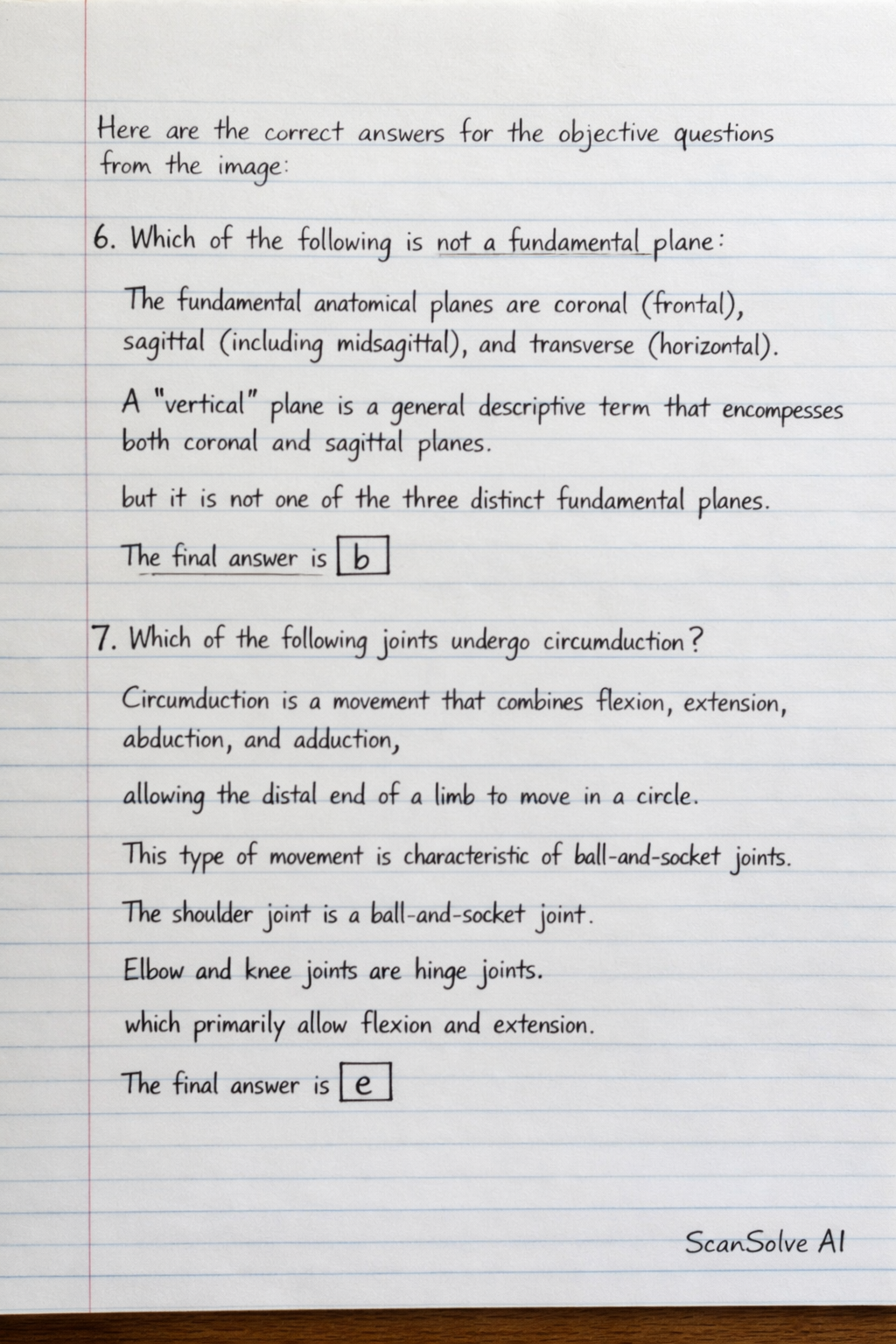
Here are the correct answers for the objective questions from the image:
6. Which of the following is not a fundamental plane:
The fundamental anatomical planes are coronal (frontal), sagittal (including midsagittal), and transverse (horizontal). A "vertical" plane is a general descriptive term that encompasses both coronal and sagittal planes, but it is not one of the three distinct fundamental planes.
The final answer is
7. Which of the following joints undergo circumduction?
Circumduction is a movement that combines flexion, extension, abduction, and adduction, allowing the distal end of a limb to move in a circle. This type of movement is characteristic of ball-and-socket joints. The shoulder joint is a ball-and-socket joint. Elbow and knee joints are hinge joints, which primarily allow flexion and extension.
The final answer is
8. Regarding anatomical position, which of the following statement is not correct?
The anatomical position describes the body standing erect, with eyes directed forward, upper limbs hanging by the sides with palms facing anteriorly, and lower limbs parallel with toes directed forward. The fetal position is a curled-up posture, which is not the anatomical position.
The final answer is
9. Regarding fundamental position, select the correct statement:
The fundamental position is similar to the anatomical position, but with one key difference: the palms face medially (towards the thighs), rather than anteriorly.
The final answer is
11. Which one of the following bones is an example of an irregular bone?
Irregular bones have complex shapes that do not fit into the categories of long, short, or flat bones. Vertebrae are classic examples of irregular bones due to their intricate and varied shapes. The femur is a long bone, the scapula and sternum are flat bones.
The final answer is
12. Which one of the following planes divides the body into superior & inferior parts?
The transverse (or horizontal) plane divides the body into upper (superior) and lower (inferior) portions. The frontal (coronal) plane divides into anterior and posterior, and the sagittal plane divides into left and right.
The final answer is
13. Which one of the following bones is a bone of the axial skeleton?
The axial skeleton consists of the bones that form the longitudinal axis of the body, including the skull, vertebral column, and thoracic cage (ribs and sternum). The sternum is part of the thoracic cage. The femur, humerus, and scapula are all part of the appendicular skeleton.
The final answer is
14. The following is true about the vertebral column EXCEPT?
Let's evaluate each statement:
- a) 5 lumbar vertebrae: This is correct.
- b) 5 sacral vertebrae fused to form sacrum: This is correct.
- c) 5 coccygeal vertebrae fused to form coccyx: This is incorrect. The coccyx is typically formed by the fusion of 3 to 5 (most commonly 4) coccygeal vertebrae.
- d) Formed of 33 bones in total: This is generally considered correct when counting the individual vertebrae before fusion (7 cervical + 12 thoracic + 5 lumbar + 5 sacral + 4 coccygeal = 33).
The statement that is NOT true is that there are 5 coccygeal vertebrae.
The final answer is
Try one yourself
A new problem that tests the same skill.
Still stuck on this one?
Ask a follow-up, and the answer starts from this question.
More Biology Questions
Handwritten Step-by-Step Solution
Get this as a handwritten image on WhatsApp — like a tutor wrote it for you.
Try on WhatsApp