
We read your photo as:
Answer all questions. All questions carry equal marks (15% each). Use relevant examples, particularly from the Sierra Leonean context (Lumbar/Port Loko district) where applicable. Diagrams and bullet points are acceptable where appropriate, provided they are clearly labeled.
ScanSolve AI Answer
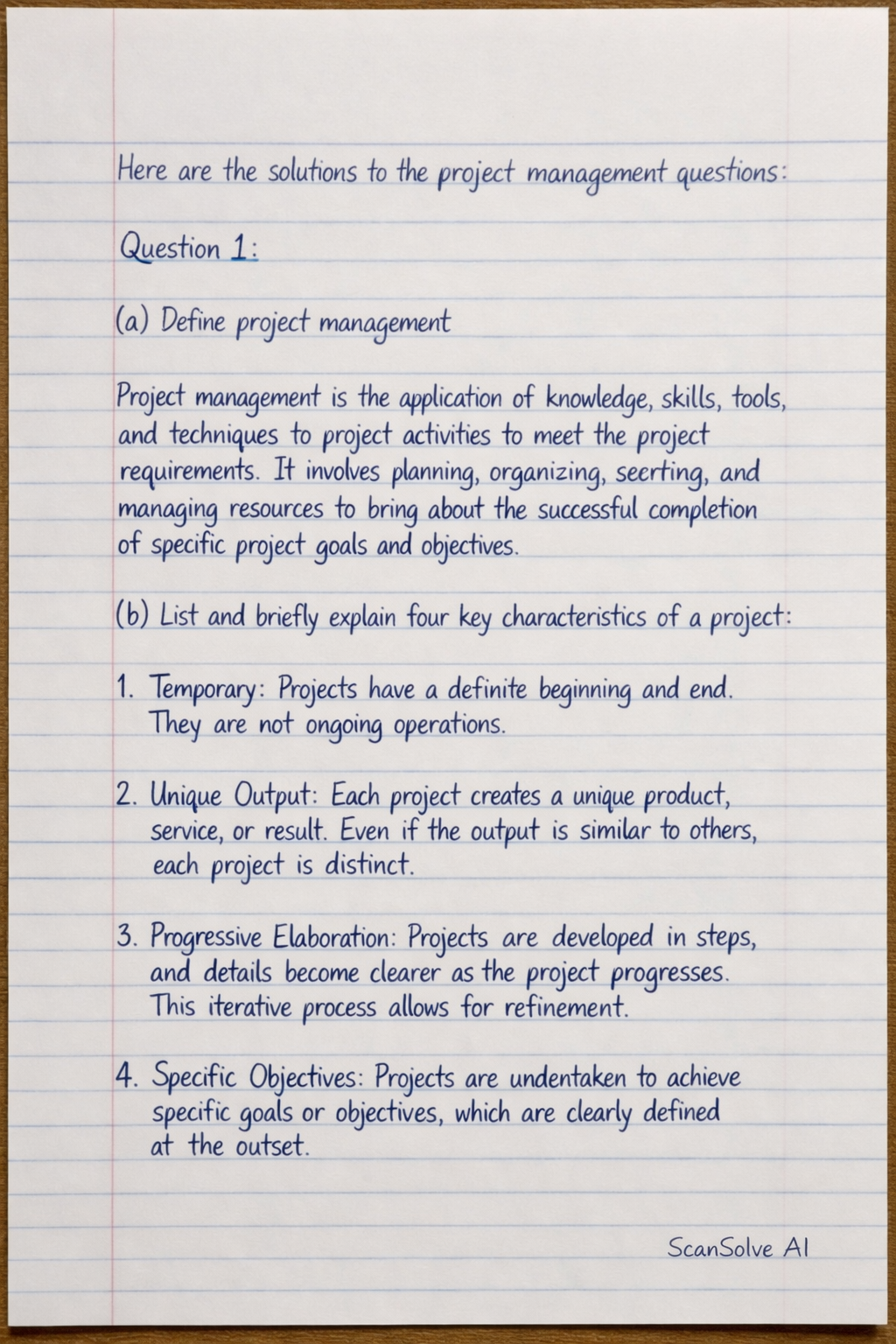
Here are the solutions to the project management questions:
Question 1:
a) Define project management
Project management is the application of knowledge, skills, tools, and techniques to project activities to meet the project requirements. It involves planning, organizing, securing, and managing resources to bring about the successful completion of specific project goals and objectives.
b) List and briefly explain four key characteristics of a project
- Temporary: Projects have a definite beginning and end. They are not ongoing operations.
- Unique Output: Each project creates a unique product, service, or result. Even if the output is similar to others, each project is distinct.
- Progressive Elaboration: Projects are developed in steps, and details become clearer as the project progresses. This iterative process allows for refinement.
- Specific Objectives: Projects are undertaken to achieve specific goals or objectives, which are clearly defined at the outset.
c) In the context of ICT projects in Sierra Leone (e.g., network installation, system migration, or software development), explain why project management is essential for ensuring project success.
Project management is essential for ICT projects in Sierra Leone due to resource constraints, infrastructure challenges, and the need for clear communication. It ensures efficient allocation of limited funds and skilled personnel, mitigates risks associated with unreliable power or connectivity, and provides a structured approach to meet stakeholder expectations and deliver functional, sustainable solutions.
Question 2:
a) Using the five phases of the project life cycle (Initiation, Planning, Execution, Monitoring & Controlling, and Closure), describe one key activity you would perform in each phase for this project.
- Initiation: Conduct a feasibility study to assess the technical viability and economic benefits of a solar-powered water pumping system for the community and health clinic.
- Planning: Develop a detailed project schedule outlining all tasks, timelines, resource requirements (e.g., solar panels, pump, storage tank), and responsibilities for installation and testing.
- Execution: Install the solar panels, pump, and piping system according to the design specifications, ensuring proper connection to the borehole and distribution points.
- Monitoring & Controlling: Regularly track progress against the schedule and budget, perform quality checks on the installed components, and address any deviations or issues promptly.
- Closure: Conduct a final inspection and handover of the operational water system to the community and health clinic, including training on maintenance and documentation.
b) Explain why the temporary nature of a project is a critical consideration in this context.
The temporary nature of this project is critical because it emphasizes that the installation of the solar-powered water system has a defined end. This means the project team must focus on delivering a fully functional and sustainable system within the set timeframe, ensuring all components are properly installed and tested before the project concludes. It also highlights the need for a clear handover plan to ensure long-term operation and maintenance by the community after the project team departs.
Question 3:
a) Define the following six project management terms:
(i) Project: A temporary endeavor undertaken to create a unique product, service, or result.
(ii) Program: A group of related projects, subsidiary programs, and program activities managed in a coordinated way to obtain benefits not available from managing them individually.
(iii) Portfolio: A collection of projects, programs, subsidiary portfolios, and operations managed as a group to achieve strategic objectives.
(iv) Stakeholder: An individual, group, or organization who may affect, be affected by, or perceive itself to be affected by a decision, activity, or outcome of a project.
(v) Deliverable: Any unique and verifiable product, result, or capability to perform a service that is produced to complete a process, phase, or project.
(vi) Milestone: A significant point or event in a project schedule, often representing the completion of a major deliverable or phase.
b) Briefly explain the relationship between a project, a program, and a portfolio.
A project is a temporary effort to create a unique output. A program is a collection of related projects managed together to achieve broader benefits. A portfolio is a strategic collection of projects and programs, even if unrelated, aligned to achieve organizational strategic objectives. Projects are components of programs, and both projects and programs are components of portfolios, forming a hierarchical structure for organizational goal achievement.
Question 4:
a) Identify the specific project management problem described above.
The specific project management problem described is scope creep or uncontrolled change. The community is requesting additional features (storage tank, piping to three taps) without corresponding adjustments to the budget or timeline.
b) List three common causes of this problem.
- Poorly defined scope: The initial project scope was not clear or detailed enough, leading to misunderstandings about what was included.
- Lack of formal change control: There was no established process for managing changes to the project scope, budget, or schedule.
- Stakeholder pressure: The project manager succumbed to pressure from the community (a key stakeholder) to add features without proper evaluation.
c) Describe two prevention strategies a project manager should have implemented from the outset to avoid this situation.
- Develop a comprehensive scope statement: The project manager should have created a detailed scope statement at the planning phase, clearly defining all deliverables, project boundaries, and exclusions. This document, signed off by all key stakeholders, would serve as a baseline for what is and isn't part of the project.
- Implement a formal change control process: A change control process should have been established, requiring all requested changes to be formally documented, assessed for impact on budget and schedule, and approved by relevant stakeholders before implementation. This ensures that any scope changes are managed and agreed upon.
Still stuck on this one?
Ask a follow-up, and the answer starts from this question.
More Business/Management Questions
Handwritten Step-by-Step Solution
Get this as a handwritten image on WhatsApp — like a tutor wrote it for you.
Try on WhatsApp