
We read your photo as:
Briefly explain on the following communication terms: a. Vertical communication b. Horizontal communication c. Grapevine d. Interpersonal communication
ScanSolve AI Answer
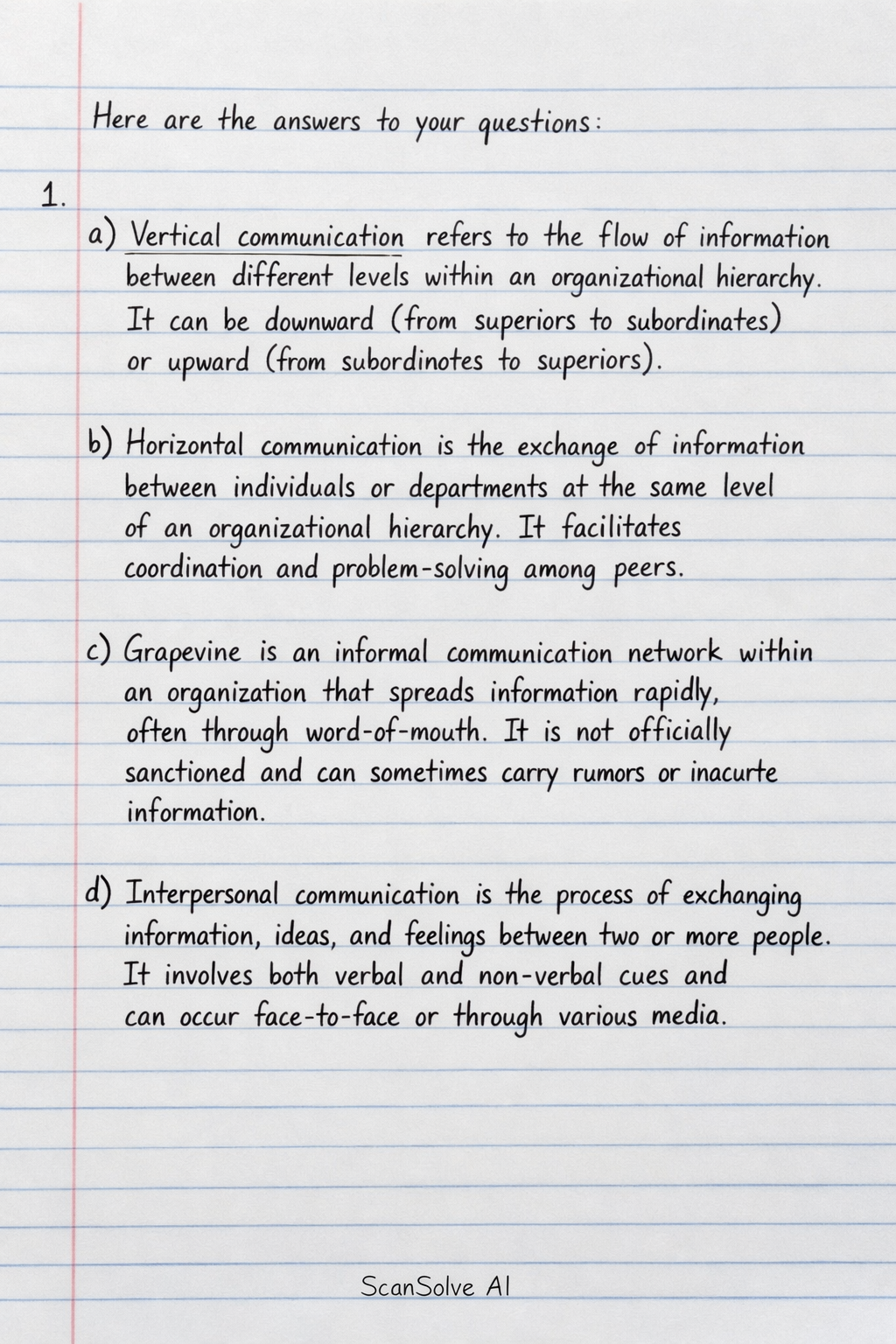
Here are the answers to your questions:
QUESTIONS
1.
a) Vertical communication refers to the flow of information between different levels within an organizational hierarchy. It can be downward (from superiors to subordinates) or upward (from subordinates to superiors).
b) Horizontal communication is the exchange of information between individuals or departments at the same level of an organizational hierarchy. It facilitates coordination and problem-solving among peers.
c) Grapevine is an informal communication network within an organization that spreads information rapidly, often through word-of-mouth. It is not officially sanctioned and can sometimes carry rumors or inaccurate information.
d) Interpersonal communication is the process of exchanging information, ideas, and feelings between two or more people. It involves both verbal and non-verbal cues and can occur face-to-face or through various media.
2.
a) Communication is the process of conveying information, ideas, or feelings from one person or group to another through a shared system of signs, symbols, or behaviors.
b) Four elements of the communication process:
- Sender: The person who initiates the communication and encodes the message.
- Message: The information, idea, or feeling that the sender wants to convey.
- Channel: The medium through which the message is transmitted (e.g., spoken word, written text, email).
- Receiver: The person or group to whom the message is directed, who decodes and interprets it.
- Feedback: The response from the receiver to the sender, indicating whether the message was understood.
- Noise: Any interference that distorts or disrupts the message during transmission.
3.
a) Oral communication involves conveying messages through spoken words. It includes face-to-face conversations, phone calls, presentations, and meetings. It allows for immediate feedback and clarification.
b) Visual communication uses images, symbols, graphs, charts, and other visual aids to convey information. It is effective for presenting complex data, illustrating concepts, and capturing attention.
c) Written communication involves transmitting messages through written words. Examples include emails, reports, letters, memos, and documents. It provides a permanent record and allows for careful crafting of the message.
d) Non-verbal communication is the transmission of messages without the use of words. It includes body language (gestures, posture, facial expressions), eye contact, tone of voice, and physical proximity. It often complements or contradicts verbal messages.
4.
a) Information overload occurs when an individual receives too much information at once, making it difficult to process, understand, and respond effectively. This can lead to stress, confusion, and missed important details.
b) Information distortion happens when a message changes or is misinterpreted as it passes from the sender to the receiver, or through multiple channels. This can be due to misinterpretation, selective perception, or deliberate alteration.
c) Inadequate information refers to a situation where the message provided is incomplete, insufficient, or lacks necessary details. This can lead to misunderstandings, incorrect decisions, or an inability to complete a task.
d) Cultural barriers arise from differences in cultural backgrounds, values, beliefs, languages, and communication styles between individuals or groups. These differences can lead to misinterpretations, offense, or a complete breakdown in communication.
5.
The communication process typically involves a series of steps that can be represented as a flow chart:
Flow Chart of Communication Process:
Explanation of the Communication Process:
- Sender: The process begins with the sender, who is the source of the message. The sender has an idea or information they wish to convey.
- Encoding: The sender then encodes this idea into a message. Encoding involves translating thoughts into a form that can be understood by others, such as words, gestures, or symbols.
- Message: The message is the actual content being sent. It could be verbal (spoken or written) or non-verbal (body language, visuals).
- Channel: The sender selects a channel or medium through which to transmit the message. This could be face-to-face conversation, phone call, email, letter, presentation, etc. The choice of channel depends on the message's nature and the receiver's context.
- Receiver: The message travels through the chosen channel to the receiver, who is the intended recipient of the message.
- Decoding: The receiver decodes the message, interpreting the symbols, words, or gestures back into an understandable idea. Effective decoding relies on the receiver's understanding of the language, context, and non-verbal cues.
- Feedback: After decoding, the receiver provides feedback to the sender. Feedback is the receiver's response, indicating whether the message was received and understood as intended. This could be a verbal reply, a nod, an action, or a written response. Feedback completes the communication loop and allows the sender to assess the effectiveness of their message.
- Noise: Throughout this entire process, noise can interfere with the transmission and reception of the message. Noise can be physical (e.g., loud sounds), psychological (e.g., distractions, biases), semantic (e.g., jargon), or environmental (e.g., poor internet connection).
This cyclical process ensures that information is exchanged and understood between parties, with feedback allowing for clarification and adjustment.
Still stuck on this one?
Ask a follow-up, and the answer starts from this question.
More Business/Management Questions
Handwritten Step-by-Step Solution
Get this as a handwritten image on WhatsApp — like a tutor wrote it for you.
Try on WhatsApp