
We read your photo as:
c) Explain the apparent loss of weight of the wood.
ScanSolve AI Answer
Step-by-step solution
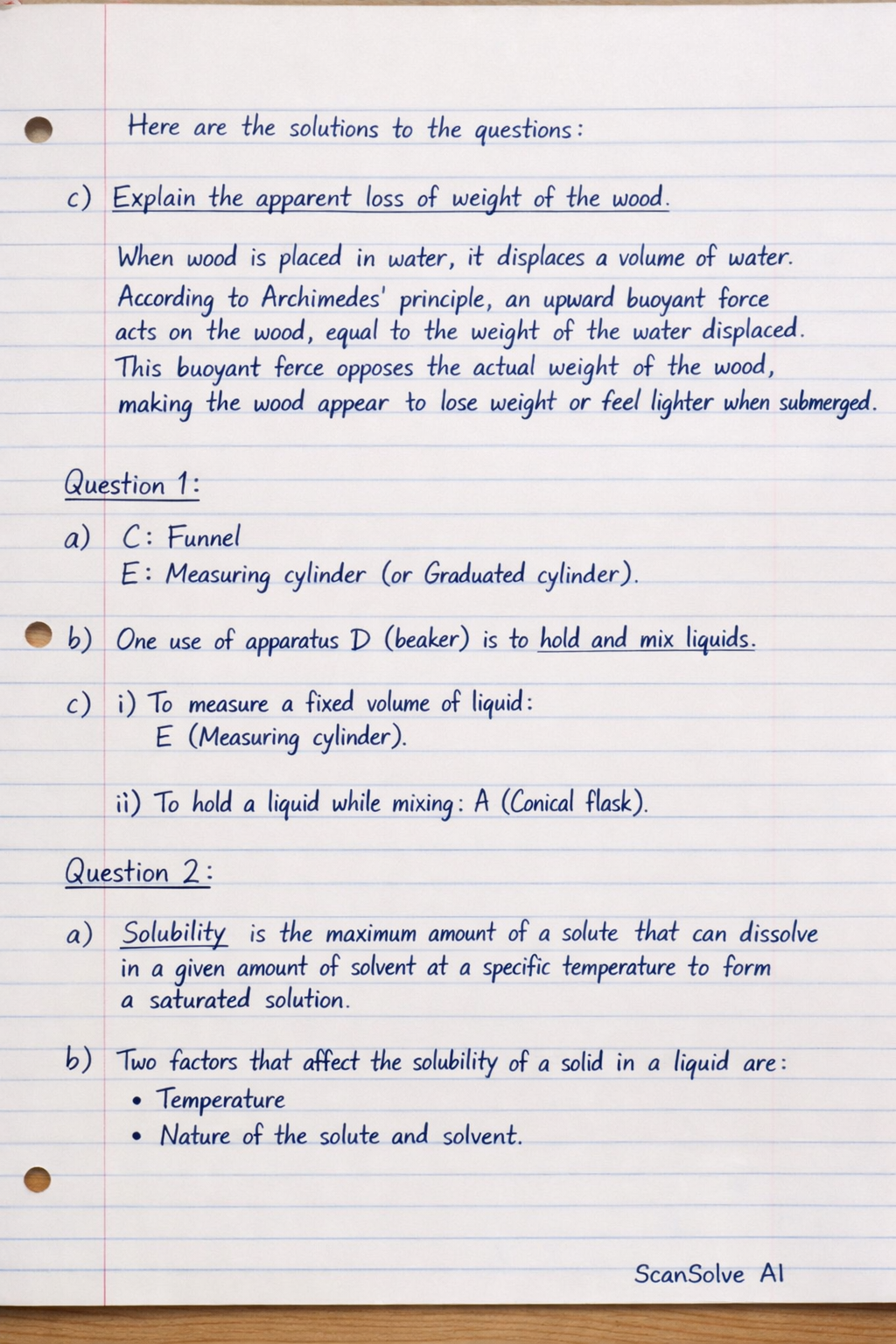
5 stepsHere are the solutions to the questions:
c) Explain the apparent loss of weight of the wood.
When wood is placed in water, it displaces a volume of water. According to Archimedes' principle, an upward buoyant force acts on the wood, equal to the weight of the water displaced. This buoyant force opposes the actual weight of the wood, making the wood appear to lose weight or feel lighter when submerged.
Question 1:
a)
- C: Funnel
- E: Measuring cylinder (or Graduated cylinder)
b)
One use of apparatus D (beaker) is to hold and mix liquids.
c)
- i) To measure a fixed volume of liquid: E (Measuring cylinder)
- ii) To hold a liquid while mixing: A (Conical flask/Erlenmeyer flask)
Question 2:
a)
Solubility is the maximum amount of a solute that can dissolve in a given amount of solvent at a specific temperature to form a saturated solution.
b)
Two factors that affect the solubility of a solid in a liquid are:
- Temperature
- Nature of the solute and solvent
c)
Measure out exactly of water into a beaker and maintain it at the given temperature.
Add the salt gradually to the water while stirring continuously until no more salt dissolves and some undissolved salt remains at the bottom of the beaker.
This indicates a saturated solution has formed.
Carefully filter the solution to separate the undissolved salt from the saturated salt solution.
Transfer the filtered saturated solution to an evaporating dish and gently heat it to evaporate all the water.
Once all the water has evaporated, dry the remaining salt and weigh its mass.
This mass represents the amount of salt that dissolved in of water at the given temperature.
d)
You would know the solution is saturated when no more salt dissolves in the water, and any additional salt added remains as a solid at the bottom of the container.e)
One use of the information obtained from this experiment is to determine the maximum concentration of a substance that can be dissolved in a solvent for industrial or pharmaceutical applications.Question 5. a) Explain the following terms:
i) Evaporation
Evaporation is the process where a liquid changes into a gas or vapor, typically occurring at the surface of the liquid at temperatures below its boiling point.ii) Condensation
Condensation is the process by which a gas or vapor changes into a liquid, usually due to cooling, such as when water vapor in the air forms liquid water droplets.iii) Sublimation
Sublimation is a phase transition where a solid changes directly into a gas without first passing through a liquid phase. An example is dry ice (solid carbon dioxide) turning directly into carbon dioxide gas.
Still stuck on this one?
Ask a follow-up, and the answer starts from this question.
More Business/Management Questions
Handwritten Step-by-Step Solution
Get this as a handwritten image on WhatsApp — like a tutor wrote it for you.
Try on WhatsApp