
We read your photo as:
Differentiate between Environmental Assessments and Project Monitoring, and Project Evaluation and Project Auditing, with two points each.
ScanSolve AI Answer
1a. With two points each, differentiate between:
i) Environmental assessments and project monitoring
- Environmental Assessments (EA):
- Purpose: Proactive process conducted before a project begins to predict potential environmental impacts and identify mitigation measures.
- Timing: Typically a one-time or initial process completed during the planning phase.
- Project Monitoring:
- Purpose: An ongoing process conducted during and after project implementation to track actual environmental impacts, measure performance, and ensure compliance with regulations and mitigation plans.
- Timing: A continuous activity throughout the project lifecycle.
ii) Project evaluation and project auditing
- Project Evaluation:
- Purpose: Assesses the overall success, effectiveness, relevance, efficiency, and sustainability of a project against its objectives, focusing on learning and improvement.
- Scope: Broader, examining the project's outcomes, impacts, and overall contribution to goals.
- Project Auditing:
- Purpose: Verifies compliance with established policies, procedures, regulations, and contractual agreements, often focusing on financial records and operational adherence.
- Scope: Narrower, typically focused on accountability, accuracy, and adherence to specific rules or standards.
1b. What are indicators?
Indicators are measurable variables that provide information about the state or condition of a phenomenon, system, or process. They are used to track progress, measure performance, and assess impact against predefined objectives or targets in project monitoring and evaluation.
1c. Discuss any two types of indicators in project monitoring and evaluation
- Input Indicators: These measure the resources (financial, human, material) that are invested into a project. They assess whether the necessary resources are being provided as planned.
- Example: The amount of budget allocated and spent on a dam construction project, or the number of engineers assigned to the project.
- Outcome Indicators: These measure the short-to-medium term effects or changes that result from the project's outputs. They assess the direct benefits or changes experienced by the target beneficiaries.
- Example: An increase in the area of land under irrigation due to the dam, or a reduction in water scarcity for local communities.
1d. What is the difference between screening and scoping?
- Screening: This is the initial step in the Environmental Impact Assessment (EIA) process. Its purpose is to determine whether a proposed project requires a full EIA, a less rigorous assessment, or no assessment at all, based on its nature, size, and potential environmental significance.
- Scoping: If screening determines that an EIA is required, scoping is the subsequent step. Its purpose is to identify the key environmental issues, potential impacts, and alternatives that need to be addressed in the EIA study. It also defines the boundaries and focus of the assessment.
Still stuck on this one?
Ask a follow-up, and the answer starts from this question.
More Business/Management Questions
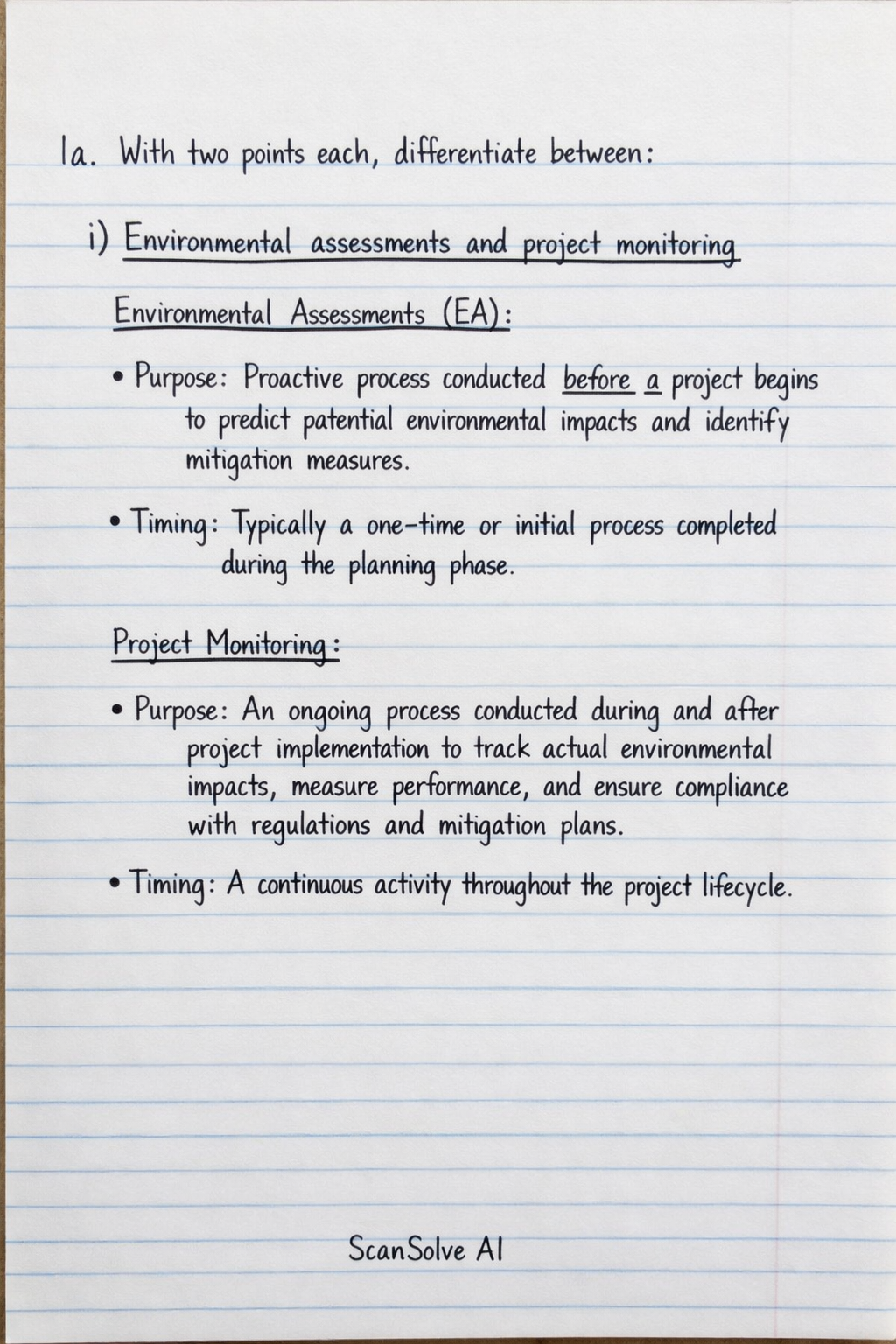
Handwritten Step-by-Step Solution
Get this as a handwritten image on WhatsApp — like a tutor wrote it for you.
Try on WhatsApp