
We read your photo as:
Define hazard analysis and critical control points and list their principles.
Business/Management
ScanSolve AI Answer
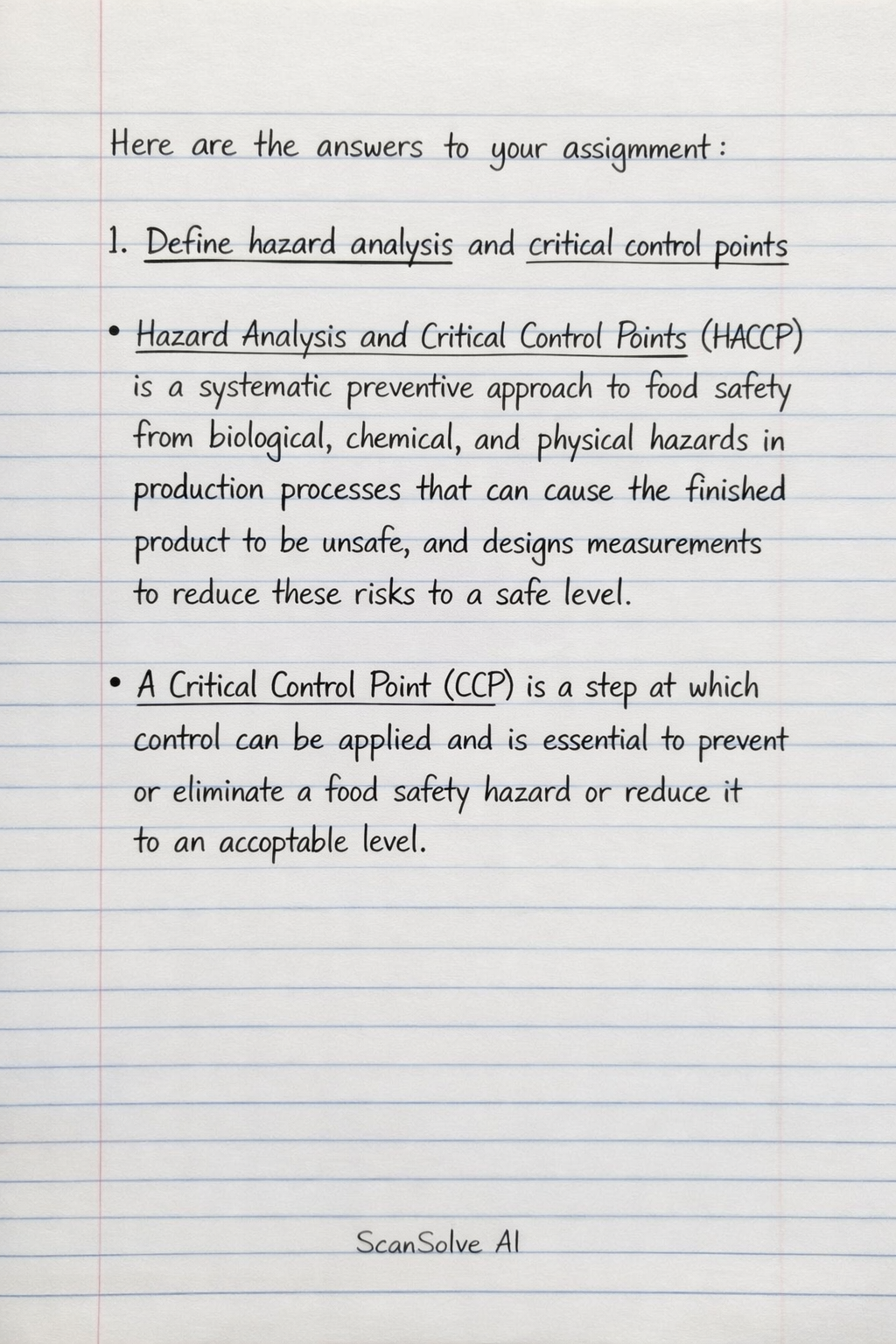
Here are the answers to your assignment:
-
Define hazard analysis and critical control points
- Hazard Analysis and Critical Control Points (HACCP) is a systematic preventive approach to food safety from biological, chemical, and physical hazards in production processes that can cause the finished product to be unsafe, and designs measurements to reduce these risks to a safe level.
- A Critical Control Point (CCP) is a step at which control can be applied and is essential to prevent or eliminate a food safety hazard or reduce it to an acceptable level.
-
Their principles The seven principles of HACCP are:
- Principle 1: Conduct a hazard analysis. Identify potential hazards and assess their risks.
- Principle 2: Determine the Critical Control Points (CCPs). Identify points in the process where hazards can be controlled.
- Principle 3: Establish critical limits. Set maximum or minimum values for parameters at CCPs to ensure safety.
- Principle 4: Establish a system to monitor control of the CCPs. Implement procedures to observe and measure CCPs.
- Principle 5: Establish the corrective action to be taken when monitoring indicates that a particular CCP is not under control. Define actions to restore control when deviations occur.
- Principle 6: Establish procedures for verification to confirm that the HACCP system is working effectively. Regularly check if the HACCP plan is being followed and is effective.
- Principle 7: Establish documentation concerning all procedures and records appropriate to these principles and their application. Maintain records of the HACCP plan and its implementation.
-
Types of food Hazards Food hazards are typically categorized into three main types:
- Biological Hazards: These include harmful microorganisms such as bacteria (e.g., Salmonella, E. coli), viruses (e.g., Norovirus), parasites (e.g., Giardia), and fungi (e.g., molds).
- Chemical Hazards: These are harmful substances that can contaminate food, such as pesticides, cleaning agents, allergens (e.g., peanuts, shellfish), heavy metals (e.g., lead, mercury), and naturally occurring toxins (e.g., mycotoxins).
- Physical Hazards: These are foreign objects in food that can cause injury, such as glass, metal fragments, plastic, wood, stones, jewelry, or bone fragments.
-
Methods of food preservation Common methods of food preservation include:
- Refrigeration: Slows down microbial growth and enzymatic reactions by keeping food at low temperatures (typically ).
- Freezing: Stops microbial growth and significantly slows enzymatic activity by storing food at temperatures below .
- Canning: Involves heating food in sealed containers to destroy microorganisms and enzymes, creating a vacuum seal.
- Drying/Dehydration: Removes moisture from food, inhibiting microbial growth and enzymatic activity.
- Salting/Curing: Uses salt to draw out moisture and inhibit microbial growth, often combined with smoking.
- Sugaring: High concentrations of sugar preserve food by drawing out moisture (e.g., jams, jellies).
- Fermentation: Uses beneficial microorganisms to convert sugars into acids, alcohols, or gases, which preserve food and alter its flavor.
- Pickling: Preserves food in an acidic solution, typically vinegar, which inhibits microbial growth.
- Pasteurization: A heat treatment that destroys pathogenic microorganisms and reduces spoilage organisms in liquids like milk and juice.
-
Stages of food processing Food processing generally involves several stages, which can vary depending on the product:
- Harvesting/Sourcing: Raw materials are collected from farms or suppliers.
- Preparation/Cleaning: Raw ingredients are sorted, washed, trimmed, peeled, or shelled to remove unwanted parts and contaminants.
- Processing/Transformation: Ingredients undergo various treatments like cutting, grinding, mixing, cooking (heating, baking, frying), fermentation, or extraction to create the desired product.
- Preservation: Methods like canning, freezing, drying, or pasteurization are applied to extend shelf life and ensure safety.
- Packaging: The finished product is placed into containers (e.g., bottles, cans, bags) to protect it from contamination and spoilage, and for convenient distribution.
- Storage/Distribution: Packaged products are stored under appropriate conditions and transported to retailers or consumers.
-
Mycotoxins associated with maize. [Create a chart] toxin, sources, etiology
| Toxin | Sources
Was this helpful?
Still stuck on this one?
Ask a follow-up, and the answer starts from this question.
Got a different question?Ask your own question
More Business/Management Questions
QMatch each physical hazard control with its type of control (Engineering Control or Personal…QComplete the table by identifying how to control the risks from the given hazards.QComplete the table for controlling risks from hazards.QDiscuss the hierarchy of controls using any occupational hazard of your choice.QMatch each physical hazard control with the correct type of control: Administrative, Engineering, or…
Handwritten Step-by-Step Solution
Get this as a handwritten image on WhatsApp — like a tutor wrote it for you.
Try on WhatsApp