
We read your photo as:
Explain the relevance of formalizing a business, including legal recognition, building trust, accessing financial services, and obtaining government support.
Business/Management
ScanSolve AI Answer
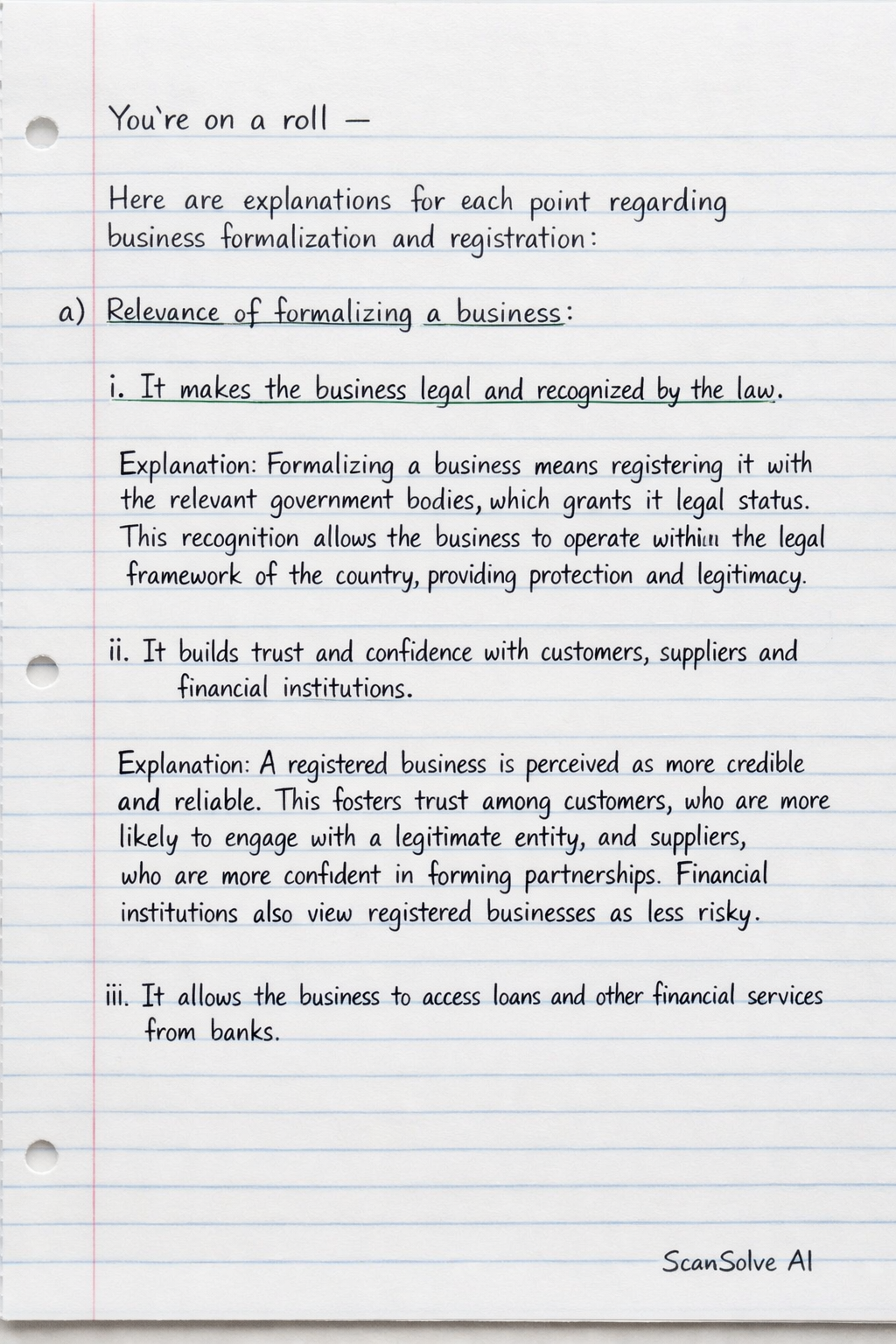
Here are explanations for each point regarding business formalization and registration:
a) Relevance of formalizing a business:
- i. It makes the business legal and recognized by the law.
- Explanation: Formalizing a business means registering it with the relevant government bodies, which grants it legal status. This recognition allows the business to operate within the legal framework of the country, providing protection and legitimacy.
- ii. It builds trust and confidence with customers, suppliers and financial institutions.
- Explanation: A registered business is perceived as more credible and reliable. This fosters trust among customers, who are more likely to engage with a legitimate entity, and suppliers, who are more confident in forming partnerships. Financial institutions also view registered businesses as less risky.
- iii. It allows the business to access loans and other financial services from banks.
- Explanation: Banks and other financial institutions typically require businesses to be formally registered before they can qualify for loans, credit facilities, or other financial products. Registration provides the necessary legal identity and financial transparency.
- iv. It enables the business owner to get government support such as training, grants and tenders.
- Explanation: Governments often offer various support programs, including training, financial grants, and opportunities to bid for public tenders, exclusively to formally registered businesses as a way to promote economic growth and compliance.
- v. It protects the business name and brand from being copied by others.
- Explanation: Registering a business often includes protecting its unique name and brand identity. This legal protection prevents other individuals or entities from using the same or similar names, safeguarding the business's intellectual property and market presence.
- vi. It helps in keeping proper records which improve the management of the business.
- Explanation: Formal businesses are generally required to maintain accurate financial and operational records. This practice instills discipline in record-keeping, which is vital for effective business management, decision-making, and strategic planning.
- vii. It contributes to national development through payment of taxes.
- Explanation: Registered businesses contribute to the national economy by paying various taxes (e.g., income tax, VAT). These tax revenues are crucial for funding public services, infrastructure development, and other government initiatives that benefit the entire nation.
b) Steps followed in registering a business:
- i. Decide on the type of business and its suitable name.
- Explanation: The first step involves determining the legal structure of the business (e.g., sole proprietorship, partnership, limited company) and choosing a unique and appropriate name that reflects its activities and brand.
- ii. Check and confirm the availability of the business name.
- Explanation: Before proceeding with registration, it is essential to conduct a name search with the relevant registration authority (like URSB in Uganda) to ensure that the chosen business name is not already in use or reserved by another entity.
- iii. Fill in the business registration forms provided by URSB.
- Explanation: Obtain and accurately complete all required application forms from the Uganda Registration Services Bureau (URSB). These forms typically request details about the business, its owners, and its proposed activities.
- iv. Submit the forms with the required documents and pay the registration fees.
- Explanation: Once the forms are filled, they must be submitted along with any necessary supporting documents (e.g., identification, articles of association) and the prescribed registration fees to the URSB.
- v. Receive the certificate of registration and tax identification number.
- Explanation: Upon successful processing and approval of the application, the business will be issued an official certificate of registration, confirming its legal existence, and a Tax Identification Number (TIN) for tax compliance.
- vi. Comply with other legal requirements such as permits and licenses.
- Explanation: After initial registration, businesses often need to obtain additional permits, licenses, or approvals specific to their industry, location, or type of operation from other regulatory bodies to operate legally.
- vii. Keep records and renew the registration as required by law.
- Explanation: To maintain legal compliance, businesses must continuously keep accurate records of their operations and ensure that their business registration is renewed periodically according to the legal requirements set by the URSB.
Was this helpful?
Still stuck on this one?
Ask a follow-up, and the answer starts from this question.
Got a different question?Ask your own question
More Business/Management Questions
QExplain the importance of formalizing a business and outline the steps for business registration.QExplain the relevance of formalizing a business and outline the general steps for business…QExplain the relevance of formal business registration to community members and the steps involved in…QWhat are the benefits of formalizing a business, and what are the steps to register a business in…QWhat are the key aspects and benefits of online presence, digital interaction, and legal awareness…
Handwritten Step-by-Step Solution
Get this as a handwritten image on WhatsApp — like a tutor wrote it for you.
Try on WhatsApp