
We read your photo as:
What are the definitions and examples of key business concepts like durability, business opportunity, and feasibility?
Business/Management
ScanSolve AI Answer
Step-by-step solution
2 steps-
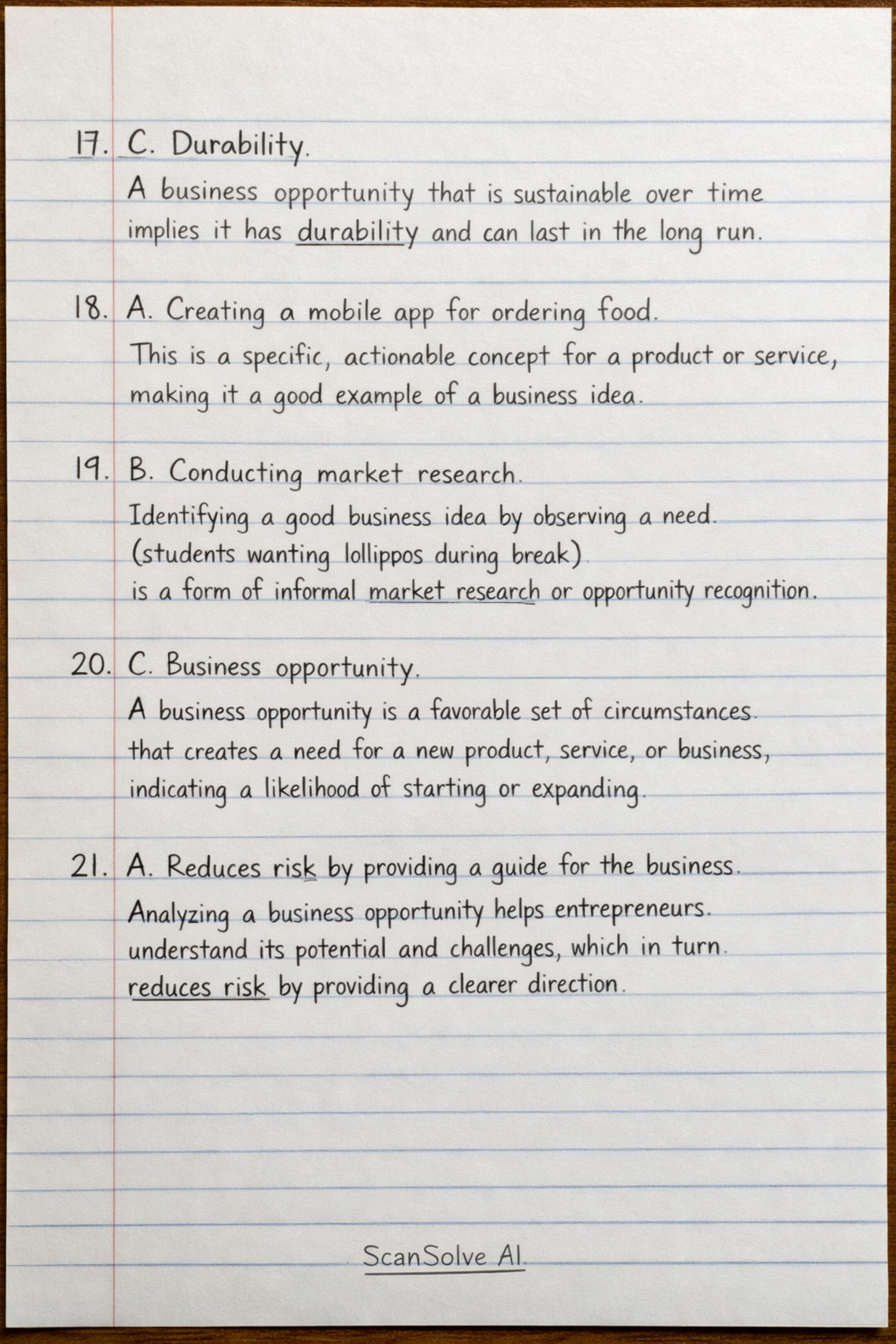
C. Durability
- A business opportunity that is sustainable over time implies it has durability and can last in the long run.
-
A. Creating a mobile app for ordering food
- This is a specific, actionable concept for a product or service, making it a good example of a business idea.
-
B. Conducting market research
- Identifying a good business idea by observing a need (students wanting lollipops during break) is a form of informal market research or opportunity recognition.
-
C. Business opportunity
- A business opportunity is a favorable set of circumstances that creates a need for a new product, service, or business, indicating a likelihood of starting or expanding.
-
A. Reduces risk by providing a guide for the business
- Analyzing a business opportunity helps entrepreneurs understand its potential and challenges, which in turn reduces risk by providing a clearer direction.
-
D. Organisational Feasibility
- Organisational Feasibility assesses whether the proposed business has the necessary management expertise, skills, and structure to succeed.
-
B. To evaluate the viability of a business idea
- The primary purpose of a feasibility study is to determine if a business idea is practical and has the potential for success.
-
A. Forecasting revenue, cost and profit
- This component of a business plan directly focuses on evaluating the financial projections, including projected incomes.
-
C. Idea generation
- The entrepreneurial project typically begins with the idea generation stage, where potential business concepts are conceived.
-
A. Feasibility studies
- Feasibility studies are specifically conducted to evaluate whether a business idea is viable and practical.
-
C. Launching
- Launching is the stage where the entrepreneur implements the business plan and turns the idea into an operational, real business.
-
A. Cost of capital
- Before choosing a source of finance, an entrepreneur primarily considers the cost of capital, which includes interest rates, fees, and equity implications.
-
B. Provides resources to run and grow the business
- The main benefit of finance for an entrepreneur is to provide the necessary resources (capital) to operate, invest, and expand the business.
-
A. Reduces financial risk
- Effective financial planning helps in managing funds, anticipating financial challenges, and making informed decisions, thereby reducing financial risk.
-
C. Income statement
- The income statement (also known as the profit and loss statement) reports a company's revenues, expenses, and net profit or loss over a period, thus showing its profitability.
-
A. 210,000F
Identify the salary and expenses.
Salary = 250,000F Expenses = 40,000FCalculate the income left by subtracting expenses from the salary.
    $$
    \text{Income left} = \text{Salary} - \text{Expenses}
    $$
    $$
    \text{Income left} = 250,000\text{F} - 40,000\text{F}
    $$
    $$
    \text{Income left} = 210,000\text{F}
    $$
*   The income left is **210,000F**.
Was this helpful?
Still stuck on this one?
Ask a follow-up, and the answer starts from this question.
Got a different question?Ask your own question
More Business/Management Questions
QWhat are the key concepts in business strategy, including enablers, customer segmentation, and value…QWhat are the definitions and examples of key marketing concepts like services, transactional…QWhat are the definitions and importance of financial literacy, needs vs wants, and entrepreneurship…QWhat criteria are used to qualify a good business idea?QMultiple choice questions on business ownership, valuation, and success factors.
Handwritten Step-by-Step Solution
Get this as a handwritten image on WhatsApp — like a tutor wrote it for you.
Try on WhatsApp