
We read your photo as:
When you apply for a position you usually submit a Curriculum Vitae (CV). However, a future employer may also consider your online presences, such as your LinkedIn profile, your Facebook, Instagram an
ScanSolve AI Answer
Question 1
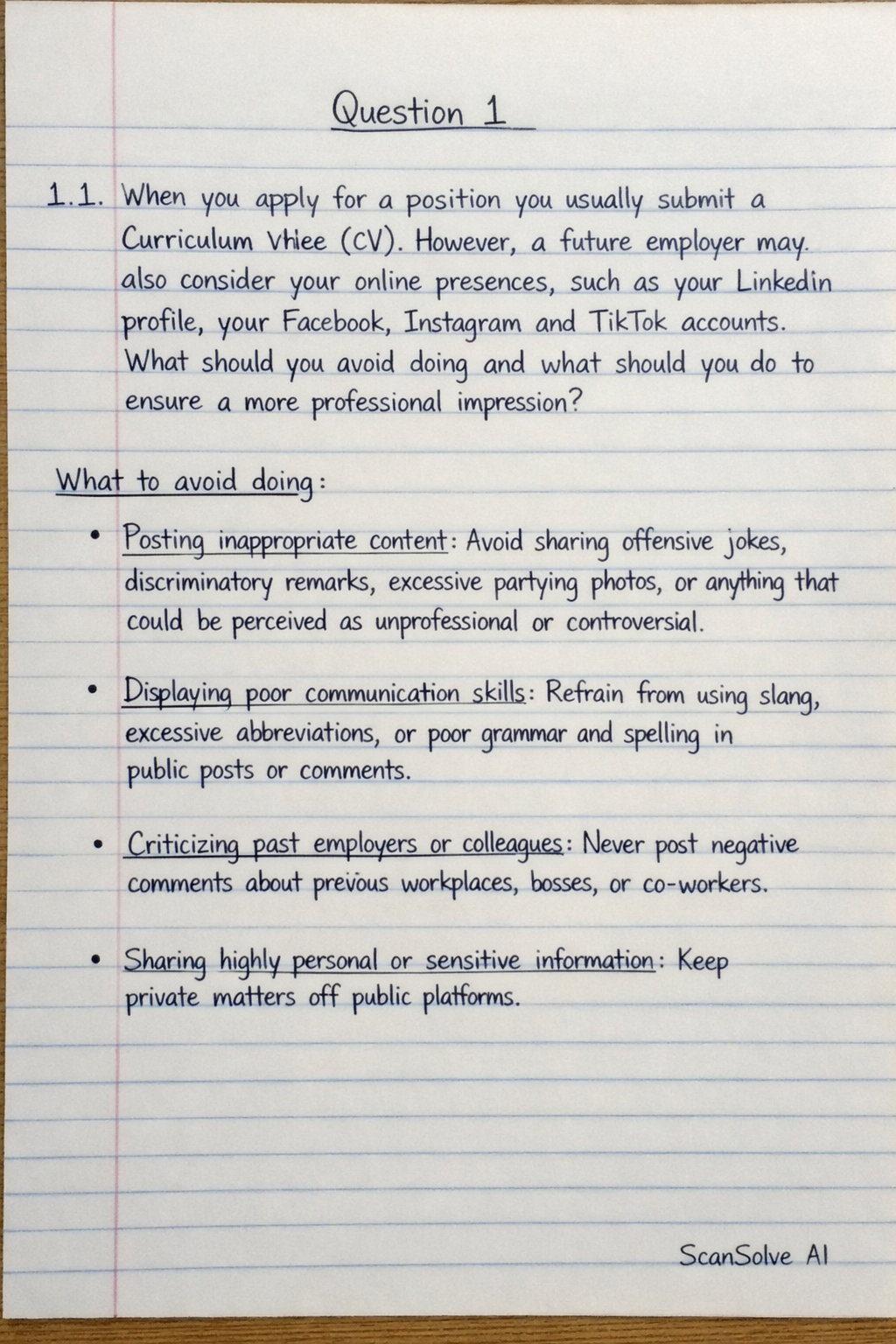
1.1 When you apply for a position you usually submit a Curriculum Vitae (CV). However, a future employer may also consider your online presences, such as your LinkedIn profile, your Facebook, Instagram and TikTok accounts. What should you avoid doing and what should you do to ensure a more professional impression?
-
What to avoid doing:
- Posting inappropriate content: Avoid sharing offensive jokes, discriminatory remarks, excessive partying photos, or anything that could be perceived as unprofessional or controversial.
- Displaying poor communication skills: Refrain from using slang, excessive abbreviations, or poor grammar and spelling in public posts or comments.
- Criticizing past employers or colleagues: Never post negative comments about previous workplaces, bosses, or co-workers.
- Sharing highly personal or sensitive information: Keep private matters off public platforms.
- Having outdated or inconsistent information: Avoid having profiles with old job titles, conflicting information, or inactive accounts.
-
What to do to ensure a more professional impression:
- Curate your content: Share articles, insights, and achievements relevant to your industry or career aspirations.
- Maintain a professional profile picture: Use a clear, appropriate headshot, especially on platforms like LinkedIn.
- Showcase relevant skills and experience: Highlight projects, volunteer work, or accomplishments that demonstrate your capabilities.
- Engage positively and professionally: Participate in industry discussions, share valuable content, and interact respectfully.
- Review and adjust privacy settings: Ensure that highly personal content is not publicly accessible to potential employers.
- Proofread all public posts: Check for grammar and spelling errors to maintain a polished image.
1.2 An impactful cover letter is used to support your CV and to attract the attention of the reader. Briefly discuss the three elements that you should include in your cover letter.
An impactful cover letter typically includes three main elements:
-
Introduction: This element immediately captures the reader's attention. It should clearly state the position you are applying for, where you learned about the opportunity, and a brief, enthusiastic statement about why you are interested in the role and the company. The goal is to make a strong first impression and encourage the reader to continue.
-
Body Paragraphs: This is the core of the letter where you elaborate on your qualifications. You should highlight your most relevant skills, experiences, and achievements that directly align with the requirements outlined in the job description. Provide specific examples and quantify your accomplishments whenever possible to demonstrate how you can add value to the company. This section connects your background to the employer's needs.
-
Conclusion: The concluding element summarizes your interest and reiterates your enthusiasm for the position. It should express your eagerness for an interview to discuss your qualifications further and thank the hiring manager for their time and consideration. A professional closing, such as "Sincerely" or "Yours faithfully," followed by your typed name, completes the letter.
1.3 A colleague asked you to read and suggest how the cover letter that he/she wrote to apply for the position of office manager can be improved. Read the letter below and provide some guidelines for improving the letter.
Critique of Joe Soap's Cover Letter:
Joe Soap's cover letter is weak because it is generic, lacks specific examples, and highlights a lack of direct experience without effectively compensating for it. It fails to convince the reader of his suitability for the office manager position.
Guidelines for Improving the Letter:
-
Personalize the Salutation: Instead of "Dear Sir," try to find the name of the hiring manager or the head of the department. If a specific name isn't available, use a more formal but less generic title like "Dear Hiring Manager" or "Dear [Company Name] Team."
- Example: "Dear Ms. Smith," or "Dear Hiring Manager,"
-
Strengthen the Opening: Clearly state the position being applied for and express genuine enthusiasm for this specific role and this specific company. Avoid vague statements about suitability.
- Example: "I am writing to express my keen interest in the Office Manager position at [Company Name], as advertised on [Platform where you saw the ad]. With my proven organizational skills and dedication to efficient operations, I am confident I can significantly contribute to your team."
-
Focus on Transferable Skills and Achievements: The letter explicitly states that previous roles are "not directly related." This is a major red flag. Instead, Joe should identify and highlight transferable skills from his past experiences that are crucial for an office manager (e.g., organization, scheduling, communication, problem-solving, administrative support, managing resources, attention to detail). Provide concrete examples and quantify achievements where possible.
- Instead of: "I have a lot of previous work experience and have fulfilled different roles in the past. These roles are not directly related to the responsibilities required of an office manager."
- Suggest: "While my previous roles may not have been explicitly titled 'Office Manager,' I have consistently developed and applied strong organizational, administrative, and communication skills. For instance, in my role as [Previous Role], I successfully [mention a specific achievement, e.g., 'managed complex schedules for a team of 10, ensuring all deadlines were met,' or 'streamlined the filing system, improving document retrieval efficiency by 20%']."
-
Demonstrate Company Research and Value Proposition: The current letter only states "such a well-known company." Joe needs to show he has researched the company and understands its mission, values, or recent achievements. Then, he should connect his skills to how he can specifically benefit this company.
- Example: "I am particularly drawn to [Company Name]'s commitment to [mention a specific company value or project, e.g., 'innovation in sustainable practices'] and believe my proactive approach to office management aligns perfectly with your dynamic environment."
-
Confident and Professional Tone: Avoid language that sounds uncertain or apologetic (e.g., "Although my experience is not in the field... I am confident that I will be able to handle..."). Instead, project confidence in his abilities and potential.
- Instead of: "Although my experience is not in the field of office management, I am confident that I will be able to handle the responsibilities of this position."
- Suggest: "My diverse professional background has equipped me with a robust skill set in [mention 2-3 key transferable skills], which I am eager to apply to the responsibilities of an Office Manager at your esteemed company."
-
Strong Call to Action: Reiterate interest in an interview to discuss qualifications in more detail.
- Example: "I have attached my CV for your review and welcome the opportunity to discuss how my skills and enthusiasm can benefit [Company Name] in an interview."
-
Proofread Meticulously: Ensure there are no grammatical errors, typos, or awkward phrasing.
Still stuck on this one?
Ask a follow-up, and the answer starts from this question.
More Business/Management Questions
Handwritten Step-by-Step Solution
Get this as a handwritten image on WhatsApp — like a tutor wrote it for you.
Try on WhatsApp