
We read your photo as:
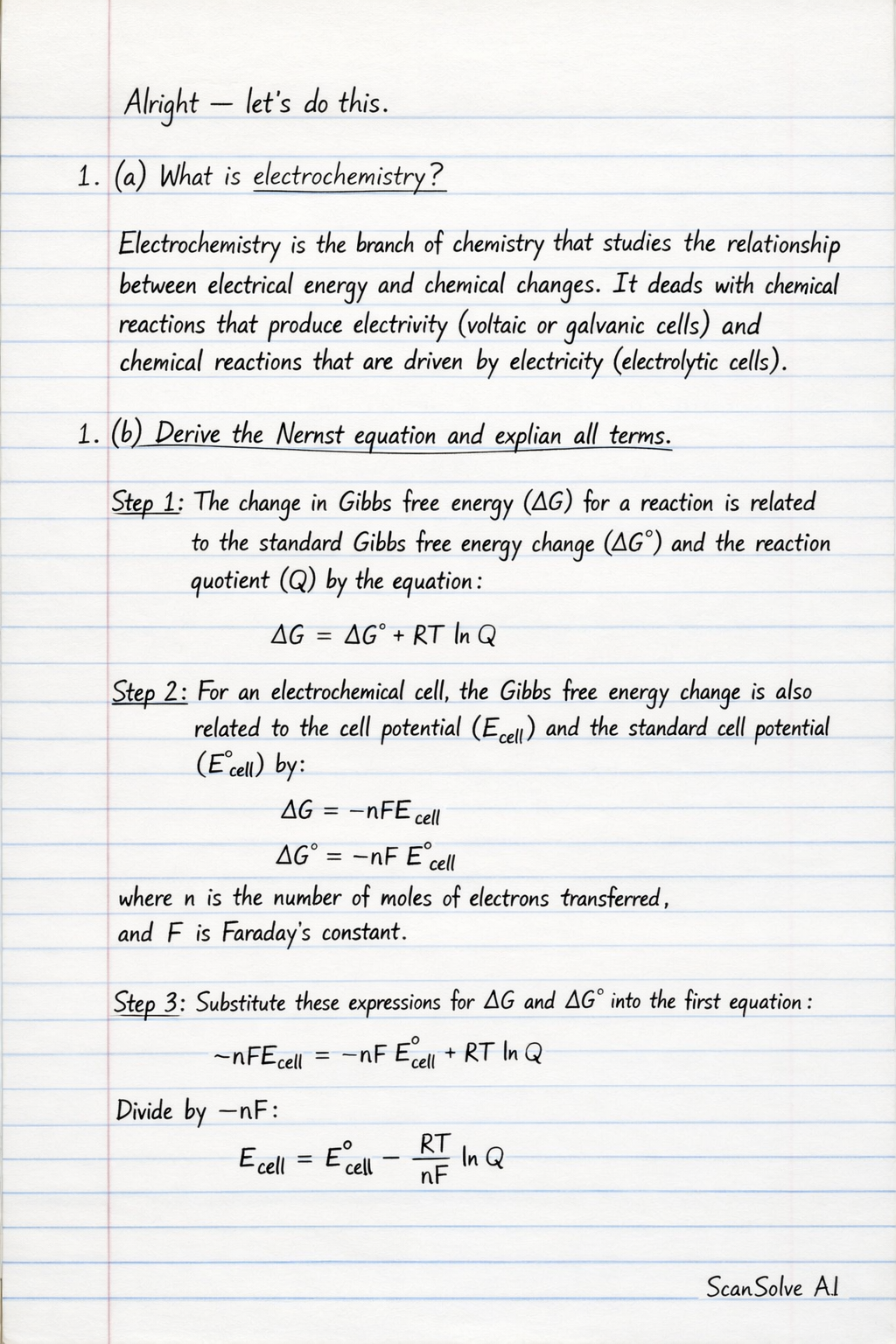
1 (a) What is electrochemistry?
ScanSolve AI Answer
1 (a) What is electrochemistry?
Electrochemistry is the branch of chemistry that studies the relationship between electrical energy and chemical changes. It deals with chemical reactions that produce electricity (voltaic or galvanic cells) and chemical reactions that are driven by electricity (electrolytic cells).
1 (b) Derive the Nernst equation and explain all terms.
Step 1: The change in Gibbs free energy () for a reaction is related to the standard Gibbs free energy change () and the reaction quotient () by the equation:
Step 2: For an electrochemical cell, the Gibbs free energy change is also related to the cell potential () and the standard cell potential () by:
where is the number of moles of electrons transferred, and is Faraday's constant.
Step 3: Substitute these expressions for and into the first equation:
Step 4: Divide the entire equation by :
This is the Nernst equation. For the given reversible reaction , the reaction quotient is:
Substituting into the Nernst equation:
Step 5: Convert the natural logarithm () to base-10 logarithm () using :
Explanation of terms:
- : The cell potential (or electromotive force, EMF) under non-standard conditions, measured in Volts (V).
- : The standard cell potential under standard conditions (1 M concentration for solutions, 1 atm pressure for gases, 298 K temperature), measured in Volts (V).
- : The ideal gas constant, .
- : The absolute temperature in Kelvin (K).
- : The number of moles of electrons transferred in the balanced redox reaction.
- : Faraday's constant, the charge of one mole of electrons, approximately (given as in constants).
- : The reaction quotient, which expresses the relative amounts of products and reactants at any given time. For the reaction , .
1 (c) Calculate the potential of the zinc electrode.
Step 1: Identify the half-reaction and given values.
The half-reaction for zinc reduction is:
Given:
- Standard electrode potential,
- Temperature,
- Initial concentration of zinc sulphate,
- Dissociation of zinc sulphate =
- Number of electrons transferred,
- Faraday's constant,
- Gas constant,
Step 2: Calculate the actual concentration of ions.
Since dissociates into and , and it's dissociated:
Step 3: Apply the Nernst equation for a half-cell.
For a reduction half-reaction , the Nernst equation is:
Or, using and substituting at as :
Since the temperature is , we must use the full term.
The potential of the electrode is .
2 (a) Use an unambiguous diagram to illustrate how a beam of radiation is attenuated by an absorbing substance, and define the terms and .
Step 1: Diagram.
Still stuck on this one?
Ask a follow-up, and the answer starts from this question.
More Chemistry Questions
Handwritten Step-by-Step Solution
Get this as a handwritten image on WhatsApp — like a tutor wrote it for you.
Try on WhatsApp