

This chemistry question involves key chemical concepts and calculations. The detailed solution below walks through each step, from identifying the reaction type to computing the final answer.
ScanSolve AI Answer
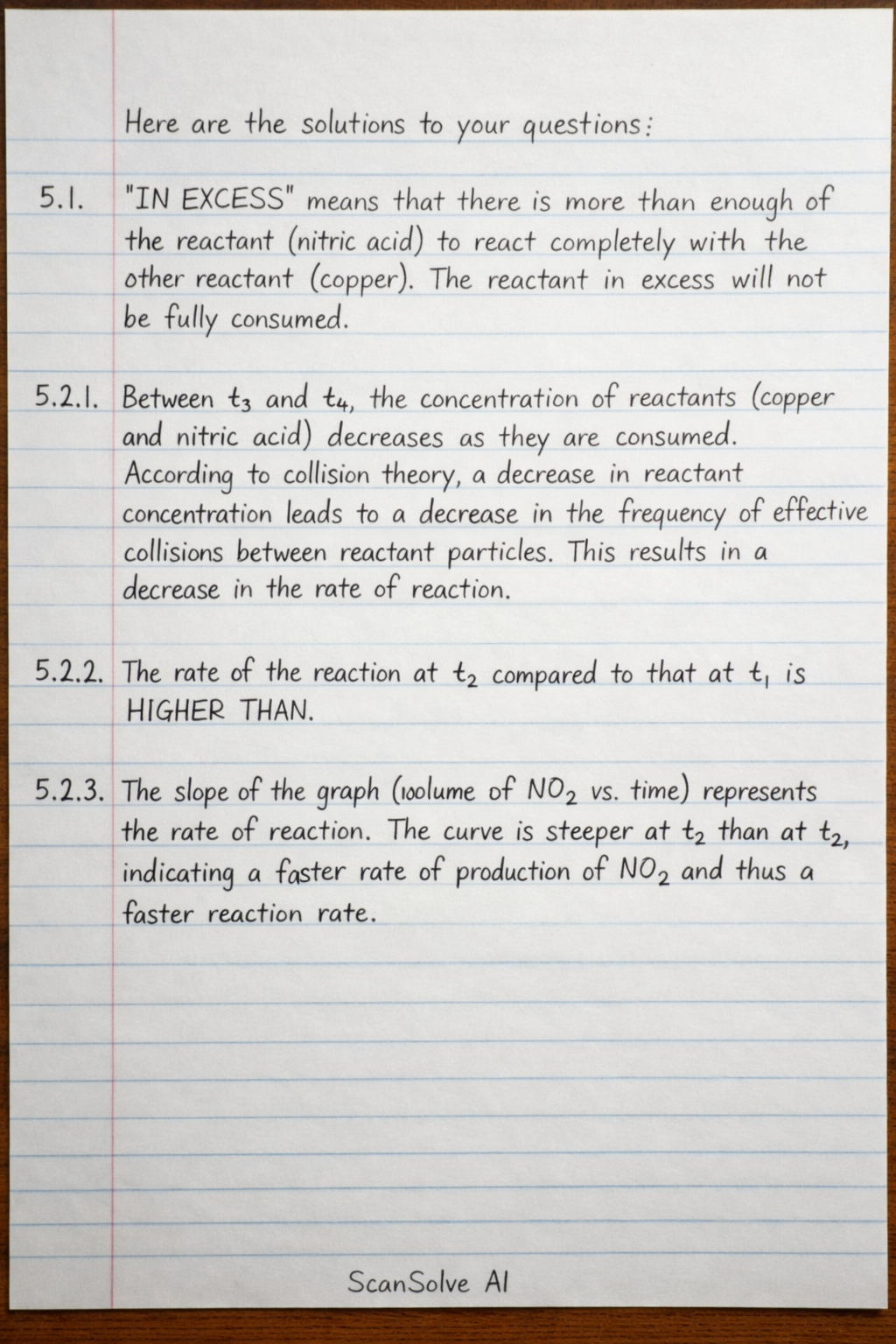
Here are the solutions to your questions: 5.1. 'IN EXCESS' means that there is more than enough of the reactant (nitric acid) to react completely with the other reactant (copper). The reactant in excess will not be fully consumed. 5.2.1. Between t_3 and t_4, the concentration of reactants (copper and nitric acid) decreases as they are consumed. According to collision theory, a decrease in reactant concentration leads to a decrease in the frequency of effective collisions between reactant particles. This results in a decrease in the rate of reaction. 5.2.2. The rate of the reaction at t_2 compared to that at t_1 is HIGHER THAN. 5.2.3. The slope of the graph (volume of NO_2 vs. time) represents the rate of reaction. The curve is steeper at t_2 than at t_1, indicating a faster rate of production of NO_2 and thus a faster reaction rate. 5.2.4. Step 1: Use the formula for average rate. Average rate = Volume of NO_2 Time Step 2: Substitute the given values and solve for t_4. 0.02 dm^3·s^-1 = 1.7 dm^3 - 0 dm^3t_4 - 0 s t_4 = (1.7)/(0.02) t_4 = 85 s The value of time t_4 is 85 s. 5.2.5. The balanced chemical equation is: Cu(s) + 4HNO_3(conc.) Cu(NO_3)_2(aq) + 2NO_2(g) + 2H_2O(l) Step 1: Calculate the moles of NO_2 produced at completion from the graph. From the graph, the maximum volume of NO_2 produced is 1.92 dm^3. Moles of NO_2 = VolumeMolar gas volume = 1.92 dm^325 dm^3·mol^-1 = 0.0768 mol Step 2: Calculate the moles of HNO_3 that reacted using stoichiometry. From the equation, 4 moles of HNO_3 react for every 2 moles of NO_2 produced. Moles of HNO_3 reacted = 0.0768 mol NO_2 × 4 mol HNO_32 mol NO_2 = 0.1536 mol Step 3: Calculate the initial moles of HNO_3. Initial concentration of HNO_3 = 12 mol·dm^-3 Volume of HNO_3 = 20 cm^3 = 0.020 dm^3 Initial moles of HNO_3 = Concentration × Volume = 12 mol·dm^-3 × 0.020 dm^3 = 0.24 mol Step 4: Calculate the moles of HNO_3 remaining after the reaction. Moles of HNO_3 remaining = Initial moles - Moles reacted Moles of HNO_3 remaining = 0.24 mol - 0.1536 mol = 0.0864 mol Step 5: Calculate the concentration of HNO_3 remaining. The volume of the acid does not change, so it remains 0.020 dm^3. Concentration of HNO_3 remaining = Moles remainingVolume = 0.0864 mol0.020 dm^3 = 4.32 mol·dm^-3 Since HNO_3 is a strong acid, it dissociates completely: HNO_3 H^+ + NO_3^-. Therefore, the hydronium ion concentration is equal to the concentration of remaining HNO_3. Hydronium ion concentration = 4.32 mol·dm^-3 5.2.6. The reaction states that copper is oxidized in excess nitric acid, meaning copper is the limiting reactant. To produce more NO_2 gas, the amount of the limiting reactant (copper) must be increased. A: Using the same mass of pure copper will produce the same amount of NO_2. B: Using impure copper with greater mass implies a greater overall amount of material, which would likely contain a greater amount of actual copper, thus increasing the limiting reactant and producing more NO_2. C: Increasing the concentration of HNO_3 (which is already in excess) will not increase the total amount of product