
We read your photo as:
1- What the effect of temperature on exothermic reaction:
ScanSolve AI Answer
Answer
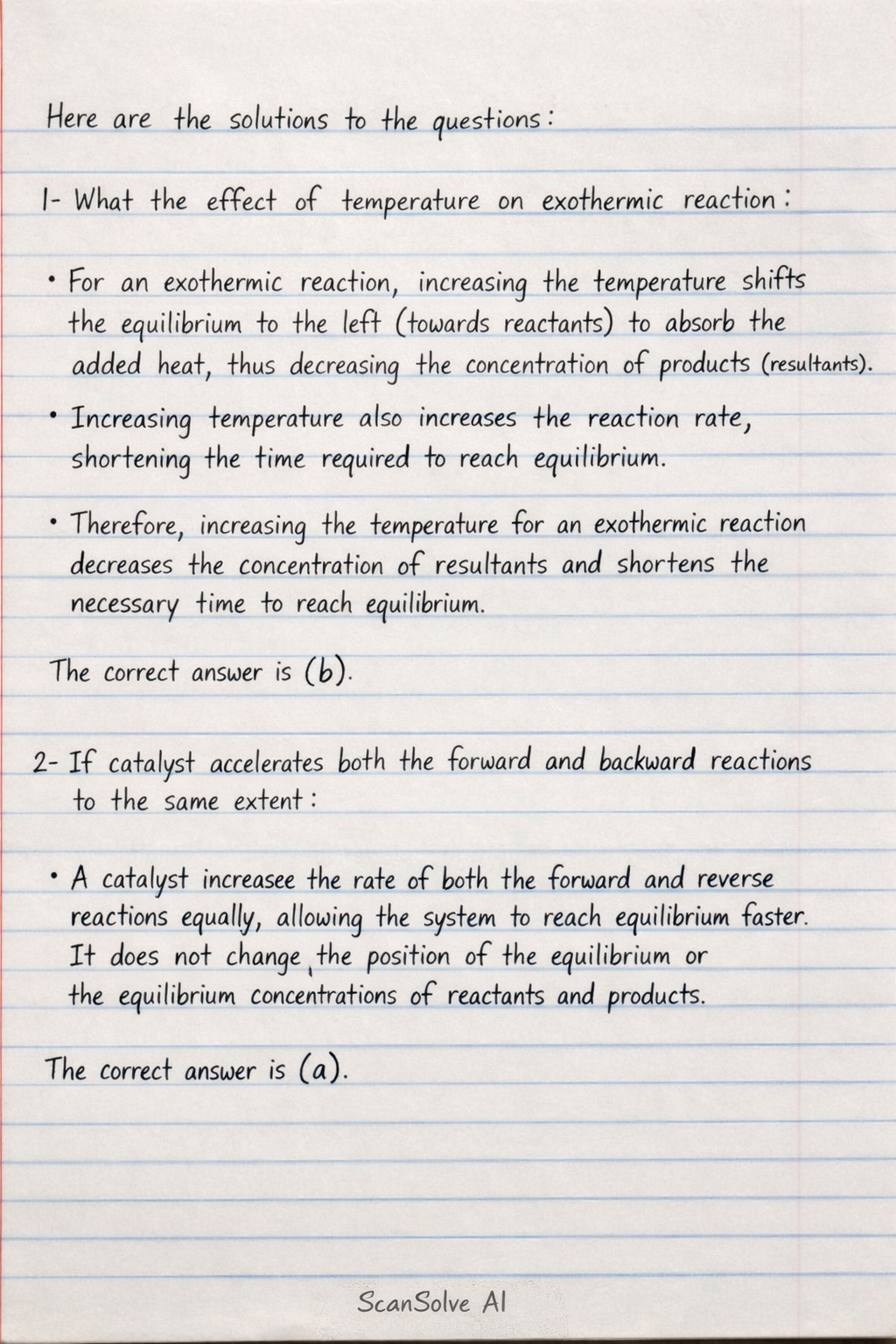
Here are the solutions to the questions:
1- What the effect of temperature on exothermic reaction:
- For an exothermic reaction, increasing the temperature shifts the equilibrium to the left (towards reactants) to absorb the added heat, thus decreasing the concentration of products (resultants).
- Increasing temperature also increases the reaction rate, shortening the time required to reach equilibrium.
- Therefore, increasing the temperature for an exothermic reaction decreases the concentration of resultants and shortens the necessary time to reach equilibrium.
The correct answer is (b).
2- If catalyst accelerates both the forward and backward reactions to the same extent:
- A catalyst increases the rate of both the forward and reverse reactions equally, allowing the system to reach equilibrium faster. It does not change the position of the equilibrium or the equilibrium concentrations of reactants and products.
The correct answer is (a).
3- The Relation between and is:
- The relationship between the equilibrium constants and is given by the equation: where is the change in the number of moles of gaseous products minus the number of moles of gaseous reactants. If represents the sum of moles of gaseous products and represents the sum of moles of gaseous reactants, then .
The correct answer is (b).
4- When solid is added to solution, the equilibrium shifts to the left:
- is a weak base that dissociates as:
- is a strong electrolyte that dissociates completely:
- Adding introduces a common ion, , into the solution. According to Le Chatelier's principle, the equilibrium of the dissociation will shift to the left to consume the added , thereby decreasing the concentration of .
The correct answer is (a).
5- In Ostwald Law of Dilution, "the dissociation degree, ,"
- Ostwald's Dilution Law states that for a weak electrolyte, the degree of dissociation () increases as the solution is diluted (i.e., as its concentration decreases).
The correct answer is (b).
6- A reaction is at equilibrium. What happens to the value of the equilibrium constant if an additional quantity of reactant is added to the reaction mixture.
- The equilibrium constant ( or ) is a constant for a given reaction at a specific temperature. Its value does not change with changes in concentrations of reactants or products, pressure, or the addition of a catalyst. Adding a reactant will shift the equilibrium position to favor product formation, but the value of the equilibrium constant remains the same.
The correct answer is (d).
7- The bond order for =
- The total number of electrons in is electrons.
- Filling the molecular orbitals:
- Number of bonding electrons () =
- Number of antibonding electrons () =
- Bond order =
The correct answer is (b) 2.5.
8- Total number of high electron density regions around the central atom for equal to
- The central atom is Oxygen (O). Oxygen has 6 valence electrons.
- It forms two single bonds with two Hydrogen atoms.
- Number of bonding pairs = 2.
- Remaining valence electrons = electrons, which form 2 lone pairs.
- Total high electron density regions (electron domains) = 2 (bonding pairs) + 2 (lone pairs) = 4.
The correct answer is (a) 4.
9- Each treble bond is counted as one region of high electron density.
- In VSEPR theory, a multiple bond (double or triple bond) is considered a single electron domain or region of high electron density when determining molecular geometry.
This statement is ✅ Correct.
10- Hybridization for is
- The central atom is Sulfur (S). Sulfur has 6 valence electrons.
- It forms two single bonds with two Hydrogen atoms.
- Number of bonding pairs = 2.
- Remaining valence electrons = electrons, which form 2 lone pairs.
- Total electron domains (regions of high electron density) = 2 (bonding pairs) + 2 (lone pairs) = 4.
- For 4 electron domains, the hybridization of the central atom is .
The correct answer is (a) sp3.
Try one yourself
A new problem that tests the same skill.
Still stuck on this one?
Ask a follow-up, and the answer starts from this question.
More Chemistry Questions
Handwritten Step-by-Step Solution
Get this as a handwritten image on WhatsApp — like a tutor wrote it for you.
Try on WhatsApp