Chemistry: 11. Solubility is the maximum amount of a solute that can dissolve in a given am... — Step-by-Step Solution | ScanSolve
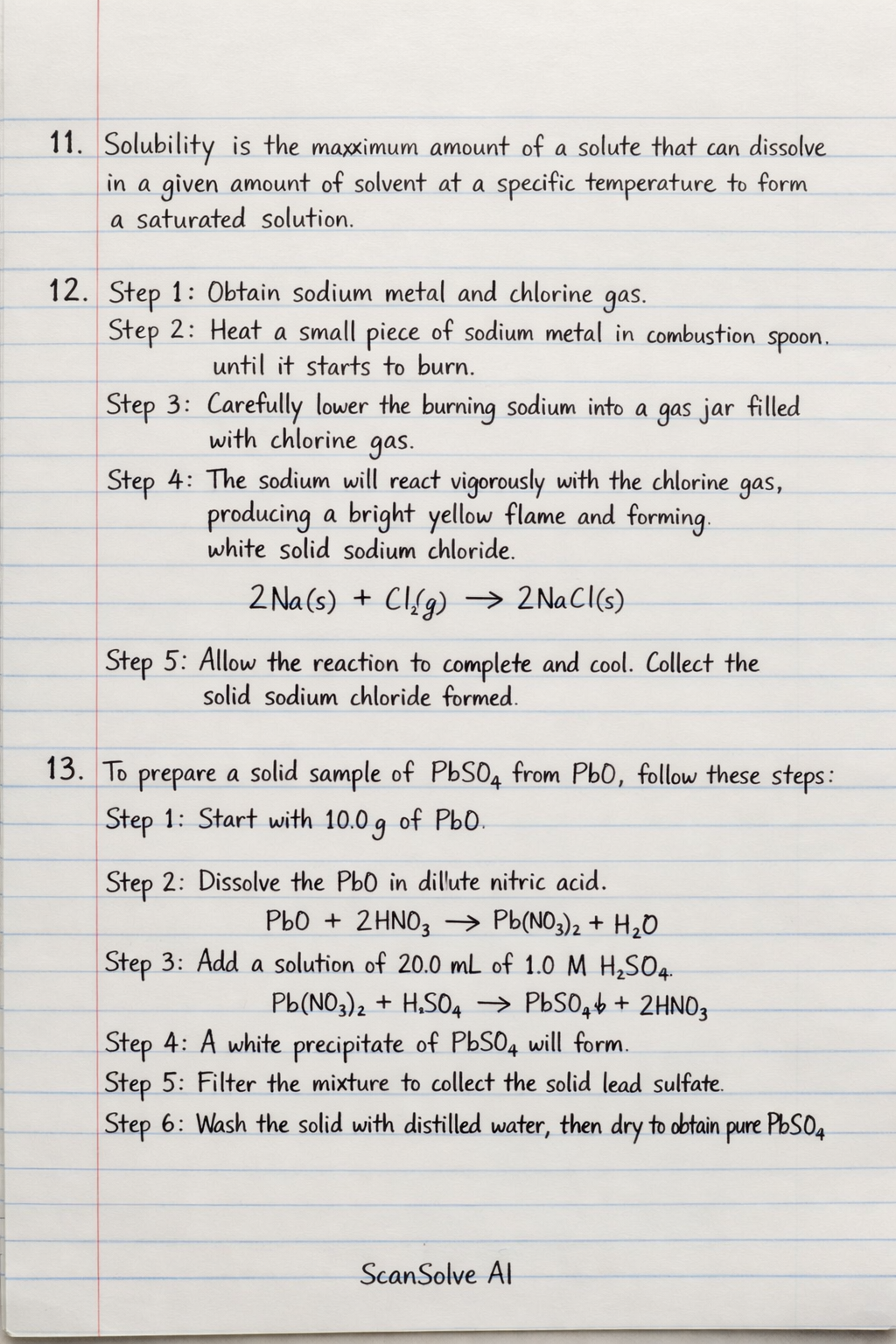
11. Solubility is the maximum amount of a solute that can dissolve in a given amount of solvent at a specific temperature to form a saturated solution.
This chemistry question involves key chemical concepts and calculations. The detailed solution below walks through each step, from identifying the reaction type to computing the final answer.
ScanSolve AI Answer
11. Solubility is the maximum amount of a solute that can dissolve in a given amount of solvent at a specific temperature to form a saturated solution.
12. Step 1: Obtain sodium metal and chlorine gas.
Step 2: Heat a small piece of sodium metal in a combustion spoon until it starts to burn.
Step 3: Carefully lower the burning sodium into a gas jar filled with chlorine gas.
Step 4: The sodium will react vigorously with the chlorine gas, producing a bright yellow flame and forming white solid sodium chloride.
$$2\text{Na(s)} + \text{Cl}_2\text{(g)} \to 2\text{NaCl(s)}$$
Step 5: Allow the reaction to complete and cool. Collect the solid sodium chloride formed.
13. To prepare a solid sample of $\text{PbSO}_4$ from $\text{PbO}$, follow these steps:
Step 1: Prepare a soluble lead(II) salt solution from $\text{PbO}$.
Since $\text{PbO}$ is an insoluble base, it must first be reacted with a dilute acid to form a soluble lead(II) salt. Nitric acid is commonly used as it forms soluble nitrates.
Add dilute nitric acid to $\text{PbO}$ and warm gently until all the $\text{PbO}$ dissolves, forming lead(II) nitrate solution.
$$\text{PbO(s)} + 2\text{HNO}_3\text{(aq)} \to \text{Pb(NO}_3)_2\text{(aq)} + \text{H}_2\text{O(l)}$$
Step 2: Precipitate lead(II) sulfate.
Add a solution of a soluble sulfate, such as sodium sulfate ($\text{Na}_2\text{SO}_4$) or dilute sulfuric acid ($\text{H}_2\text{SO}_4$), to the lead(II) nitrate solution. Lead(II) sulfate is an insoluble salt and will precipitate out as a white solid.
$$\text{Pb(NO}_3)_2\text{(aq)} + \text{Na}_2\text{SO}_4\text{(aq)} \to \text{PbSO}_4\text{(s)} + 2\text{NaNO}_3\text{(aq)}$$
or
$$\text{Pb(NO}_3)_2\text{(aq)} + \text{H}_2\text{SO}_4\text{(aq)} \to \text{PbSO}_4\text{(s)} + 2\text{HNO}_3\text{(aq)}$$
Step 3: Isolate and purify the lead(II) sulfate.
Filter the mixture to separate the solid $\text{PbSO}_4$ precipitate from the solution.
Wash the precipitate thoroughly with distilled water to remove any soluble impurities.
Dry the solid $\text{PbSO}_4$ in an oven or desiccator.
14. Graham's Law of Diffusion/Effusion:
Graham's Law states that the rate of diffusion or effusion of a gas is inversely proportional to the square root of its molar mass (or density), assuming constant temperature and pressure.
Expressed mathematically:
$$\frac{\text{Rate}_1}{\text{Rate}_2} = \sqrt{\frac{M_2}{M_1}}$$
where $\text{Rate}_1$ and $\text{Rate}_2$ are the rates of diffusion/effusion of gas 1 and gas 2, respectively, and $M_1$ and $M_2$ are their respective molar masses.
11. Solubility is the maximum amount of a solute that can dissolve in a given amount of solvent at a specific temperature to form a saturated solution.
|Chemistry
11. Solubility is the maximum amount of a solute that can dissolve in a given amount of solvent at a specific temperature to form a saturated solution.
ScanSolve AI Answer
Solubility is the maximum amount of a solute that can dissolve in a given amount of solvent at a specific temperature to form a saturated solution.
Step 1: Obtain sodium metal and chlorine gas.
Step 2: Heat a small piece of sodium metal in a combustion spoon until it starts to burn.
Step 3: Carefully lower the burning sodium into a gas jar filled with chlorine gas.
Step 4: The sodium will react vigorously with the chlorine gas, producing a bright yellow flame and forming white solid sodium chloride.
2Na(s)+Cl2(g)→2NaCl(s)
Step 5: Allow the reaction to complete and cool. Collect the solid sodium chloride formed.
To prepare a solid sample of PbSO4 from PbO, follow these steps:
Step 1: Prepare a soluble lead(II) salt solution from PbO.
Since PbO is an insoluble base, it must first be reacted with a dilute acid to form a soluble lead(II) salt. Nitric acid is commonly used as it forms soluble nitrates.
Add dilute nitric acid to PbO and warm gently until all the PbO dissolves, forming lead(II) nitrate solution.
PbO(s)+2HNO3(aq)→Pb(NO3)2(aq)+H2O(l)
Step 2: Precipitate lead(II) sulfate.
Add a solution of a soluble sulfate, such as sodium sulfate (Na2SO4) or dilute sulfuric acid (H2SO4), to the lead(II) nitrate solution. Lead(II) sulfate is an insoluble salt and will precipitate out as a white solid.
Pb(NO3)2(aq)+Na2SO4(aq)→PbSO4(s)+2NaNO3(aq)
or
Pb(NO3)2(aq)+H2SO4(aq)→PbSO4(s)+2HNO3(aq)
Step 3: Isolate and purify the lead(II) sulfate.
Filter the mixture to separate the solid PbSO4 precipitate from the solution.
Wash the precipitate thoroughly with distilled water to remove any soluble impurities.
Dry the solid PbSO4 in an oven or desiccator.
Graham's Law of Diffusion/Effusion:
Graham's Law states that the rate of diffusion or effusion of a gas is inversely proportional to the square root of its molar mass (or density), assuming constant temperature and pressure.
Expressed mathematically:
Rate2Rate1=M1M2
where Rate1 and Rate2 are the rates of diffusion/effusion of gas 1 and gas 2, respectively, and M1 and M2 are their respective molar masses.
Need help with your own homework?
Get instant step-by-step solutions to any question. Free to start.