
We read your photo as:
The formation of a bond between hydrogen and a highly electronegative atom results in a. polarity b. dipole c. metallic bond d. electrovalent bond.
Chemistry
ScanSolve AI Answer
Answer
c
Here are the solutions to the questions:
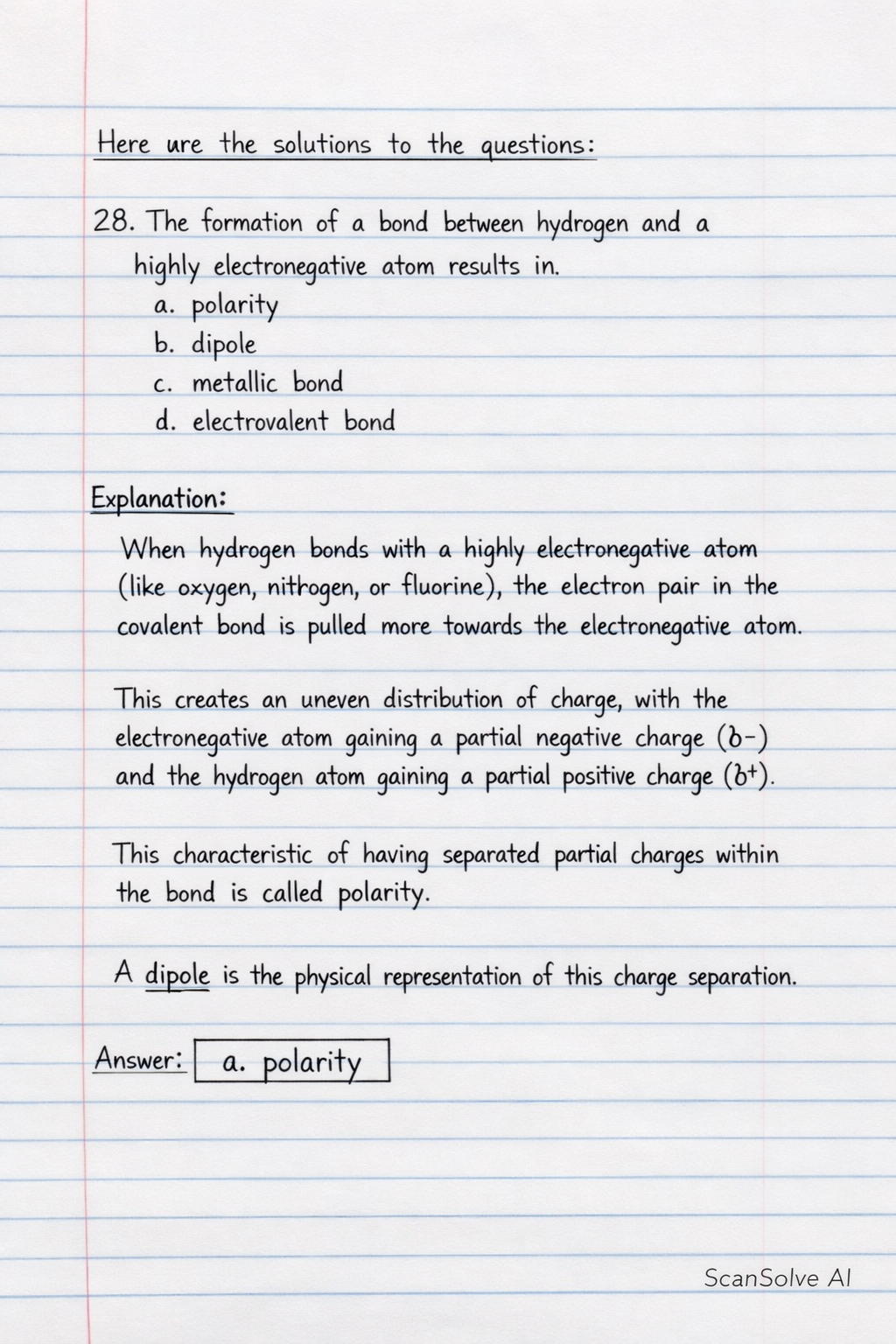
28. The formation of a bond between hydrogen and a highly electronegative atom results in a. polarity b. dipole c. metallic bond d. electrovalent bond.
- Explanation: When hydrogen bonds with a highly electronegative atom (like oxygen, nitrogen, or fluorine), the electron pair in the covalent bond is pulled more towards the electronegative atom. This creates an uneven distribution of charge, with the electronegative atom gaining a partial negative charge () and the hydrogen atom gaining a partial positive charge (). This characteristic of having separated partial charges within the bond is called polarity. A dipole is the physical representation of this charge separation.
- Answer:
29. The molecule that has a non-polar covalent bond is a. H₂O b. HCl c. NH₃ d. Cl₂
- Explanation: A non-polar covalent bond forms between two atoms that have identical or very similar electronegativity, leading to an equal sharing of electrons.
- a. H₂O (Water): The O-H bonds are polar because oxygen is significantly more electronegative than hydrogen.
- b. HCl (Hydrogen chloride): The H-Cl bond is polar because chlorine is more electronegative than hydrogen.
- c. NH₃ (Ammonia): The N-H bonds are polar because nitrogen is more electronegative than hydrogen.
- d. Cl₂ (Chlorine gas): This molecule consists of two identical chlorine atoms. Since both atoms have the same electronegativity, the electron pair is shared equally, resulting in a non-polar covalent bond.
- Answer:
Was this helpful?
Try one yourself
A new problem that tests the same skill.
Still stuck on this one?
Ask a follow-up, and the answer starts from this question.
Got a different question?Ask your own question
More Chemistry Questions
QA) Hydrogen bond and Electrovalent bondQI) An ionic bond is formed by the electrostatic attraction between oppositely charged ions…QA solid substance with high melting and boiling points is likely to be a. a covalent compound b. a…QI) A chemical bond is a strong force of attraction that holds atoms or ions together in a molecule…QAs the difference in electronegativity between bonded atoms increases, the polarity of the bond
Handwritten Step-by-Step Solution
Get this as a handwritten image on WhatsApp — like a tutor wrote it for you.
Try on WhatsApp