
We read your photo as:
The diagram below represents a set-up that can be used for the electrolysis of dilute sulphuric acid
ScanSolve AI Answer
Step-by-step solution
8 stepsHere's the solution to question 3:
3. The diagram below represents a set-up that can be used for the electrolysis of dilute sulphuric acid
a) Name the electrodes A and B
Identify the terminals.
Electrode A is connected to the positive terminal of the battery.
Electrode B is connected to the negative terminal of the battery.Name the electrodes based on their connection.
In an electrolytic cell, the electrode connected to the positive terminal is the anode, and the electrode connected to the negative terminal is the cathode.
a) Name the electrodes A and B:
A: Anode
B: Cathodeb) Write an equation for the reaction taking place at electrode B
Identify the electrode and process.
Electrode B is the cathode, where reduction occurs.
Identify species available for reduction.
In dilute sulphuric acid (), the species present are , , and .
At the cathode, ions are preferentially reduced over water in acidic conditions.Write the reduction half-equation.
b) Equation for the reaction taking place at electrode B:
c) What happens to the concentration dilute sulphuric acid as the reaction continues?
Determine the reactions at both electrodes.
At the cathode (B):
At the anode (A), water is oxidized to oxygen gas and hydrogen ions:Write the overall reaction.
To balance the electrons, multiply the cathode reaction by 2:
Cathode:
Anode:
Adding the two half-reactions:The on both sides cancel out, resulting in the net reaction:
Analyze the change in concentration.
The overall reaction shows that water is consumed during the electrolysis. Sulphuric acid acts as a catalyst and is not consumed. As water (the solvent) is consumed, the amount of solvent decreases, leading to an increase in the concentration of the sulphuric acid (the solute).
c) What happens to the concentration dilute sulphuric acid as the reaction continues?
The concentration of dilute sulphuric acid increases because water is consumed during the electrolysis.
Still stuck on this one?
Ask a follow-up, and the answer starts from this question.
More Chemistry Questions
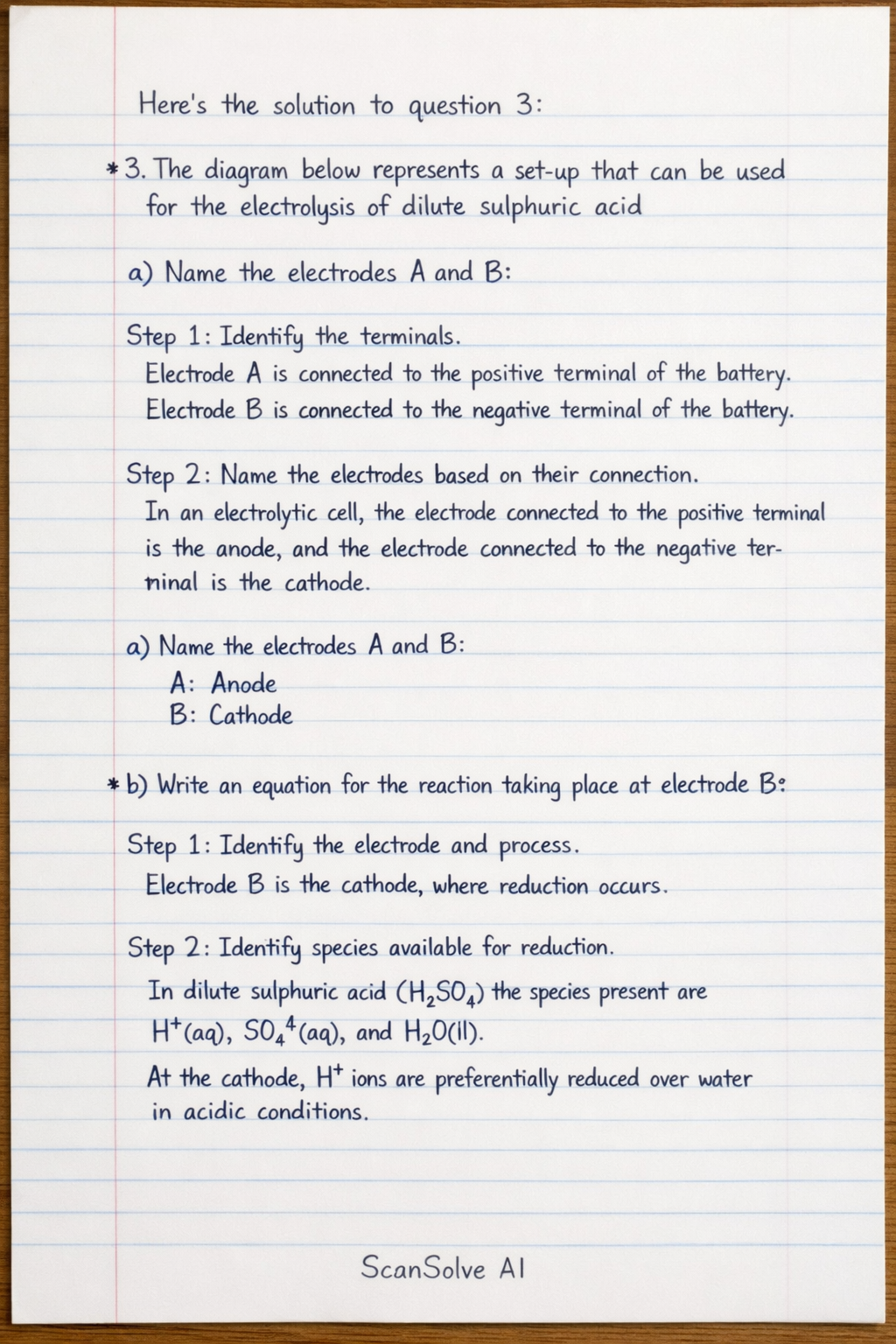
Handwritten Step-by-Step Solution
Get this as a handwritten image on WhatsApp — like a tutor wrote it for you.
Try on WhatsApp